Chief Bromden and Randle McMurphy's alliance
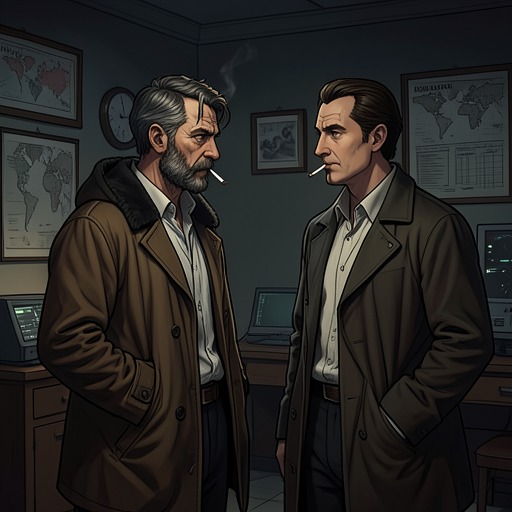
One Flew Over the Cuckoo's NestChief Bromden and Randle McMurphy’s alliance is a struggle over whether Bromden can risk being seen and heard. Randle Patrick McMurphy urges him toward participation and resistance, while Bromden initially understands the fog as a refuge from danger. Their decisive connection emerges when Bromden raises his hand at a ward meeting: McMurphy has called on him, but Bromden comes to recognize the choice as his own. The moment brings Bromden into the group and strengthens the patients’ vote, even as it exposes him to fears about what the staff may now know.
A refuge challenged
Bromden describes the fog as both oppressive and protective. It makes ordinary movement difficult: at night he has to crawl beneath his bed to find the chewing gum stuck under its springs. Yet he understands why the patients do not complain about it. Inside the mist, they can retreat and feel safe; outside it, they are exposed and easier to reach. This fear gives the alliance its central tension. McMurphy wants to pull Bromden out into the open, while Bromden experiences that invitation as a risk rather than uncomplicated liberation.
That tension is not simply a difference in temperament. Bromden has learned to fear being lost in the fog and ending up at the Shock Shop. He once tried to hold tightly to whatever came into view, but believes that his own frightened cries helped the staff track him. He discovers that staying quiet when the fog comes over him can keep him from being drawn toward the treatment room, and that being lost is not necessarily worse than being found. His desire for safety has a history within the ward; McMurphy’s challenge therefore asks him to surrender a protection that has also confined him.
McMurphy’s challenge to the ward
Bromden sees McMurphy’s influence extending beyond their private connection. He believes the ward has been fogged more frequently because McMurphy has not yet been brought under control and has begun to unsettle the established order. Several times, McMurphy has roused Cheswick, Dale Harding, and other patients to the point where they might stand up to a black boy. In Bromden’s account, the fog begins just as the patients seem close to helping one another resist. This pattern makes McMurphy’s effort to draw Bromden out part of a wider contest over whether the patients can act together.
Bromden’s explanation of the fog’s purpose is his interpretation, not a confirmed account of the staff’s motives. Still, the timing he observes shapes how he understands McMurphy’s campaign: any new participation may be met by a renewed attempt to blur the patients’ attention and contain their response. When the group assembles for a therapeutic meeting, Bromden is already cleaning the glass at the Nurses’ Station. He hears Nurse Ratched arrange a staff meeting to discuss whether Randle Patrick McMurphy should remain on the ward, describing his effect on the other patients as a problem. The prospect of McMurphy being sent to the Disturbed Ward makes the demand for solidarity immediate, rather than abstract.
Bromden’s vote and McMurphy’s response
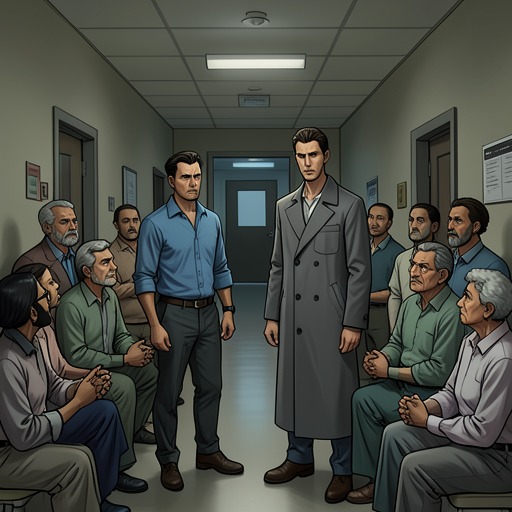
During the meeting, McMurphy appeals to the patients to help secure a majority. He calls on several men, then turns to Bromden as the last possibility. Bromden is in the mist, frightened and resistant to being left alone under McMurphy’s attention. But when his hand begins to rise, he imagines that McMurphy has somehow put hidden wires on it and is lifting it to drag him out of the fog. That explanation preserves Bromden’s old sense that his actions are controlled from elsewhere.
The crucial change comes when Bromden rejects that account: he recognizes that he lifted his hand himself. McMurphy’s appeal has prompted the action, but it has not mechanically caused it. Bromden’s distinction restores agency to a gesture he had first experienced as a frightening loss of control. The hand raised in the mist is both a vote and a public sign that Bromden has heard, understood, and chosen to take part.
McMurphy answers by whooping, pulling Bromden to his feet, and pounding his back. He announces that Bromden’s vote brings the count to twenty-one and declares that the result is a majority. Cheswick yells in approval, and the other Acutes come toward Bromden. Their response gives the gesture a collective consequence: Bromden’s participation changes the count and draws him into the patients’ shared action. McMurphy’s physical celebration treats the previously silent man as a participant whose contribution matters.
Trust, exposure, and consequence
The victory does not erase Bromden’s fear. Nurse Ratched says the meeting was closed and leaves with her neck red and swelling, a visible sign of anger in Bromden’s account. More immediately, Bromden realizes that the staff have seen him raise his hand. For years, he has cleaned the staff room during meetings because the staff believe he cannot hear; now he fears they may understand that he has been listening to conversations intended only for them. He is afraid to leave his chair, yet also worries that failing to perform his usual cleaning duty will reveal that he can hear.
Bromden understands this predicament as the price of being lured out of the fog. That phrasing keeps the alliance complicated: McMurphy’s encouragement helps Bromden act, but the action places Bromden under new scrutiny and leaves him to face the ward’s routines afterward. A black boy watches him, then brings a bucket of soapy water and a sponge and tells him to get to his duties. Bromden’s return to cleaning shows that a single public gesture has not ended the ward’s control over his time or work. It has, however, altered what that familiar duty means: Bromden now knows the staff may question the silence on which his old safety depended.
The alliance is therefore neither a simple rescue nor a transfer of power from Bromden to McMurphy. McMurphy supplies the challenge and recognizes Bromden’s vote as consequential; Bromden supplies the choice that makes the vote a majority. His suspicion that McMurphy’s hidden wires are raising his hand gives way to the more difficult recognition that the act belongs to him. Their bond rests, in this moment, on that distinction: being urged into the open is not the same as being controlled, and joining the others remains Bromden’s own decision.