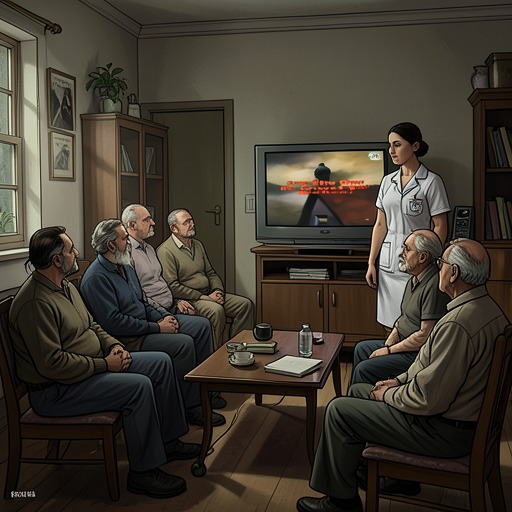
Discharge decision rule for involuntary patients
One Flew Over the Cuckoo's NestThe Discharge decision rule for involuntary patients places the timing of release in institutional hands rather than giving the patient a known endpoint. Randle Patrick McMurphy arrives thinking in terms of a finite sentence; he learns that commitment may have no fixed end date and that Nurse Ratched can help determine when he is released. That discovery transforms his wager against her from a contest over ward policy into a personal calculation about how much resistance he can afford.
Commitment Without a Release Date
The contrast first becomes concrete at the swimming pool. McMurphy is talking with the lifeguard, who explains that jail sentences have a date on which a prisoner knows he will be released, whereas commitment does not work that way. McMurphy stops splashing, swims to the pool’s edge, and asks what happens if someone is committed. The lifeguard’s answer is borne out by his own circumstances: picked up for drunk and disorderly conduct, he has spent eight years and eight months in the hospital. He says that he could have done some kind of work even with his injured arm, but the nurse on his ward keeps telling the doctor he is not ready to leave.
For McMurphy, the example makes the difference between a sentence and a commitment immediate. He has served two months of a six-month sentence at Pendleton Work Farm and expects to have four months left; after nearly a month in the hospital, he begins to understand that a more comfortable bed and orange juice do not compensate for the possibility of being kept there for years. The governing fact is not simply that the hospital restricts him, but that he cannot calculate when the restriction will end.
Authority and the Ward’s Procedures
The ward’s ostensibly democratic procedures do not give patients an effective way to control that authority. When the patients vote to change the television policy, Nurse Ratched counts twenty votes among forty patients and declares the measure defeated because it lacks a majority. McMurphy protests that the twenty people present are all of them there, but she closes the vote by appealing to the policy. She then calls attention to his apparent agitation and suggests that the meeting end early. The episode shows how procedure can be used to deny a collective decision while leaving management’s power intact.
That imbalance matters especially because McMurphy initially treats the other patients’ requests as ordinary grievances he can challenge on their behalf. He later tells Dale Harding that he has learned the patients did not warn him of the risk: they knew that Nurse Ratched could keep him committed until she was ready to let him go. McMurphy had assumed that antagonizing her might cost him little; the newly understood possibility of an indefinite stay gives that conflict a personal price.
Voluntary and Involuntary Patients
Dale Harding’s status sharpens the difference McMurphy had missed. During the conversation about the consequences of provoking Nurse Ratched, Fredrickson explains that a patient labeled potentially assaultive may be sent to the Disturbed Ward, where patients do not even get to leave for the Saturday movie or watch television. Harding also warns that continued hostility can lead to the Shock Shop and perhaps an operation. These threats show other forms of institutional control, but McMurphy does not yet understand how directly his commitment affects his freedom to leave.
When he confronts Dale Harding about the risks he was not told, Harding replies that he is voluntary, not committed. He says that only a few men on the ward are committed, including McMurphy and Scanlon, as well as some chronic patients. McMurphy falls silent, then asks whether Harding and the others have been deceiving him. No one answers. His assumption that the patients share the same exposure to the institution’s power collapses: Harding may fear the ward, but McMurphy’s legal status makes the possibility of an extended stay a different and more immediate danger.
Consequences for Resistance and Treatment
McMurphy responds by changing his tactics. He says he has learned why the others defer to Nurse Ratched and explains that he will not keep risking another year or so in the hospital merely to champion their complaints. His retreat is not a sudden change of allegiance so much as a recalculation prompted by the release rule. He has discovered that the patients who relied on him to challenge management did not share his particular risk of remaining confined.
The institution’s control over duration is reinforced by the treatments used when resistance continues. Randle Patrick McMurphy undergoes three more electroshock treatments in one week. As he begins to recover, Nurse Ratched and the doctor ask whether he is ready to return to the ward and face his problem; when he refuses to give in, they authorize another treatment. The pattern makes the ward’s language of readiness consequential: the patient’s return and cure are presented as matters to be accepted under staff direction, while refusal brings another intervention. Later, after McMurphy has been gone for three weeks, he is wheeled back into the day room on a gurney marked postoperative and lobotomy. The rule does not itself specify that outcome, but the return makes visible how far institutional authority can extend beyond the question of a release date.