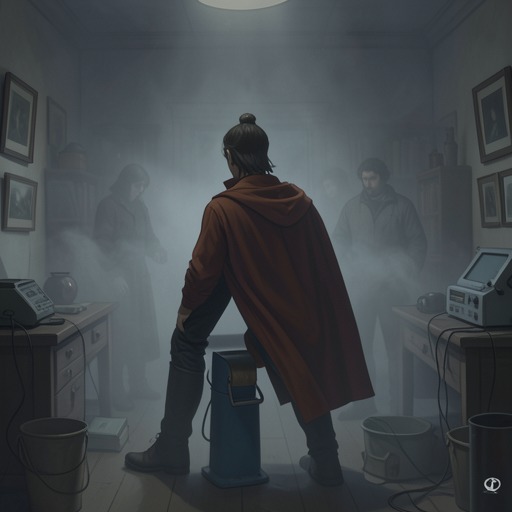
Fog as Oppression and Escape
One Flew Over the Cuckoo's NestFog as Oppression and Escape is the recurring condition through which Chief Bromden experiences the ward’s power to obscure, disorient, and contain its patients. It is at once a fog machine’s physical output and a refuge that patients retreat into when the open world feels dangerous; that double function makes it both an instrument of control and a shelter from the demands of resistance.
Appearance and Operation
Chief Bromden measures the fog by its consequences for perception. It can persist for what feels like three days or even years; when it clears enough for him to see, other patients move about as if they scarcely notice the mist. He believes it affects their memory differently from his own. The Ward loudspeaker, sounding overhead like a bell buoy, becomes a guide to location when sight fails. The fog does not merely hide the ward’s surroundings: it weakens the sense of where one is and what has happened.
His account also gives the effect a concrete mechanism. Recalling his military service, he describes a Fog machine used around overseas airfields when an attack seemed possible or military activity was meant to be concealed. A compressor drew water and special oil from separate tanks and forced them together; the resulting white cloud could cover an airfield in ninety seconds. After his transport landed in Europe, he watched jeeps bring the machines up to the plane and fog roll against its scratched, round windows. A lieutenant’s horn guided the crew through visibility of only a few feet. Sounds dissolved nearby, and the white cloud seemed to erase the body below the waist. That remembered scene gives the ward’s fog a physical analogue while establishing its distinctive emotional contradiction: it could protect from an enemy and leave a person acutely alone.
Fear, Refuge, and Withdrawal
In the ward, concealment becomes a kind of safety. Chief Bromden has trouble finding his bed at night and crawls beneath it, feeling for gum stuck under the springs. The detail makes the fog’s disorientation intimate and bodily: even the familiar bed is no longer readily visible, and touch replaces sight as a means of finding one’s place. Yet he understands why the patients do not complain. However bad the fog is, one can slip back into it and feel safe.
That safety is also a retreat from exposure. Chief Bromden sees Randle Patrick McMurphy trying to pull the others out into the open, where they would be easier to attack. McMurphy appears not to recognize when he himself has been fogged in, or at least does not show that it bothers him. He meets Nurse Ratched and The ward's black aides with exaggerated good manners; when rules and condescension provoke him, he becomes more polite until he sees their absurdity and laughs. His refusal to appear troubled contrasts with the patients’ wish to disappear from notice. For Chief Bromden, McMurphy’s effort to draw them out is therefore not simply an invitation to courage: it threatens the shelter they have learned to depend on.
Chief Bromden’s earlier fear of being lost shows how that shelter can become a trap. He tried to hold on to anything visible, afraid that wandering in the fog would bring him to the Shock Shop. He says that this happened two or three times a month as the fog grew thicker. Eventually he recognizes that his own fear had helped lead him there: when he panicked and called out, staff could track him. Remaining still and quiet, rather than signaling for rescue, lets him avoid the door. His changed response does not make the fog harmless; it marks a shift from fearing disorientation at any cost to accepting that being lost may be preferable to being found and subjected to treatment.
Fog During the Group Meeting
The fog becomes especially consequential when Nurse Ratched calls a group meeting at a moment when McMurphy has stirred Cheswick, Harding, and others toward standing up to the ward’s authority. As the patients move tables out of the Day room, Chief Bromden hears a compressor start in the grille. The mist oozes across the floor until his trouser legs are wet. While cleaning the glass at the station, he overhears Nurse Ratched telephone the doctor: she wants a staff meeting to consider whether Randle Patrick McMurphy should remain on the ward, because his recent influence is upsetting the patients. Chief Bromden understands the fog as unusual in this setting and connects it to the effort to deal with McMurphy. He suspects that the institution is trying to catch him off guard before he can be brought under control or sent to the Disturbed Ward.
The meeting’s ordinary therapeutic business becomes almost impossible for Chief Bromden to follow. He hears discussion of Billy Bibbit’s stutter and its origins, but the words reach him as if through water. The fog feels so thick that it seems to float him out of his chair; sound grows louder and fainter while sight disappears altogether. Billy’s account of being unable to answer roll call at college comes through his worsening stutter, but the meeting’s details are separated from Chief Bromden by the fog’s sensory distortion. The group is physically assembled, yet he experiences himself as suspended outside the room’s ordinary order.
At the meeting, McMurphy again tries to redirect attention to the patients’ vote on television time and asks whether anyone has gained the courage to raise the issue. Chief Bromden hears him as far away and recognizes that he is still trying to pull people out of the fog. The effort reaches him, but it also sharpens his resistance: he wants McMurphy to leave him alone. The fog thus does more than obstruct communication. It makes solidarity perceptible as a distant appeal while preserving the isolation that keeps the patients from acting together.
Dissolution and Memory
At its thickest, the fog carries Chief Bromden toward an imagined condition of death. He feels farther away than ever and associates losing himself in the fog with becoming one of the patients called a Vegetable: motionless, fed until the body stops eating, and then burned. In this vision there is no pain, only a chill he expects will pass. The apparent comfort of numbness is inseparable from the fear of being reduced to a body without agency. The image makes the fog’s refuge deeply ambivalent: it offers release from exposure by resembling the loss of self.
As ordinary perception falls away, memories and images surface instead. Chief Bromden sees his commanding officer posting notices about what the men should wear, and the US Department of Interior bearing down on his tribe with a gravel-crushing machine. He also recalls hunting with his father: his father’s shots miss a buck, while Chief Bromden brings it down with his second shot and grins at him. These images place military discipline, the dispossession of his people, and a remembered act of competence beside the ward’s present-day obscurity. The narrative does not present this sequence as a clear escape from the fog; it shows memory and vision continuing within a consciousness that can no longer reliably orient itself in the room.
Narrative and Thematic Significance
The fog’s meaning develops through tension between what can be physically explained and what remains subjectively unstable. Chief Bromden can describe the workings of a Fog machine in exact practical terms, yet in the ward the mist seems to float him, erase distance, and alter the scale of time. The material account does not cancel the uncanny force of his experience; it makes the contrast more pointed. A technology used to conceal an airfield is echoed in a ward where patients lose sight, memory, and confidence in their own position.
The image also connects institutional pressure with a learned desire for concealment. Chief Bromden sees the fog as something the ward can use to disorient patients, particularly when McMurphy’s influence threatens its established order. At the same time, patients retreat into it because being seen and reached can feel more dangerous than remaining lost. McMurphy’s insistence on drawing them into the open challenges both the institution’s obscuring power and the patients’ dependence on obscurity. The fog’s double role—as control imposed from above and shelter sought from below—explains why escape from it cannot be reduced to simply seeing clearly: visibility may restore contact, but it also exposes the person who has been hiding.