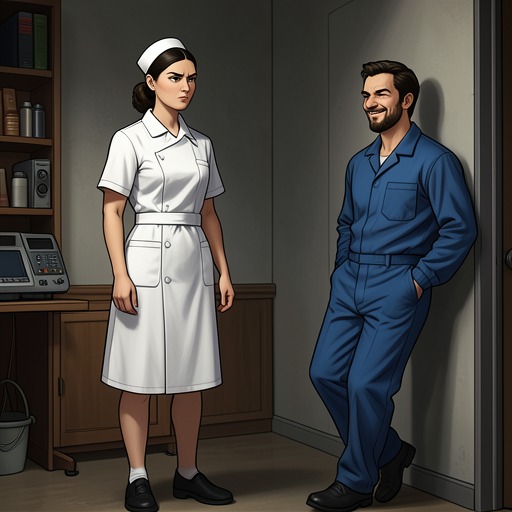
McMurphy Breaks the Nurses' Station Window
One Flew Over the Cuckoo's NestMcMurphy Breaks the Nurses' Station Window turns Nurse Ratched’s attempt to punish the patients into a vivid confrontation with her authority. After she announces that the men will lose the tub room they use for card games, Randle Patrick McMurphy walks to the Nurses’ Station, reaches through its glass, and takes a pack of cigarettes from the carton bearing his name. His act is at once practical and defiant: he claims something that belongs to him, but does so by breaking the barrier through which the ward’s rules are administered.
Background and Stakes
The announcement comes after the patients have already seen how ward procedures can defeat their participation. In an earlier vote, McMurphy counts twenty votes and initially assumes that the support of everyone present is enough. Nurse Ratched points out that there are forty patients on the ward and that a majority is required to change policy; she closes the vote as defeated. When McMurphy protests that the men have been cheated, she describes him as upset and asks Dr. Spivey to note it. The scene establishes a pattern that informs the window-breaking: resistance can be recast as evidence of a patient’s condition, while the staff retains control of what counts as a valid decision.
McMurphy has also learned that open defiance carries risks beyond an argument with the nurse. Fredrickson explains that telling her to go to hell can lead to a Potential Assaultive listing and transfer to the Disturbed Ward. He says that this has happened to him three times and describes the patients upstairs as cut off even from a Saturday movie and television. Harding warns that continued hostility could lead to the Shock Shop and perhaps an operation. These warnings make McMurphy’s later decision more than an impulsive response to a lost convenience: he understands that the institution can attach serious consequences to conduct it defines as hostile.
The Revoked Privilege
Nurse Ratched presents the tub-room decision as a measured disciplinary response. She says that discipline is difficult in these surroundings and that the staff cannot arrest the patients or put them on bread and water. The privilege to be taken away is their use of the tub room for daytime card games. Her question about whether the ruling seems unfair gives the announcement the form of consultation, but the decision has already been made.
The patients’ reaction makes the ruling’s emotional stakes visible. One by one, they look toward McMurphy; even the Chronics stretch their necks to see him. Bromden describes their faces as carrying scared hope. The attention turns the room into a public test of whether McMurphy will respond. He scratches the stitchmarks across his nose, grins, tips his cap politely, and does not immediately answer the nurse. His restraint prolongs the moment, while the onlookers’ expectation makes his next move consequential for more than his own access to the tub room.
The Window-Breaking
As Nurse Ratched moves to end the discussion, McMurphy rises, stretches, yawns, and strolls across the day room toward her station. Bromden sees the familiar swagger return: McMurphy appears in his imagination as a logger, gambler, brawling Irishman, and cowboy walking toward a dare. The sequence makes the change in mood legible through gesture and movement rather than an explanation of McMurphy’s thoughts. Nurse Ratched, who expected the ruling to complete her victory, watches him approach and looks for the black boys.
McMurphy stops at the station window and says that he figures he can use one of the cigarettes he bought that morning. He then puts his hand through the glass. It breaks apart, and Nurse Ratched throws her hands to her ears. McMurphy takes the carton marked with his name, removes a pack, and puts the carton back. The detail matters: he does not empty the supply or turn the act into a general seizure. He claims one pack, making the immediate object of his action unmistakable even as the broken window makes its challenge to the ward impossible to ignore.
He then turns back to Nurse Ratched, who sits rigidly, and gently brushes glass from her hat and shoulders. His apology is delivered with elaborate courtesy, claiming that the window was so clean he forgot it was there. The courtesy does not undo the damage; it sharpens the contrast between his polite manner and the force of his action. In a few seconds, he has broken the barrier, taken his cigarettes, and made the nurse receive the gesture as well as the loss.
Aftermath and Significance
McMurphy walks back across the day room, lights a cigarette, and returns to his chair. The action ends without a narrated punishment or a further confrontation in this scene. Bromden notes instead that the ringing in his head has stopped. That shift gives the episode a consequence beyond the broken glass: the room’s suspended tension releases, and the act has interrupted the atmosphere of Nurse Ratched’s announced victory.
The window-breaking does not abolish the ward’s rules or reverse the revoked privilege. Its force lies in exposing the difference between formal participation and actual power. The patients’ vote could be closed by a rule requiring a majority of all forty men; McMurphy’s hand, by contrast, passes physically through the station’s transparent barrier. His measured retrieval of one pack, followed by his tender removal of glass from the nurse, combines refusal with control of the scene’s tone. The result is a small material gain and a public refusal to let Nurse Ratched’s disciplinary ruling stand as an unquestioned final word.