McMurphy's diagnosis as a psychopath and suspected feigning
One Flew Over the Cuckoo's NestRandle Patrick McMurphy's diagnosis as a psychopath and suspected feigning is defined less by a clear clinical finding than by a conflict over who gets to name his conduct and determine his freedom. The court's label follows fights at the work farm, and McMurphy treats it as a useful bargain: it gets him out of the fields, even as a doctor's note raises the possibility that he is pretending to be ill. The uncertainty persists beside a more concrete fact: his state commitment gives the institution power over how long he remains there.
Origins of the Diagnosis
McMurphy tells the ward that a couple of fights at the work farm led the court to call him a psychopath. He says he will accept whatever label the authorities want if it keeps him from returning to the pea fields and the weeding hoe. He repeats the institution's crude account of the diagnosis as a tendency to fight and pursue sex, then turns that account into comic provocation. His ease with the word does not establish that he is well or ill; it shows that he recognizes its practical value and refuses to treat the label with solemn deference.
The record Nurse Ratched reads identifies him as thirty-five, never married, and committed by the state from Pendleton Work Farm for Correction for diagnosis and possible treatment. It also lists a Distinguished Service Cross for leading an escape from a Communist prison camp during the Korean War, followed by a dishonorable discharge for insubordination. A history of street brawls and barroom fights appears alongside arrests for drunkenness, assault and battery, disturbing the peace, repeated gambling, and statutory rape. The file thus gives the diagnosis an administrative setting, but its catalogue of conduct is not itself a demonstration that the psychopath label explains him.
The Question of Feigning
When asked whether he has been in mental institutions before, McMurphy says this is his first trip. He then performs uncertainty about his own diagnosis, crossing the room to look through his file and drawing attention to a passage Nurse Ratched omitted from her summary. The work-farm doctor had written that repeated outbreaks of passion suggested a possible diagnosis of psychopath, but had also warned staff not to overlook the possibility that McMurphy might be feigning psychosis to escape the drudgery of farm work.
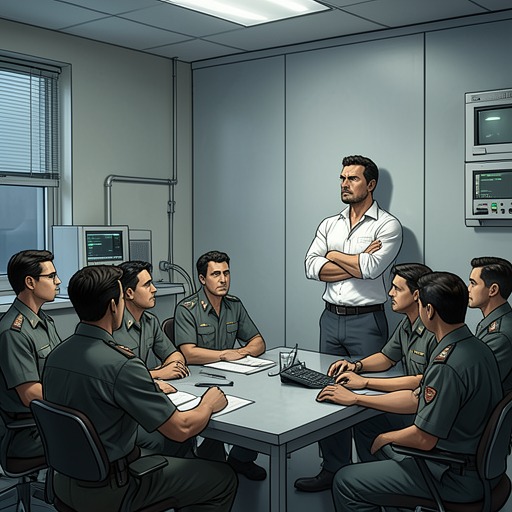
McMurphy brings this ambiguity into the open by asking whether he looks sane. His broad, tough appearance and mock display of anxious concern turn the diagnostic exchange into a performance before Dr. Spivey and the patients. Dr. Spivey struggles not to laugh; patients smile, including some of the Chronics. Nurse Ratched does not answer McMurphy's question. Instead, she takes the folder back and redirects the meeting toward its rules. The scene leaves the underlying uncertainty unresolved: McMurphy may be exploiting a diagnosis, but the evidence supplied does not settle whether that means he is feigning psychosis or simply making use of a label imposed for another purpose.
Diagnosis and Institutional Power
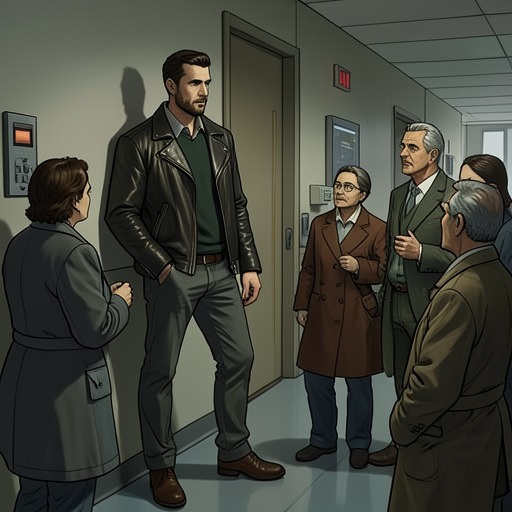
The distinction between a diagnosis and a practical judgment matters on the ward because staff can translate behavior into restrictions. Fredrickson tells McMurphy that hostile conduct may get a patient listed as potentially assaultive and sent to the Disturbed Ward, where patients lose ordinary privileges such as attending the Saturday movie or watching television. Harding adds the threat of the Shock Shop and possibly an operation. Their warning makes the diagnosis part of a larger disciplinary vocabulary: anger can be treated not merely as disagreement but as evidence warranting transfer or treatment.
The ward's voting procedure shows a related limit on patients' control. When McMurphy tries to change policy, Nurse Ratched declares the vote defeated because only twenty of the forty patients voted; a majority of the whole ward, rather than a majority of those present, is required. When he protests, she describes him as upset and asks Dr. Spivey to note his condition. The scene does not establish that his psychopath diagnosis caused the vote's defeat, but it shows how his anger can be recorded and reframed within a system whose rules remain under staff control.
The Commitment Behind the Label
McMurphy's understanding changes when Dale Harding explains that he is voluntary, while McMurphy is committed. Harding says only a few men on the ward are committed, naming Scanlon, some of the Chronics, and McMurphy. McMurphy initially suspects that the others are deceiving him, then realizes that his own case carries a different risk: he cannot assume that he may simply choose to leave. His question about whether they are misleading him marks a shift from treating the psychopath label as a convenient way out of farm labor to recognizing the legal force of his confinement.
That difference sharpens his later account of why he has eased his attacks on Nurse Ratched. He says he has learned that the other patients were using him to challenge her without telling him the danger: he could provoke her into adding another year or so to his sentence. He says a person sometimes has to swallow pride and look after himself. His retreat is not evidence that the diagnosis has been resolved; it reflects new knowledge about the consequences of defiance for someone committed rather than voluntarily hospitalized.
Treatments and the Limits of Diagnosis
The novel places the disputed label alongside coercive procedures without presenting those procedures as proof of it. Chief Bromden recalls that patients are herded to Building One for what the hospital calls chest X-rays, while he understands the trip as a check on whether their machinery is functioning. He sees patients taken through an unmarked metal door for electroshock treatment and hears one scream. McMurphy asks whether electricity is sent through a person's skull and why. The question registers his encounter with the ward's treatment system, not a confirmation of the work-farm doctor's suspicion.
Later, after repeated electroshock treatments, McMurphy continues to taunt Nurse Ratched when she asks whether he is ready to face his problem and return to the ward for a cure. The narration describes three further treatments in one week and his refusal to yield, including a gesture that enrages her. After he has been away for three weeks, the ward receives a gurney bearing his name and a chart marked as post-operative and lobotomy. These events show the severe institutional consequences that surround his confinement, but the evidence does not identify them as treatment specifically for psychopathy. The diagnosis remains unsettled; what becomes unmistakable is the imbalance between the label's uncertainty and the institution's power to act on the person carrying it.