Order Daily Cards
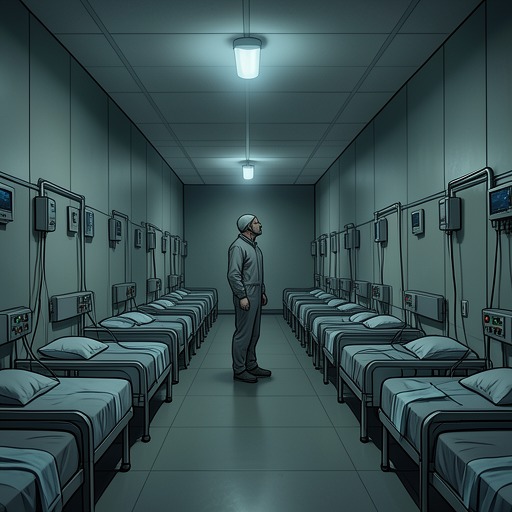
One Flew Over the Cuckoo's NestOrder Daily Cards are the punched commands through which Nurse Ratched’s ward routine is translated into a daily program. In Chief Bromden’s account, they make institutional control tangible: private observations become machine-readable instructions, and a card inserted into a steel door appears to set the patients’ day in motion.
Production and Physical Form
Nurse Ratched’s notes on the patients are typed and fed into a machine Bromden hears humming behind the steel door at the rear of the Nurses’ Station. The machine returns Order Daily Cards marked by patterns of small square holes. At the beginning of the day, the correctly dated card is inserted into a slot in the door. The cards are thus presented not as informal reminders but as the output and input of a concealed system: observations are processed, encoded, and returned as instructions for the ward.
The card’s modest physical form contrasts with the scale of the routine attributed to it. Once it is inserted, the walls hum and the day’s sequence begins. Bromden’s description makes the card a point of contact between Nurse Ratched’s handwritten surveillance and the ward’s apparent machinery, linking an individual’s notes to a schedule imposed on everyone.
Daily Operation
The card-programmed morning begins at six-thirty. Lights come on, and Acutes are roused and put to work buffing the floor, emptying ashtrays, and polishing marks from the walls. Wheelers wait for their chairs to be brought to them; patients described as Vegetables are roused from beds after wetting them and then washed and dressed by the black boys. At six-forty-five, the Acutes line up alphabetically at the mirrors to shave; walking Chronics follow, and Wheelers are brought in afterward. The routine sorts patients by both condition and mobility, assigning each group its place in a fixed sequence.
At seven-thirty, the ward returns to the day room. A sound like a sheet of tin being shaken signals that everyone must come to order. Acutes wait on one side for cards and Monopoly games, while Chronics wait on the other for puzzles. The instructions Bromden imagines for particular patients turn routine into a sequence of prescribed poses and behaviors: Ellis goes to the wall with his hands raised; Pete wags his head; Scanlon works at a make-believe bomb; and Dale Harding begins gesturing before trapping his hands under his arms. Mr. Sefelt is assigned his familiar complaints. The contrast between the patients’ individual conditions and the sameness of their scheduled places shows how the routine reduces distinct people to administrable cases.
Programmed Bodies and Control
Bromden extends the card’s authority from tasks to bodily rhythm. He depicts everyone breathing in and out in order, with hearts beating at the rate the cards command, like matched cylinders. This is not a literal technical specification of what the cards contain; it is the narrator’s image of a system so pervasive that even involuntary life seems synchronized to its timetable. The ward resembles a cartoon in which figures jerk through assigned motions, except that the figures are real patients.
The cards’ force lies in making coercion appear to be orderly procedure. Patients are awakened, divided into groups, moved through routines, and given activities according to a schedule that precedes their choices. The machine behind the steel door remains out of sight, but its effects are visible in the timed lights, ordered lines, divided day room, and repetitive tasks. By representing this process through punched cards, Bromden gives the ward’s discipline a mechanical form: Nurse Ratched’s authority seems to operate not only through direct commands but through a system that has already arranged what each person is expected to do.
Narrative Significance
Order Daily Cards concentrate the novel’s image of the ward as a managed, mechanized environment. Their square holes make human behavior appear sortable and repeatable, while the exact times—six-thirty, six-forty-five, and seven-thirty—give the routine the precision of a production schedule. Bromden’s account turns an administrative object into a symbol of how observation can become regulation: a note about a patient is transformed into a place, task, or posture in the following day’s program.
The cards also sharpen the contrast between a patient’s particular life and the institution’s standardized categories. Each person is assigned a position within the same ordered sequence, and even the day room’s games and puzzles arrive as parts of that arrangement. Their significance is therefore not simply that they organize activities; they embody the ward’s effort to make its patients predictable, coordinated, and subject to Nurse Ratched’s system.