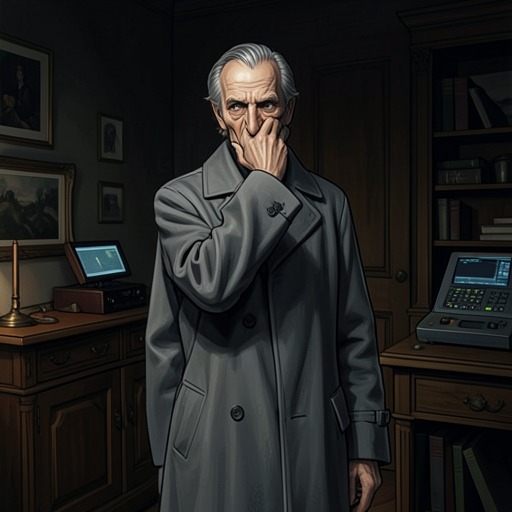
Randle McMurphy's post-lobotomy state
One Flew Over the Cuckoo's NestRandle Patrick McMurphy's post-lobotomy state is the final, devastating transformation of the ward's most forceful resister into a person who can no longer show the vitality that defined him. Returned after three weeks away with a chart identifying him as postoperative and naming a lobotomy, he is physically recognizable but seems emptied of expression and agency. His condition turns the ward's disciplinary threat into a visible body—and leads Chief Bromden to end his life rather than leave him there as a warning.
Treatment and Return
Before McMurphy disappears from the ward, Nurse Ratched and the doctor repeatedly bring him back from electroshock treatment and ask whether he is ready to face his problem and return to the ward for a cure. He answers with defiance, making clear that he will not yield. The cycle repeats three times in one week: as he starts to recover, Nurse Ratched arrives with the doctor, and his refusal is followed by authorization for another treatment. The scene presents his resistance as a performance before the other patients as well as a refusal of the terms being imposed on him.
After McMurphy has been gone for three weeks, Nurse Ratched's last move is disclosed when the ward's black aides wheel in a gurney bearing his name and the word lobotomy. They leave him in the day room beside the patients called the Vegetables. The placement makes his altered condition public: the ward's patients can read what was done before they look at the face on the pillow.
Recognition and Altered Appearance
The patients initially dispute whether the figure is really McMurphy. His broken nose, familiar scar, sideburns, and tattoos remain, but these outward identifiers do not restore the person they knew. Chief Bromden emphasizes what is missing: the face has no expression, like a store dummy. Scanlon likewise calls attention to its blankness. The contrast is sharpened by McMurphy's recognizable, large arms and hard body; physical marks and bulk survive, while the animating look that made those features unmistakably his does not.
As the bruising and swelling around his eyes subside, patients return to look at him, pretending to go to the magazine rack or drinking fountain. Their covert glances suggest that the problem is not simply identifying the body. They are trying to reconcile its familiar details with the absence of the person who gave those details meaning. Chief Bromden is certain McMurphy would not have allowed his body to remain in the day room for years as an example to anyone who might challenge the system.
Chief Bromden's Vigil and McMurphy's Death
That night, Chief Bromden waits until the dormitory is quiet and the ward's black aides have stopped making rounds. He has listened for hours to McMurphy's breathing, which stumbles and stops before starting again, hoping it will cease; only then does he turn to look. In the moonlight, McMurphy's eyes are open and fixed, following Chief Bromden as he crosses between the beds. The face remains blank even as the body responds to his movement.
Chief Bromden lies on top of McMurphy and presses a pillow over his face, restraining his kicking legs as the body fights for a long time. When the struggle ends, he lowers McMurphy's eyelids. The blank expression has not changed. Scanlon hears Chief Bromden and tells him to take it easy, confirming that the killing has not passed unnoticed. McMurphy's state therefore ends not in recovery or return to ordinary ward life, but in death at the hands of his closest ally.
Meaning of the State
The lobotomy's consequence is conveyed through the distance between recognition and presence: McMurphy's scars, tattoos, and body can be identified, yet the expression and force by which the patients knew him are gone. The chart's clinical label and the patients' intimate recognition of the person beneath it occupy the same scene, but they do not describe the same loss. What the ward can record as a postoperative condition, Chief Bromden experiences as the destruction of the man who had resisted its authority.
The state also completes the threat implicit in the ward's repeated use of treatment and coercion. McMurphy has refused the invitation to submit after electroshock; his return shows that his resistance has been answered by an irreversible bodily intervention. Chief Bromden's decision rejects the alternative of leaving him exposed in the day room as a cautionary display. The scene makes the aftermath inseparable from the choice it forces on those who remain: whether to accept the ward's imposed example or to act against it.