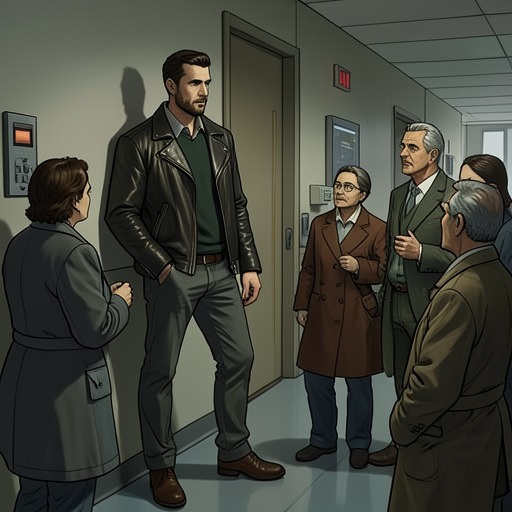
Ratched’s campaign to discredit McMurphy
One Flew Over the Cuckoo's NestNurse Ratched’s campaign to discredit Randle Patrick McMurphy turns the ward’s finances into an argument about loyalty. By displaying records of the patients’ losses and McMurphy’s gains, she encourages them to reinterpret his organizing as calculated self-interest. The effort unsettles their confidence without fully undoing it: his actual profits are difficult to deny, but neither are the help he has given nor the ties he has built with the men.
Background and Strategy
The maneuver begins the day after the fishing trip. Nurse Ratched has been considering it since a conversation with McMurphy about how much money he made from the trip and other ward enterprises. She spends the night thinking through her approach, then circulates hints the next day so suspicion can take hold before she makes a direct accusation. Her strategy depends on a familiar social unease: people may begin to distrust someone who appears unusually generous and wonder what that person expects in return.
She gives that suspicion a documentary form by posting a statement of the patients’ finances over the preceding months. The figures show a steady drain on the Acutes’ funds, with one exception: McMurphy’s balance has risen since he arrived. The display is the product of hours spent digging through records. Rather than simply calling him selfish, Nurse Ratched invites the men to read the arithmetic for themselves and supplies a story in which his busy efforts on their behalf may conceal a private return.
Those efforts give her case a broader reach than the ledger alone. McMurphy has helped organize fishing trips, Bingo, and basketball, and has pushed to loosen the rule requiring groups of eight whenever patients go somewhere. He has also maneuvered Dr. Spivey into ordering magazines such as Playboy, Nugget, and Man in place of the old McCall’s magazines brought in by the Public Relations man. He has even sent a petition to Washington asking for an investigation of lobotomies and electroshock in government hospitals. Nurse Ratched’s insinuation is that this activity, unusual in a ward where men had been content to drift, deserves to be examined for motive.
The Group Meetings
After the suspicion has circulated for about a week, Nurse Ratched first tries to make her case at a group meeting with McMurphy present. She begins by describing the ward as having fallen into a pathetic state, pointing to pornography clipped from the magazines and pinned on the walls, and threatening an investigation by the Main Building. McMurphy breaks the silence that follows by joking that the investigators should bring little hand mirrors. His laughter disrupts the solemnity she is trying to establish, and she does not get the opening she wants to identify him as the cause.
At the next meeting she makes sure he is absent. McMurphy is waiting in the phone lobby for a long-distance call from Portland, Oregon, and Nurse Ratched declines an aide’s offer to fetch him. She says the men may want to discuss him without his dominating presence. The patients begin with funny stories and praise, while she waits for their affection to give way to questions. When they start asking why he acts as he does, and whether his story about provoking fights at the work farm to get transferred might itself be another con, she welcomes the uncertainty by calling him clever rather than saintly.
Nurse Ratched then takes a yellow sheet from her basket and reviews what she calls his philanthropy. She asks whether the tub room was really his to give, since he had acquired it as a gambling room, and cites nearly three hundred dollars in winnings deposited with the Funds. She names Mr. Sefelt, Mr. Scanlon, and Bruce Fredrickson among those who know what they personally lost. Her point is not merely that McMurphy gambles, but that the men may have mistaken transactions for gifts. She adds that the fishing trip brought him a car from Dr. Spivey, gasoline money, and other benefits without his paying anything himself. By presenting the trip and the tub-room gambling together, she makes financial advantage the lens through which the patients are invited to reassess his acts.
The Patients’ Response
The disclosure does not produce a simple reversal. Later, men gathered at the canteen door say they disagree with Nurse Ratched but concede that she has made good points. Dale Harding brings the argument into the open: the patients, he says, are privately accepting her account even as they defend McMurphy. He argues that McMurphy is a shrewd gambler and a con man who makes no pretense of being free of self-interest. In Harding’s view, recognizing that fact does not cancel the value the patients have received, and pretending McMurphy’s motives are pure would misrepresent the kind of man he is.
Billy Bibbit resists the implication that everything McMurphy does is a scheme. He points to McMurphy teaching him to dance and asks where the profit is in that. Harding tells him to wait and see how McMurphy works it. Chief Bromden observes that, for a time, Billy and he seem to be the only ones who still believe in McMurphy. That changes later the same night, when McMurphy confirms that Billy’s date with Candy is arranged and suggests that he send her some money for the trip. Billy immediately asks how much it will cost and looks toward Harding, taking the new advice as evidence for the suspicion the meeting has encouraged. The episode shows how quickly a public argument about motive can enter even a friendship Billy had treated as special.
Aftermath and Significance
The question of profit returns in a later wager over the hydrotherapy control panel. McMurphy persuades the men to bet that Chief Bromden cannot lift it, allowing the odds to build to five to one and some wagers to reach twenty dollars. He does not tell them that Bromden has already lifted it. When Bromden raises the panel in front of the group, he feels he has helped McMurphy cheat them; the men pay, but Bromden runs off without looking at McMurphy. In the latrine mirror, however, he sees his arms, chest, and shoulders restored to the size and strength he remembers from high school and the village. McMurphy offers him five dollars, and Bromden refuses it. The scene does not erase the deception, but it complicates the campaign’s account of McMurphy as merely an exploiter: the wager has also made Bromden’s recovered strength visible to himself and the others.
Nurse Ratched’s intervention succeeds in making the patients ask what McMurphy gets from helping them. It does not establish that his generosity is disinterested, and the narrative does not require it to be. The men have lost money to him, while also receiving experiences, attention, and a growing sense of possibility that cannot be measured by the posted balances. By making their finances public, Nurse Ratched tries to turn mutual dependence into suspicion; the campaign’s unsettled result is that the patients must confront both the cost of McMurphy’s schemes and what his presence has made possible.