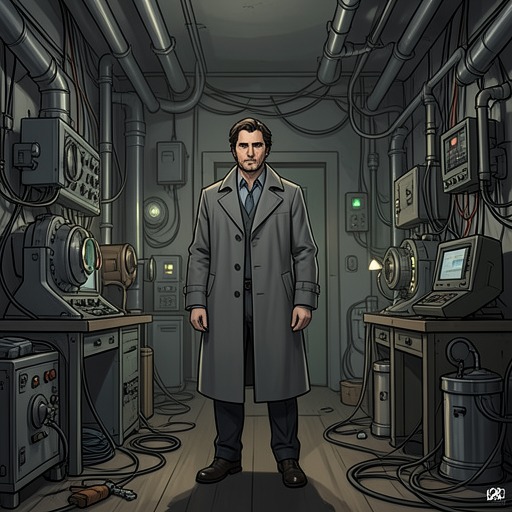
The Combine’s expanding mechanized social order
One Flew Over the Cuckoo's NestThe Combine’s expanding mechanized social order is the system Chief Bromden sees at work both in the defeat of his father and in the standardized landscape beyond the ward. Its power is not confined to an institution: it reaches into a tribe, a town, homes, schools, and the habits of ordinary people. Chief’s account joins coercion to repetition. The system makes resistance costly, while its expanding uniformity can make the damage difficult to notice.
Definition and Origins
Chief Bromden explains the system to Randle Patrick McMurphy through the history of Papa, his father. The Combine had worked on Papa for years, while demanding that the tribe live in inspected houses and seeking to take the falls. Its reach extended into the tribe itself; in town, men beat Papa in alleys and once cut his hair short. Chief links the violence to an effort to make Papa understand what awaited him if he refused to sign the papers surrendering everything to the government. The pressure was both physical and political: intimidation prepared the way for the transfer of the tribe, village, and falls.
The history also shows that the pressure did not end when the papers were signed. The tribe received checks, but Chief recalls people gathering outside his family’s door with them, asking Papa what to do, where to go, or what to buy. They looked to him for guidance after the transfer, yet by then he was, in Chief’s words, too little and too drunk. The contrast is stark: payment could be presented as compensation, but it could not answer Papa’s question, “What can you pay for the way a man lives?” Chief’s account makes the loss larger than property. A way of living and the authority to decide what came next had both been taken from the community.
How the Order Works
Papa’s history gives Chief a model for interpreting McMurphy’s position. After McMurphy has broken the Nurses’ Station window, Chief warns that the authorities have noticed his size and will now try to break him. The warning echoes what Chief has just described: resistance draws the system’s attention, and attention brings efforts to make the resister smaller. Papa had been able to fight for a time, but years of pressure, including his mother’s part in his eventual surrender, wore him down. Chief does not present the Combine as a single attacker or a one-time act of force; it works through accumulated pressures and through people acting within its reach.
Chief also describes its operation as something that can be sensed across daily life, like pressures and frequencies pushing and bending people. McMurphy understands the need for courage and tries to make the patients laugh, but Chief distinguishes performed toughness from a deeper freedom. Along the coast, the patients sit straight, grin, and stare back at strangers who look at their green uniforms. Their defiance is still a performance; Chief says McMurphy has not yet drawn a real laugh from them. In Chief’s reading, strength requires being able to see the funny side, but the pressure of the Combine can parch laughter before it becomes genuine.
The Mechanized Landscape
The coastal journey lets Chief see changes that gradual exposure might conceal. He compares his recognition to noticing how someone has changed after a long absence: a person seen every day might not register the slow transformation. One image is a train unloading a string of men in mirrored suits and machined hats. They emerge in a cluster Chief likens to a hatch of identical insects, then the train moves on to deposit another group across the spoiled land. The scene turns travel into a picture of replication: people arrive already made to look alike, and the train carries the pattern onward.
The same logic appears in the five thousand identical houses punched out by a machine across hills outside town. A sign advertises “NEST IN THE WEST HOMES—NO DOWN PAYMENT FOR VETS”; downhill, another marks “ST. LUKE’S SCHOOL FOR BOYS.” The fresh houses remain linked like sausages, while five thousand boys in matching green corduroy pants, white shirts, and green sweaters play crack-the-whip on crushed gravel behind a checker-wire fence. The game’s repeated action gives the landscape a second kind of assembly line: each crack sends a child off the end of the line and against the fence.
Repetition, Damage, and Significance
Chief’s account makes the child at the end of the whip the scene’s troubling refrain. Every crack knocks off the same little kid, again and again. The children all live in the matching houses, owned by the men who arrived on the train. The houses are so alike that children sometimes enter the wrong homes and join different families; nobody notices. By contrast, the scuffed and bruised child is visible wherever he goes, but being noticed does not rescue him from the pattern. Chief says he cannot open up and laugh either, linking this repeated injury to the broader pressure that makes laughter difficult.
These scenes extend the Combine beyond the ward without making its forms identical. Papa faces direct political and physical coercion over the tribe’s land; the coast presents manufactured likeness, unnoticed dislocation, and a child repeatedly cast out of line. Chief’s account connects the two through the consequences of a system that presses people into forms they did not choose and weakens their ability to resist or even recognize what is happening. The journey sharpens his perception: where the other patients feel pressure without being able to see its source, Chief reads the train, houses, fences, and recurring child as visible signs of the Combine’s expanding reach.