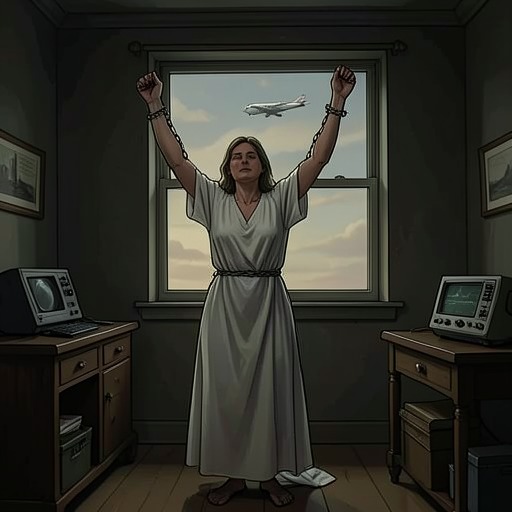
The hospital
One Flew Over the Cuckoo's NestThe hospital is the enclosed setting of the ward and the machinery of control that governs it. Its routines promise order and treatment, but the novel repeatedly shows how that promise can shade into surveillance, punishment, and the suppression of individual choice. Patients encounter the institution not only in dramatic interventions but in the breakfast line, the locked door, the scheduled shave, and the rules that decide whether a protest can matter.
The Ward as an Ordered Environment
The ward’s daily life is organized around doors, schedules, and staff movements. Patients sit in the day room after breakfast, listening for the lock and watching for whoever might enter: a resident observing them before medication, a visiting wife, or schoolteachers on a tour. The arrival of visitors is usually disappointing, but the possibility of something unexpected keeps the patients alert. The Public Relations man presents the hospital as having left old cruelties behind, while the ward’s residents experience a tightly managed environment in which even a visitor’s arrival becomes an event to anticipate.
The hospital’s routines continue when the narrator is too sedated to remember them clearly. After being taken from the shaving room and locked in Seclusion, Chief Bromden cannot recall whether he received breakfast. He remembers other mornings in the room: the black boys eating food supposedly brought for him, or forcing him to eat cold, unsalted mush. The ward door’s opening tells him it is at least eight o’clock and that he may have been unconscious for an hour and a half. That blank interval is frightening precisely because he cannot know what may have happened while he was unable to observe or resist it.
Schedule, Surveillance, and Adjustment
Nurse Ratched treats disorder as something to be corrected. A minor disruption, in Chief Bromden’s account, can provoke her tightly contained anger until the nuisance has been dealt with and the patient has been adjusted to surroundings. Her authority reaches beyond the ward: she works alongside the Combine, which Chief Bromden imagines as an organization intent on adjusting the outside world as well. The hospital is thus not an isolated institution in his understanding but a local part of a larger social system that prizes smooth functioning.
The ward’s efficiency is rendered as a machine. Notes made during the day are typed and fed into a machine behind the steel door at the Nurses' Station; punched Order Daily Cards set the next day’s routine in motion. At six-thirty, the Acutes are roused and put to work cleaning. Wheelers wait for their chairs, while patients called Vegetables are subjected to a buzzer and an electric shock when they wet their beds. At six-forty-five, the Acutes line up alphabetically to shave, followed by the walking Chronics and then the Wheelers. Even the order in which patients reach the mirrors reflects a system that sorts bodies into categories and assigns each a place in the timetable.
Surveillance is part of this order. The black boys appear where patients try to be alone or speak privately, while the staff’s control is described through Chief Bromden’s image of invisible wires and signals. That image belongs to his account of what he sees and fears; within the narrative, however, it gives form to the ward’s pervasive sense that private thought and action are exposed to institutional scrutiny. The hospital’s routines do not need to announce every command: observation and anticipation help keep patients within bounds.
Treatment and Coercion
The institution’s treatment practices can become physically coercive. When Maxwell Taber questions his medication, Nurse Ratched takes hold of his arm and tells him that he may leave if he will not take the medicine orally. The apparent choice is followed by force: the black boys catch him in the latrine, drag him to the mattress room, and pin him down while Nurse Ratched administers an injection. Afterward they carry him, wrapped in a damp sheet, to the lab. The episode makes the gap between the language of kindness and the ward’s capacity to compel unmistakable.
The hospital’s reach also includes the Shock Shop. During a visit to Building One, Chief Bromden sees patients being taken through an unmarked metal door, hears a man scream, and watches another patient resist being pulled toward the treatment table before the door closes. The sequence makes the procedure’s institutional setting as important as the treatment itself: patients wait in a line, are given red capsules, and are handled by staff as they are moved into the room. Randle Patrick McMurphy asks what the procedure does and why it is used, bringing the practice into direct question rather than accepting it as routine.
Nurse Ratched’s authority is also exercised through decisions about where patients may go and what they may challenge. Fredrickson describes being classified as Potential Assaultive and sent to the Disturbed Ward after confronting authority; he says it happened to him three times. There, patients do not get to leave for the Saturday movie or watch television. The threat of transfer, Shock Shop treatment, or an operation gives weight to the ward’s apparently ordinary conversations and rules: disagreement can carry consequences beyond the immediate dispute.
Rules, Choice, and Resistance
The ward’s claims to democratic procedure are tested when the patients vote on television. Nurse Ratched counts twenty votes, then points out that the ward has forty patients and that a majority is required to change policy. She closes the vote as defeated. When Randle Patrick McMurphy protests, she asks Dr. Spivey to note that he seems upset and suggests ending the meeting early. The result exposes how a formal rule can be applied to stop a change the patients believed they had voted for, while their protest is recast as evidence about their behavior.
The hospital’s control is not identical for every patient. At the X-ray line, Dale Harding explains that he is voluntary and not committed. Randle Patrick McMurphy realizes that his own situation is different: only a few men are committed, and he is among them. He asks whether the others have misled him, then understands that the risk of antagonizing Nurse Ratched may include an uncertain extension of his stay. The distinction between voluntary and committed patients turns the question of freedom into a practical one: some can sign out, while his ability to leave is not simply his own decision.
The Hospital’s Consequences
The hospital describes its purpose as repairing people so that they can return to society. Chief Bromden instead calls it a factory for the Combine, where people who arrive as mistakes are made into adjusted components. Maxwell Taber becomes the example through which this account turns dark: after returning from the hospital, he is praised as a new man, yet the narrator imagines the technicians’ installed elements enabling him to adjust his own family and neighbor. In this vision, the hospital’s product does not merely fit into an existing order; it carries the work of adjustment outward.
Randle Patrick McMurphy’s repeated electroshock treatments show resistance occurring within that system. After each treatment, as he begins to recover, Nurse Ratched and the doctor ask whether he is ready to face his problem and return to the ward for a cure. He refuses in defiant terms, drawing smiles from the patients on the Disturbed Ward; Nurse Ratched then arranges another treatment. His refusal does not stop the procedure, but it changes the meaning of the scene for the men watching: the patient subjected to the institution’s power can still answer it publicly.
The hospital’s final display of authority is also an image of its damage. Three weeks after McMurphy has been gone, Nurse Ratched makes what Chief Bromden understands as her last play: the black boys wheel a gurney into the day room bearing a chart marked with McMurphy’s name and the word LOBOTOMY. The patients read the chart and look at his bruised, pale face. Scanlon spits on the floor and rejects the body as the man they knew. The ward can return McMurphy physically, but what it has done to him makes that return a confrontation with the limits of its claim to cure.
The hospital’s significance lies in the contrast between its orderly language and the coercion that sustains its order. Its clockwork routines, treatment rooms, and rules govern not just conduct but patients’ access to privacy, choice, and departure. At the same time, the patients’ protests, disbelief, and solidarity make the ward more than a machine: they reveal the human consequences of its procedures and the possibility, however constrained, of refusing the identity the institution assigns.