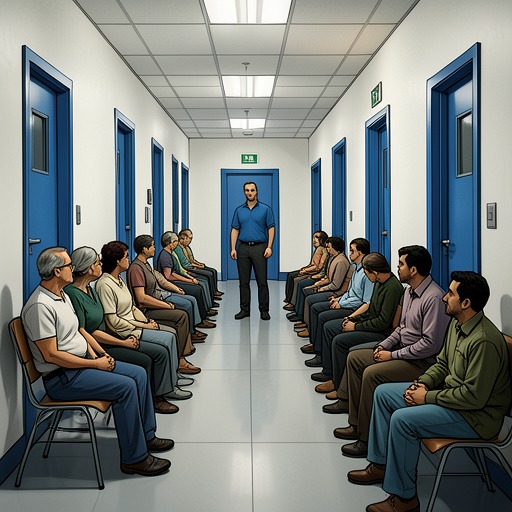
The ward’s emerging solidarity
One Flew Over the Cuckoo's NestThe ward’s emerging solidarity is the patients’ gradual movement from private fear and tentative imitation toward shared courage, laughter, and resistance. It does not arrive as a sudden victory: the men first learn how carefully the ward’s rules can punish dissent, and even their early displays of toughness remain a performance. Their change becomes meaningful when they begin to act and laugh together, recognize the cost of standing alone, and finally refuse to give Nurse Ratched the obedience she expects.
Fear, Rules, and Unequal Stakes
The patients’ hesitation has practical causes. When Randle Patrick McMurphy urges a patient to defy Nurse Ratched, Fredrickson explains that openly hostile behavior can lead to being classified as potentially assaultive and sent to the Disturbed Ward. He has been sent there three times. The men upstairs, he says, do not even leave for the Saturday afternoon movie or have a television. Another warning extends the possible punishment from transfer to the Shock Shop and even an operation. Resistance is therefore not an abstract test of nerve: the patients have seen how dissent can narrow a person’s freedom and expose him to harsher treatment.
The failed vote to change the television schedule makes the limits of ward democracy equally plain. McMurphy counts twenty votes and initially treats them as the whole group’s decision. Nurse Ratched points out that forty patients live on the ward and that a majority is required; with only half voting, the proposal fails and the vote is closed. When he protests, she describes him as upset and asks Dr. Spivey to note his condition. The procedure allows the patients to participate, but its rules let the authority they are challenging determine when their participation counts. Their shared grievance is real, yet the institution can isolate a protester by recasting protest as evidence against him.
McMurphy’s confidence changes when he learns that the other men have not told him the full extent of his personal risk. He discovers that many are voluntary patients, while he is committed and could remain in the hospital longer if he antagonizes Nurse Ratched. Harding emphasizes the difference: he is voluntary, whereas McMurphy is committed; only a small number of men are committed at all. McMurphy asks the men directly whether they have been misleading him. Their silence leaves him to grasp that they had allowed him to confront a danger they did not share. Solidarity here is not yet uncomplicated fellowship. It is tested by unequal consequences and by the possibility that one person’s courage has been serving others who remain safer.
Courage Learned, Laughter Shared
The fishing trip offers the men a different kind of practice. At traffic lights, the twelve patients copy McMurphy’s posture and grin back at strangers who stare at their green uniforms. Their defiance is deliberately theatrical, a display of toughness rather than proof that fear has disappeared. Chief Bromden observes that they still cannot produce a genuine laugh. The distinction matters: looking brave together begins to unsettle their accustomed passivity, but it is not yet the inward freedom they are trying to recover.
On the water, disorder turns into a shared release. Lines tangle; a fish fights at the men’s feet; the girl’s pole catches between her breasts as Billy helps her hold it; and George runs the boat into a log, killing the engine. Randle Patrick McMurphy laughs at the mishap and at everyone caught in it. His laughter does not pretend that nobody is hurt: Chief Bromden’s thumb aches, the girl’s breast is bruised, and Dr. Spivey has lost control of his glasses. Instead, the men begin to laugh with the pain still present. Harding, Scanlon, the girl, Sefelt, and Dr. Spivey join in. The laughter expands from one man’s response into a group experience, letting the patients share embarrassment and discomfort rather than bear them alone.
The change becomes legible on shore. The men who had watched the patients endure insults no longer see the same weak group. The onlookers do not apologize for what they said to the girl, but they ask to see her fish politely; McMurphy and the captain return with beer, and the group shares it with them before leaving. The courtesy is a small, concrete reversal. The patients have not won a formal concession, but they are no longer simply accepting the role assigned to them by strangers. Their behavior has altered how others treat them—and how they see themselves.
Recognition in the Ward
The threat to George brings the solidarity into sharper focus. During the evening shower routine, a ward attendant approaches George, who has long avoided soap and refused towels. The attendants had generally left this practice alone, but the situation has changed: after the fight, the attendant has a broken nose and stands with two colleagues behind him. As he moves to make George bend his head for the stinging salve, the room’s laughter stops. The men recognize, in the sudden quiet, what is about to happen and why they had misunderstood McMurphy. Their recognition is collective, but it is not presented as effortless heroism; it comes at the instant when George’s vulnerability makes the danger unmistakable.
That pause contrasts with the patients’ earlier joking and imitation. Laughter can draw them together, but it cannot erase the coercion that surrounds them. The scene makes solidarity more than shared amusement: the men now perceive a threat to one of their own as a matter that concerns them all. It also retrospectively changes the meaning of McMurphy’s conduct. His opposition is no longer merely a personal contest with Nurse Ratched; the patients are beginning to understand what his resistance has exposed about the ward’s power over them.
Collective Defiance and Its Limits
During the nighttime party, Chief Bromden realizes that he is drunk with other patients and guests on Nurse Ratched’s ward. He understands the night as something the men themselves have made possible, like opening a window to let fresh air in. The ward has not ceased to be the institution’s stronghold, but the patients have crossed a boundary they once treated as impassable. Bromden’s response is physical as well as inward: he scoops up Sandy and Randle Patrick McMurphy and carries them to the day room, laughing and staggering with them. The moment gives the group a new measure of what it can do together.
The solidarity is most plainly visible after McMurphy is gone. Nurse Ratched comes out demanding to know where he has gone and insists that he is still on the ward. The men meet her eyes and grin; her old confident smile has disappeared, and they no longer respond to her pressure as they once did. Their laughter now functions as a collective refusal to supply the information and submission she demands. It does not undo the ward’s rules or the patients’ exposure to authority, but it marks a decisive change in their relation to that authority: the ward’s power no longer guarantees their inward agreement. The group’s growing confidence, built through shared risk and repeated acts of mutual recognition, has become visible as solidarity.