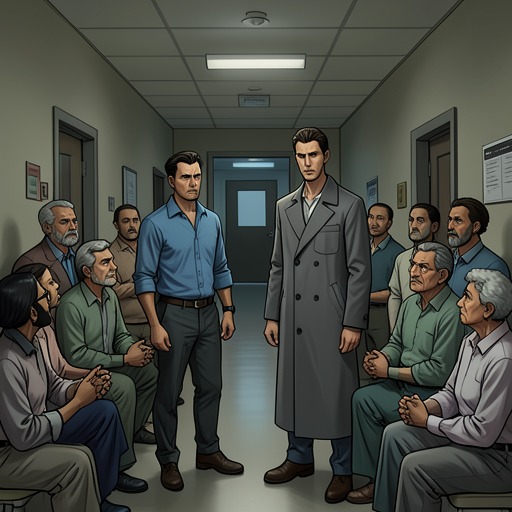
The ward's black aides
One Flew Over the Cuckoo's NestThe ward's black aides are three attendants whose spotless uniforms, quiet movements, and capacity for force make them central agents of Nurse Ratched's control of the ward. In Chief Bromden's narration, they seem to appear wherever patients might seek privacy; in practice, they clean, watch, move, and restrain patients as the ward's ordinary routines turn into instruments of discipline.
Selection and Training
Chief Bromden describes Nurse Ratched as having tested and rejected many potential aides before assembling the three she wanted. She judged the earlier candidates by how much they hated her and the ward, eventually choosing these men one at a time over several years. The account presents their hostility not as an obstacle to their employment but as a quality she deliberately sought and incorporated into her plan.
The first aide arrived five years after Chief Bromden had entered the ward. Bromden describes him as a short, sinewy man whose growth had stopped in childhood, and recounts a traumatic family history: his mother had been raped while his father was restrained, and the boy watched from a closet. That history is given through Bromden's narration rather than the aide's own voice. The attendant initially wanted to carry a sock filled with birdshot and use it to bring patients into line. Nurse Ratched instead instructed him to conceal his hatred, wait for an advantage, and apply pressure steadily. The contrast matters: her method does not remove violence from the job; it makes coercion patient and controlled.
Two more aides joined about two years later, roughly a month apart. Bromden says they looked so alike that they seemed like replicas: tall, bony men with sharp features and expressions that barely changed. Their backgrounds are not supplied in the same way as the first aide's, leaving them less individually developed in the narrative. What the account does emphasize is that Nurse Ratched trained all three to carry out her discipline without visible outbursts or openly stated orders.
Appearance and Surveillance
The aides wear starched white shirts and trousers fastened with metal snaps, along with polished white shoes whose red rubber soles let them move almost silently. Their uniforms match the ward's white, scrubbed surfaces and Nurse Ratched's own cold presentation. Chief Bromden repeatedly turns that visual contrast into an image of threat: against the pale walls, an aide's dark face and hands seem to float without a visible body. The description conveys how patients experience being watched, though its ghostly quality belongs to Bromden's perception rather than establishing anything supernatural.
Their work makes privacy feel precarious. They appear in different parts of the ward just as patients try to check themselves in private or whisper to one another. Bromden imagines their coordination as a widening connection to Nurse Ratched: first through direct wires, then through a signal that needs no spoken order. This is part of his larger vision of the ward as a machine. In that vision, the aides anticipate Nurse Ratched's wishes and help translate her notes and plans into daily action. The image makes surveillance seem constant, while the men themselves remain difficult for patients to read.
Daily Work and Coercion
The aides' duties include cleaning as well as enforcement. Early in the novel, Chief Bromden comes out of the dormitory to find them mopping a hall after sexual activity. They make him take a mop and direct him to clean a spot; one strikes the backs of his legs with a broom handle to hurry him along. They mock his size and his silence as they order him to work. The episode establishes the double character of their labor: they maintain the ward's cleanliness while humiliating and physically moving a patient who is already vulnerable.
Their coercive role becomes especially plain when Maxwell Taber refuses oral medication and questions the staff. Nurse Ratched takes hold of his arm and tells him he may leave if he will not take the medicine by mouth, framing his resistance as childishness and hostility. The two larger aides then catch him in the latrine and drag him to a mattress room. Taber kicks at one of them and shouts, but they hold him down: one sits on his head while the other tears open the back of his trousers. Nurse Ratched prepares a long needle with Vaseline and enters the room; afterward, Taber is carried across the hall to the laboratory, his clothes torn and his body wrapped in a damp sheet. The sequence shows how a dispute about medication becomes physical restraint and forced treatment, with the aides providing the force that makes the staff's decision effective.
The same threat of escalation shadows other resistance. Fredrickson tells Randle Patrick McMurphy that a patient who is labeled potentially assaultive can be sent to the Disturbed Ward, where ordinary privileges are sharply reduced, and warns that further opposition may lead to the Shock Shop or an operation. The aides do not make those decisions in this exchange, but their presence and prior use of force make the threat of institutional punishment more than an abstraction. They are part of the machinery through which the ward's decisions acquire immediate physical consequences.
Patients, Resistance, and Treatment
Randle Patrick McMurphy attempts to frustrate the aides' efforts to provoke him by responding with exaggerated manners and laughter rather than anger. Chief Bromden notes that McMurphy keeps his composure around both the aides and the nurses, treating petty rules and condescending behavior as material for amusement. The contrast exposes a limit to their power: they can enforce procedures and intimidate patients, but McMurphy's refusal to display the reaction they seek temporarily makes their tactics look ridiculous. His anger does surface at a group meeting, but it is directed at patients who remain silent about changing the television schedule, not at the aides.
The aides also take part in moving patients toward treatment. On a Friday when patients are being taken for chest X-rays, Chief Bromden sees a man on the bench being pulled to his feet by a black aide and a white attendant. The drugged patient staggers, then braces his heels against the concrete as they pull him toward the treatment-room door. Bromden hears another patient screaming and sees the man disappear inside. This brief passage connects the attendants' ordinary work of moving people through the building with the fear surrounding electroshock treatment: the patient does not walk in freely, but is physically conveyed toward a procedure he is trying to resist.
After Randle Patrick McMurphy has been away from the ward for three weeks, the aides wheel in a gurney bearing a chart marked with his name and the word lobotomy. The patients gather at the foot of the gurney and recognize his red hair and bruised face, but Scanlon rejects the idea that the inert figure is still McMurphy as they knew him. The aides' action is logistical—they bring the gurney into the day room and leave it beside the patients regarded as vegetables—but its effect is devastating. Their silent delivery makes the result of the institution's treatment visible to the ward.
Narrative Role and Significance
The aides are shown largely from Chief Bromden's fearful point of view, which describes them through masks, ghostlike faces, and mechanical signals. That imagery makes the ward's surveillance and coercion palpable, but it also reduces the attendants to threatening bodies rather than giving them sustained inner lives. The narrative partly complicates that reduction by recounting the first aide's childhood trauma and his initial wish to use overt violence; Nurse Ratched's training changes the form of his conduct, not its function. The other two remain more opaque, defined chiefly by their resemblance and their work.
Their whiteness of uniform against the dark faces that Bromden emphasizes is an important part of the novel's racialized imagery. The article's evidence does not give the three men equal access to their own perspectives, so Bromden's descriptions should be understood as a representation of how the narrator experiences and interprets them, not as an independent account of their thoughts. Within that perspective, they embody a system that operates through routine as much as through spectacle: mopping, watching, directing patients, holding them down, and wheeling in the aftermath of treatment. Nurse Ratched's authority depends not only on what she says, but on attendants prepared to turn her decisions into action. Their quiet efficiency is therefore both a practical feature of ward life and one of the novel's most unsettling images of institutional control.