
Ratoff and Carr’s Break
Operation NapoleonThe chain of command that makes Ratoff useful to Carr deteriorates when Ratoff discovers the real secret, tries to turn knowledge into leverage, and learns that his employer considers him disposable.
increasing Bearing strength in each event
 decreasing
Bearing strength in each eventdecreasingA Weapon Chosen for Secrecy
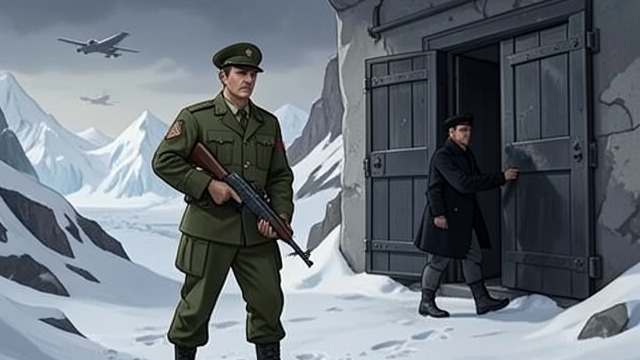
A Weapon Chosen for Secrecy
Carr selects the director
Carr assigns Ratoff to lead the glacier operation, relying on his ability to complete covert missions without regard for ordinary restraints. The mission requires a commander who can recover the aircraft quickly and keep its passengers, documents, and cargo beyond public scrutiny.
Methods create new risks
Ratoff treats Icelandic witnesses as operational obstacles. He orders attacks on Kristín, Elías, and Jóhann, and takes their warnings and resistance as reasons to apply more force. These decisions expand the mission’s exposure and bring Carr’s own methods under pressure from the Icelandic Government and the press.
The command relationship is built on usefulness rather than trust. Carr wants secrecy and results; Ratoff supplies them through violence, but each violent act creates witnesses and consequences that the operation’s political cover cannot easily absorb.
The Briefcase Changes the Mission
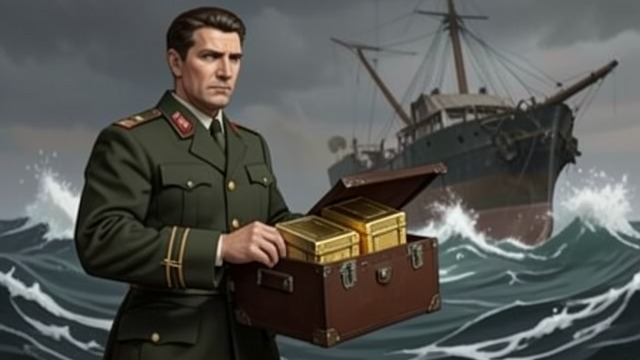
The Briefcase Changes the Mission
An unexpected cargo
Ratoff enters the wreck and discovers that the promised treasure amounts to only two crates of gold. He also finds the American general’s briefcase and papers whose contents reveal that Operation Napoleon, not bullion or a bomb, is the true reason for decades of surveillance.
The subordinate understands the danger
The papers show Ratoff that his superiors have concealed a politically explosive history and that his knowledge may itself be treated as a liability. Carr tells him to deliver every document and warns him not to read them, but Ratoff has already recognized that the order protects Carr more than it protects the mission director.
The secret alters the balance of power between the two men. Ratoff now possesses information Carr needs to contain, while Carr has the authority and personnel to prevent him from using that information freely.
The Bargaining Attempt
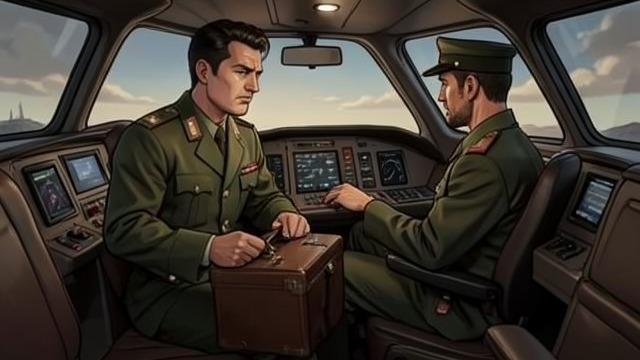
The Bargaining Attempt
An insurance policy
Aboard the C-17, Ratoff presents Carr with a briefcase that appears to hold blank pages. He claims to have hidden the actual documents and says he has arranged for them to be released if he fails to confirm that he is safe. Rather than trust the chain of command, he tries to convert secret knowledge into a guarantee of survival and money.
Carr refuses a deal
Carr rejects the proposed agreement and orders his men to search Ratoff. The empty case reveals that the papers are elsewhere, but Carr does not accept the threat as a reason to negotiate. He treats Ratoff’s attempted blackmail as insubordination at the worst possible moment, when the aircraft and secret are already in transit.
The argument exposes the difference between their expectations: Ratoff believes leverage can make him valuable, while Carr believes the operation gives him power to eliminate anyone who endangers it. Their relationship has moved from a covert working arrangement to a direct contest over who controls the documents.
The Commander Turns on His Agent
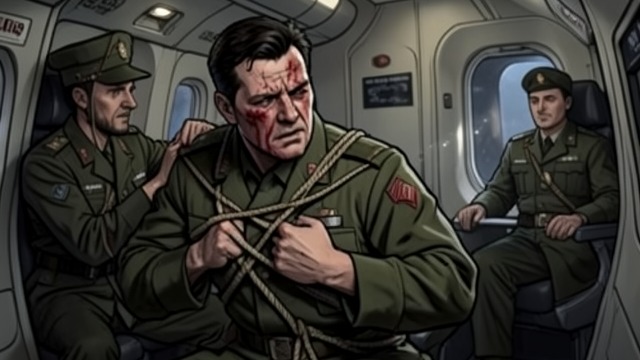
The Commander Turns on His Agent
Interrogation in the air
Carr’s men subject Ratoff to severe physical abuse in order to locate the papers and end his ability to bargain. Carr waits in the flight cabin, hears enough to know that the interrogation is proceeding, and refuses to involve himself in its details.
A final order
After the documents are found or accounted for, Carr tells his men that Ratoff is no longer needed and instructs them to do what is necessary. The order resolves the immediate threat to Carr’s control but confirms that Ratoff’s earlier suspicion was correct: his superior regarded him as expendable from the start.
The conflict culminates in the system using its own violent instrument against him. Ratoff’s brutality has not made him secure; it has made him useful only until the secret is contained and his claim to leverage can be broken.
The Warning After the Fall
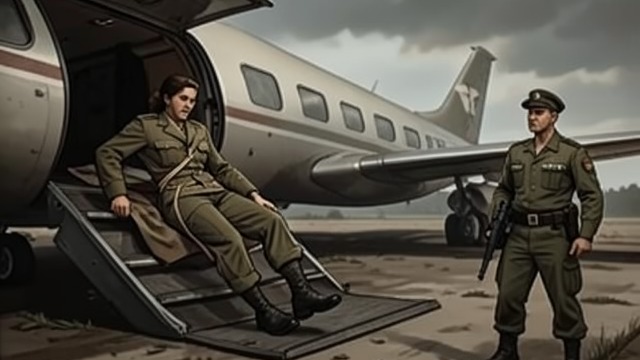
The Warning After the Fall
Kristín sees the outcome
Kristín witnesses Ratoff bound and carried toward the open rear ramp. He tells her never to cross Carr and asks for help, but she does not intervene. The man who terrorized her has become helpless in the hands of the organization he served.
Power survives the agent
Carr later faces Kristín and makes clear that the mission’s physical recovery is complete while the political concealment continues. He threatens her and the other witnesses, uses drugging to control her, and predicts that public authorities may not believe what she has learned. Ratoff’s removal does not end the threat; it demonstrates Carr’s continuing capacity to shape it.
The collapse of Ratoff’s position resolves one struggle without resolving the larger conflict. The agent is discarded, but the institution that selected him still controls the documents, the aircraft, and the official story.
27–29 January
30 January, after the aircraft breaks open
31 January, at Keflavík Airport
during the flight over the Atlantic, 31 January
after the aircraft leaves Iceland
