
Sovereignty Against Strategic Convenience
Operation NapoleonThis thread traces Iceland’s struggle to assert authority over its territory as security rhetoric, economic dependence, and the United States’ unilateral action expose the gap between formal sovereignty and practical power.
increasing Bearing strength in each event
 decreasing
Bearing strength in each eventdecreasingA Long Political Unease

A Base and Its Contradictions
Dependence without welcome
The U.S. military presence at Keflavík has long been politically controversial in Iceland. Residents and political parties object to foreign forces on Icelandic soil, even as businesses and nearby communities become economically connected to the base. Official policy says Iceland should not profit from the NATO presence, while contracts and local livelihoods still make the relationship materially consequential.
The dispute beneath the operation
That history makes the 2000 recovery more than a secret military mission. It tests the terms of a relationship shaped by strategic need, economic benefit, and public resistance. Kristín’s opposition to the base is not merely an abstract political position; the crisis forces her to confront what it means when a foreign power can act within her country while Icelandic people bear the consequences.
A Mission Without Consent
Information Replaces Permission
The operation is already under way
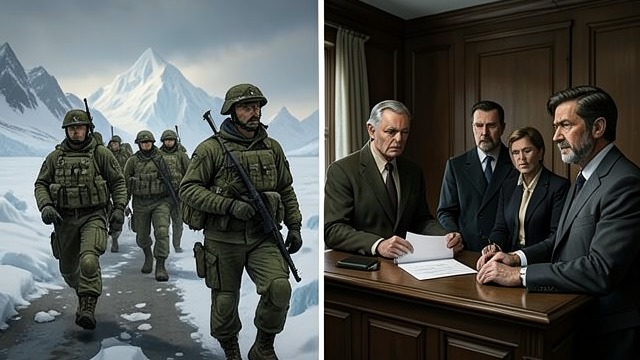
American troops arrive with equipment and move toward Vatnajökull before Icelandic leaders receive a full account of their intentions. At the first emergency meeting, U.S. officials present the operation as a scientific recovery and request cooperation without disclosing what the aircraft contains. The distinction between requesting consent and announcing a decision is apparent to the Icelandic Prime Minister.
The treaty becomes contested ground
The American delegation invokes the defence relationship while withholding facts needed for Iceland to judge the mission. Icelandic leaders object that military action on their territory cannot be legitimized by a vague appeal to mutual security. The secret operation exposes a power imbalance: one side controls the evidence and the force, while the other is asked to provide a public explanation.
A Local Witness Becomes a Target

Sovereignty Enters the Home
Violence crosses jurisdictions
After Elías contacts Kristín from the glacier, American operatives attack her in her Reykjavík apartment and kill Runólfur. The threat is not confined to the military zone: it reaches an Icelandic civilian home and draws an Icelandic government employee into the operation. Kristín has little reason to trust the police or ministries when her attackers invoke a conspiracy involving them.
A personal search becomes political
Kristín’s flight across the base and her later journey toward Vatnajökull begin as attempts to learn whether Elías is alive. As she encounters the foreign troops, however, the crisis takes on a larger meaning: people in Iceland are being treated as obstacles in an operation conducted on Icelandic soil. Her insistence on reaching the glacier becomes a refusal to accept that secrecy grants the military unlimited authority.
The Glacier Becomes a Prohibited Zone
Force Tests the Boundary
Rescue meets military control
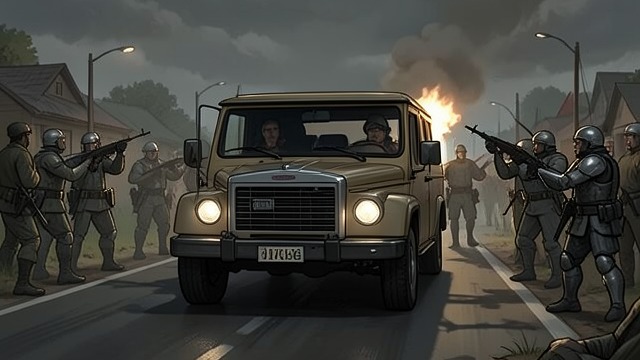
U.S. troops block the Reykjavík Air-Ground Rescue Team, demand its communications equipment, and fire on its vehicles when the volunteers refuse to withdraw. The confrontation turns an undeclared recovery operation into a direct challenge to Icelandic movement within Iceland. The rescue team is trying to reach endangered Icelanders, but the American command treats its presence as a threat to the mission.
The cost of assertion
The Icelandic government receives reports of a death, a critically injured rescuer, unauthorized helicopters, and a fabricated eruption alert. It protests and threatens to inform the public, but the immediate military facts remain controlled by the Americans. The crisis makes sovereignty visible as a practical question—who can move, communicate, and use force—not simply a treaty principle.
Accountability Stops at the Cover Story
Formal Protest, Limited Consequence
Public acknowledgment without disclosure
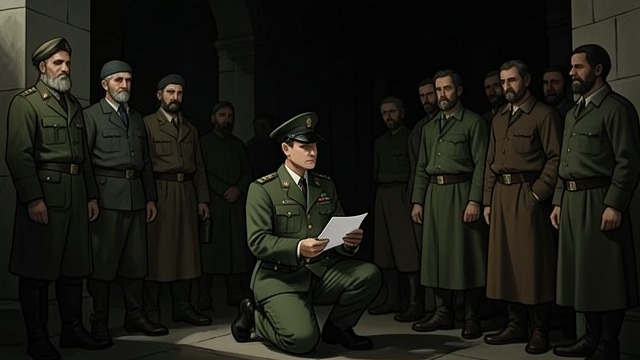
The U.S. military apologizes for soldiers firing on the rescue team and promises an inquiry and compensation, while denying knowledge of the aircraft and the deaths connected to its recovery. Icelandic leaders say permission had been granted for exercises, a position that weakens their earlier protest and helps restore the alliance’s public appearance. The official account recognizes some harm while refusing the explanation that would connect it to the secret mission.
The unequal aftermath
Legal proceedings concerning Runólfur and Jóhann fail to produce a prosecution, and the case remains locked between Icelandic authorities and the Defense Force. The public can see that military force was used, yet the most consequential claims remain officially unfounded. The ending is not a resolution of the sovereignty dispute but a demonstration of how quickly a smaller state’s demand for accountability can be absorbed into strategic convenience.
From the postwar defence settlement through the post-Cold War era
28–29 January 2000, as the U.S. operation begins
29 January 2000, after Elías calls from Vatnajökull
30–31 January 2000, as Icelandic rescuers approach the camp
The months after Kristín and Júlíus return
