1945 Vatnajökull Search Operation
Operation NapoleonThe 1945 Vatnajökull Search Operation was a US military expedition to locate an aircraft reported down on the glacier. Led by Colonel Miller, it brought hundreds of soldiers across a winter landscape where roads, daylight, weather, and unfamiliar terrain all worked against them. The search recovered only a fragment of the aircraft, but its failure was not an ending: the glacier had buried the wreck, and its eventual return decades later exposed a secret the original expedition had never resolved.
Mobilization and conditions
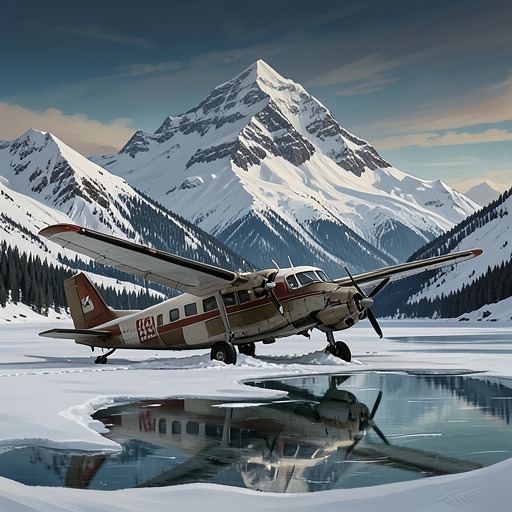
The operation followed the report of a plane seen south of Vatnajökull and believed to have crashed on the ice. Local authorities in Höfn passed the information to Reykjavík, but the US military’s air traffic controllers had not known of any aircraft in the area. A telegram soon informed the district official that the Army would take over the investigation and arrange a rescue party. It also prohibited traffic on the relevant part of the glacier, without explaining why. The sudden restriction made the matter appear closed to local residents even as a much larger expedition was being assembled.
Four days later, twelve military transport vehicles carrying two hundred soldiers reached Höfn. The force could not use the Hornafjördur airstrip, closed in the darkest winter months, and the unbridged rivers of the Skeidará sands cut off the direct route west to the capital. The expedition therefore circled the country in six-wheeled vehicles fitted with snow chains, travelling north and then south along the East Fjords. The northern leg was arduous: the road was little more than a dirt track, and the men had to dig through heavy drifts across the eastern desert of Mödrudalsöraefi.
The troops came from the 10th Infantry Regiment and the 46th Field Artillery Battalion, under General Charles H. Bonesteel, commander of the US occupying force. Some had joined winter exercises on Eiríksjökull the previous year, but few could ski. The expedition’s scale and equipment therefore did not translate into familiarity with the terrain it was sent to search.
The search on the ice
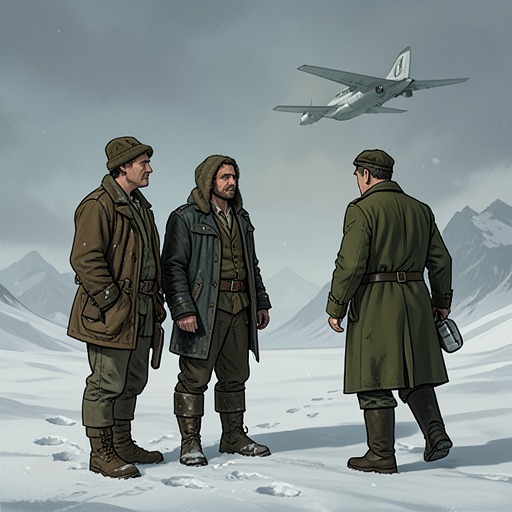
Colonel Miller’s men established themselves in barracks outside Höfn, built by the British occupation force at the beginning of the war, before moving toward the glacier. They reached the brothers’ farm almost ten days after the farmers first heard the aircraft; snow had fallen without respite in the interval. The brothers agreed to guide the soldiers, using gestures and sign language because they spoke no English. They warned Miller that finding a plane in the winter snow was unlikely: at that scale, the glacier was like a vast field in which even a small crash site could disappear, and fresh snow would erase its signs.
Miller understood the warning but pressed on. The route from the farm was passable, and the brothers led the soldiers safely around crevasses and gullies. Most of the troops, they quickly discovered, had never set foot on a glacier and had little winter expedition experience. The soldiers camped in a depression near the glacier’s edge, about 1,100 metres above sea level. With daylight lasting only from roughly eleven in the morning until half past five, each day offered a short window for searching.
For three weeks, Miller’s force combed the glacier slopes and five square kilometres of the ice cap. One party searched the foothills from a camp near the farm; another stayed on the glacier, working as long as the light allowed. When darkness fell, the men returned to the farm base to eat, sleep, and sing songs the brothers recognized from the radio. Their double-layered silk mountaineering tents, primus stoves, oil lamps, knee-length leather coats, fur-lined hoods, and thick Icelandic-wool gloves were essential against the cold, but could not remove the risks of working on the ice.
A fragment, and an abandoned search
The only aircraft evidence found during the expedition was the rim of the nose wheel, discovered by the brothers about two kilometres onto the ice cap. Colonel Miller immediately took charge of it. Beyond the fragment, the surface appeared smooth in every direction; there was no visible sign of a crash or forced landing. The brothers’ explanation was that if the aircraft had come down there, drifting snow might already have covered it. In that sense, the operation’s one physical discovery also pointed to the reason the search had failed: the glacier could conceal what lay on it.
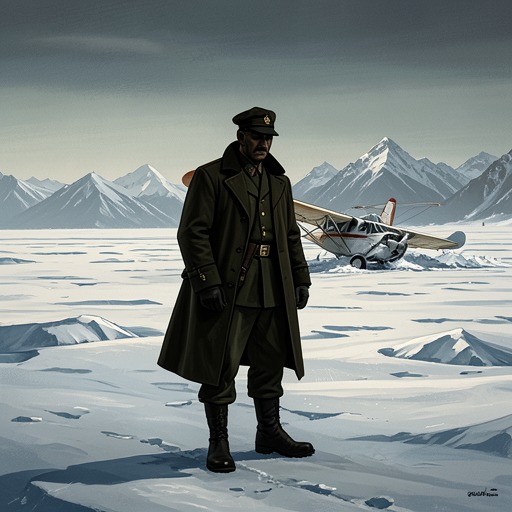
Miller pursued the search with a determination that won the brothers’ admiration. He consulted their local knowledge, and the relationship grew cordial; they were eager to help him. But severe weather twice disrupted the expedition. In the second storm, tents and other equipment disappeared beneath the snow and were lost. Miller was eventually forced to abandon the search without finding the aircraft.
The brothers also saw a private moment that contrasted with the colonel’s command of his men. They came upon him alone in the stable, stroking a horse’s head and weeping. When one of them cleared his throat, Miller started, wiped his face, and acted as if nothing had happened. They never asked his age, but guessed he was no more than twenty-five. The episode offers no explanation for his grief; set against his relentless search and evident courage, it leaves a glimpse of a young commander’s private vulnerability rather than a resolved account of it.
The wreck’s return and the operation’s afterlife
Decades later, a clear image of Vatnajökull appeared to show an object returning from the place where it had been lost. The new operation was ordered to be covert, with its work presented as a routine exercise and local resistance referred to the defense secretary. The old search thus acquired a different meaning: what had looked like a failed effort to find an aircraft had become the first chapter in a military effort to recover it without exposing what it contained.
When soldiers finally uncovered the wreck, they found a body beside the fuselage, dressed as a high-ranking German officer and wearing an Iron Cross. The aircraft itself broke in half as the recovery crew worked on it. Inside, the ice had preserved bodies, including a man in a two-star US general’s uniform with a locked aluminium briefcase handcuffed to his wrist. In the tail, three more bodies were huddled together; one wore a US fighter pilot’s uniform. Counting the body outside the aircraft, the wreck held six corpses, although the briefing had led the recovery director to expect seven. These discoveries did not belong to Miller’s 1945 search, but they define what its failure had left untouched—and why the old fragment of a wheel had never been the whole story.
The search also casts a long shadow over the later recovery’s secrecy and political consequences. The recovery director was instructed to bring back documents and the bodies with the dismantled wreck; at a meeting with Icelandic officials, a US general demanded that the rescue team leave the glacier. The contrast is sharp: in 1945, local guides helped Miller search an immense, indifferent landscape; decades later, the same ice became the site of a contested operation whose purpose was hidden from them. The first expedition failed to retrieve the plane, but its route, its fragment, and its unresolved disappearance established the history that the glacier eventually gave back.