1967 Vatnajökull Search Expedition
Operation NapoleonThe 1967 Vatnajökull Search Expedition was a large, secretive U.S. military search for a German aircraft believed to have appeared on the ice. Its failure was costly: an Easter blizzard forced the troops off the glacier, four soldiers died, and the aircraft remained unaccounted for. The operation’s public cover—a high-profile visit by astronauts, including Neil Armstrong—turned a military deployment into a story about space exploration, while leaving the purpose of the search unresolved.
Origins and Secrecy
The expedition was the second major search for the plane on Vatnajökull and, if Colonel Miller’s end-of-war attempt is counted, the third military expedition Jón had seen. The brothers at his farm knew the earlier history firsthand: they had guided Colonel Miller’s men and had later kept the colonel’s purpose secret, as promised. When the army returned in 1967, they again guided soldiers from the foothills onto the ice sheet. Jón’s account places the new search within a longer pattern of American interest in the wreck, but the aircraft’s suspected contents remained conjecture rather than established fact.
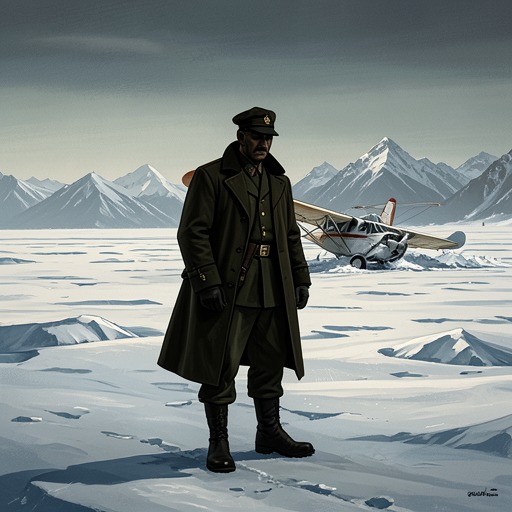
The immediate impetus, as Michael Thompson recounted it to Kristín and Steve, was a surveillance flight. In 1967, Leo Stiller was commanding routine surveillance flights when he thought he saw something on the ice. He flew back and forth taking photographs. A helicopter attempt to land failed in the winter conditions; a small expeditionary force then went onto the glacier with a metal detector. Preparations followed for a much larger operation, conducted in strict secrecy. Stiller objected to the concealment at the base and wanted to know what was happening, but, according to his wife, Sarah Steinkamp, he received no answers.
The Astronaut Cover and the Search
Military intelligence knew that Icelanders were sensitive to troop movements. The chosen distraction was to send astronauts to Iceland for training in the lava fields north of the glacier. The public explanation—that the interior landscape resembled the surface of the moon—made the military activity appear connected to space exploration. Thompson called the explanation implausible and described the visit instead as a means of diverting attention from the largest movement of American troops and equipment in Iceland since the war.
The cover drew on an existing public fascination. Captain Ian Parker, a Scorpion fighter pilot stationed in Iceland, had been in charge when a group of astronauts made an incognito refuelling stop at Keflavík in the summer of 1965. That visit attracted press attention. Parker later proposed inviting Armstrong, reasoning that he would generate still more interest: Armstrong had commanded the Gemini 8 mission in 1966. In the 1967 visit, twenty-five astronauts drew extensive press coverage. Eight astronauts had already visited in 1965, and the training trip into the volcanic interior was repeated when Armstrong and his colleagues came to Iceland. Their public welcome helped make the associated military manoeuvres easier to accept, even as the actual expedition proceeded out of view.
Concealment was difficult in a small community. The operation was conducted in the utmost secrecy, but, Thompson observed, so many people were involved that information must have leaked. Rumours claimed that the secret service had taken control of the embassy in Reykjavík and the base at Keflavík; Thompson could not confirm them. The expedition’s leader was General Vytautas Carr, whom Thompson remembered as an old-school officer, hard and exacting. The scale of the operation, the astronaut spectacle and the uncertain reports about control of the embassy and base all point to the effort made to shield the glacier search from scrutiny, without establishing every rumour as fact.
Blizzard, Deaths, and Failure
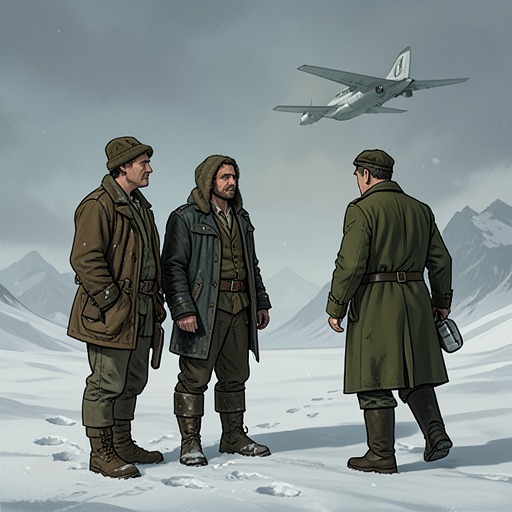
The search took place in April, when winter conditions remained severe. Thompson’s account describes an Easter blizzard that arose suddenly and lasted for days. The men were not prepared for Arctic conditions; wind and snow blinded them and drove them off the glacier. Two soldiers fell into a crevasse. Two others became separated and died of exposure. The expedition withdrew exhausted and defeated, with four men lost.
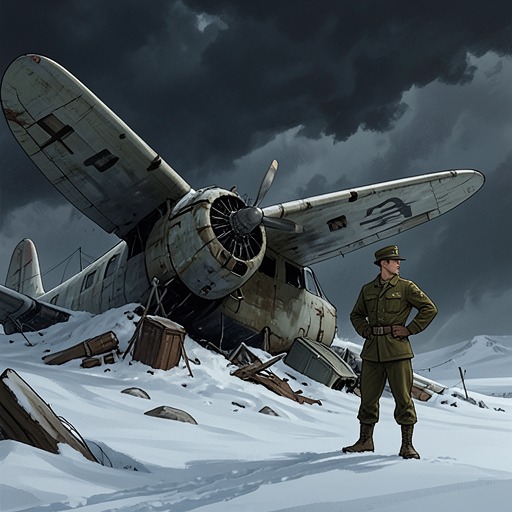
The storm also shaped what could be known about the aircraft. The military failed to find it, and when the weather cleared, the plane had vanished—if it had been there at all. Thompson was careful to distinguish what he knew from what he had heard: Stiller had told him about the earlier sighting and search, but Thompson had not taken part in the operation and could not verify all the stories surrounding it. Sarah Steinkamp later recalled Stiller’s explanation that the plane had been buried in the glacier, then reappeared and disappeared again. That account gave the failure a further uncertainty: the search might have missed a wreck that the shifting ice had already concealed.
Aftermath and Significance
The brothers at Jón’s farm remained among the few local witnesses to the repeated military searches. Their role as guides gave them direct knowledge of the troops’ movement onto the glacier, but their agreement with Colonel Miller prevented them from disclosing the expeditions’ true purpose. They were told to describe the activity as military training if neighbours asked. In private, they speculated about the plane’s cargo, imagining Nazi gold, diamonds, stolen art, a high-ranking officer or a secret weapon. None of these theories was confirmed by the 1967 expedition.
The search also marked a transition in how the glacier was watched. Jón recalled that members of the expedition told the brothers part of the wreck had appeared in a satellite image. Over the years, the brothers had sometimes noticed surveillance flights; those patrols stopped abruptly after the military adopted the new technology. The combination of aerial observation, satellite imagery and repeated expeditions made the aircraft the object of a sustained campaign, even as the public account of the troops’ presence remained a training exercise. In the story, the 1967 expedition links an elusive wreck to concealed military power and to the glacier’s capacity to bury and reveal evidence: the search ends not with an answer, but with four deaths and an aircraft that may have vanished back into the ice.