2000 U.S. Military Secret Recovery Operation on Vatnajökull
Operation NapoleonThe 2000 U.S. Military Secret Recovery Operation on Vatnajökull is the United States military’s covert attempt to locate and remove a German aircraft from the glacier. A satellite image had shown the ice returning an object lost there many years earlier. What began as a tightly controlled recovery mission became a contest over who could see, understand, or disclose the wreck: the operation uncovered bodies and documents that contradicted any simple account of an ordinary wartime crash, while its secrecy placed Icelandic civilians and rescue workers in danger.
Origins and orders
The mission arose from a long search. In an earlier expedition led by Colonel Miller, the only aircraft fragment found was the rim of a nose wheel. The brothers who guided him reasoned that if the plane had come down on that part of the ice cap, drifting snow might already have swallowed it. Two severe storms eventually forced Miller to abandon the search; in the second, tents and equipment disappeared beneath the snow. The failure did not end the mystery, and a later military expedition in 1967 also struggled to search the glacier without attracting attention.
In 2000, a clear satellite image changed the calculation. Vytautas Carr was told that the glacier appeared to be returning an object the military had lost there years before. He was to direct the operation from Keflavík, take two special forces squadrons, choose the necessary equipment, and present the deployment as a routine exercise. If local authorities resisted, they were to be directed to the defense secretary; the senior official giving Carr his orders promised to speak with the Icelandic government. The military base was politically sensitive, so Immanuel Wesson was assigned to take over the embassy in Reykjavík and act as spokesman. Carr recognized the operation as covert.
Deployment under civilian cover
On Thursday 28 January 2000, at around 8 p.m. local time, a C-17 transport plane landed at Keflavík Airport. The remote base stood amid the lava fields of the Reykjanes Peninsula, on a bleak, windswept landscape that had once served as a center for Cold War reconnaissance flights. The aircraft unloaded snowmobiles, tracked vehicles, skiing equipment, and other gear for work on the glacier. The first transporter left within fifteen minutes.
The scale of the arrival was concealed by ordinary-looking road traffic. Four trucks of different models departed at half-hour intervals, with Icelandic license plates and no conspicuous military markings. They travelled east through falling snow, past settlements and across the Skeidará sands, mingling with civilian freight. The route itself carried risk: the glacial rivers crossing the outwash plain could flood after eruptions beneath the ice cap. By the time the convoy reached Jón’s farm, soldiers were unloading equipment and the first snowmobiles were already heading toward the ice.
Ratoff, the operation’s director, moved from the farm toward a camp at the foot of the hills. A blizzard had thickened, reducing visibility as a tracked vehicle crawled along the trail left by the other vehicles. At the camp, floodlights illuminated a ring of tents, scattered supply boxes, and Delta Force soldiers in snow camouflage working methodically. A large satellite dish stood beside the communications tent. The camp was intended to move onto the ice once the aircraft was located.
Excavating the aircraft and its dead
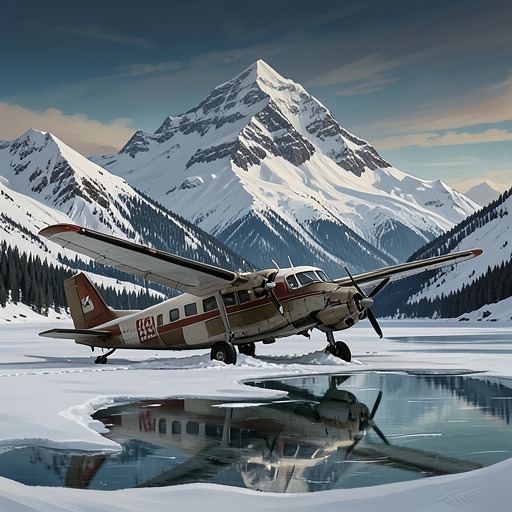
The wreck emerged under four powerful floodlights as troops dug with spades. Its nose projected from the ice like a raised fist; the intact portion and three-engine configuration identified it as a Junkers Ju 52, known to Allied troops in World War II as Iron Annie or Auntie Ju. Its propeller remained attached, its blades mangled by impact with the ice. Beneath flaking camouflage, a black swastika was visible below the cockpit window. The tail remained buried, and the wings appeared to have been sheared off and might never be found.
As recovery work continued, soldiers discovered a leg in a black army boot beside the fuselage. The body proved to be a German officer wearing an Iron Cross, with his hands crossed over his chest and his face hidden beneath a cap frozen to it. One leg was missing, torn away at the hip. Ratoff ordered the corpse freed and taken into a tent. Its placement beside the aircraft suggested to him that someone had moved or laid it there after the crash. The bodies’ preservation in the ice made their positions and clothing evidence, but the circumstances of their deaths remained uncertain. Ratoff reasoned that any passengers who survived impact would have been exposed to the winter cold and likely died within days.
When the aircraft’s front section later bent and broke away under its own weight, Ratoff entered the cabin and ordered that no one else board without his permission. Inside, he found two more bodies: a German army officer and an American two-star general whose uniform insignia he did not recognize. A locked aluminum briefcase was handcuffed to the general’s wrist. The ice had preserved both men with little visible decay. In the tail, Ratoff found three additional bodies, huddled together as if they had tried to share warmth. One wore a U.S. pilot’s World War II leather jacket, with an American flag on its sleeve and an embroidered name. The pilot appeared to have been about twenty-five. Six bodies had now been found, counting the officer discovered outside, although the briefing had specified seven passengers. The German aircraft, American uniforms, and American general made the wreck’s history more puzzling, not less.
Secrecy, testimony, and historical stakes
The operation’s secrecy extended beyond the glacier. Leo Stiller had organized regular monitoring flights over Iceland and the northern sea; once a month, his crews photographed the southeastern glacier. Personnel heard rumors that the Americans were searching for a plane carrying dangerous cargo, but the purpose of the flights remained uncertain. After Stiller died in a helicopter accident, his wife, Sarah Steinkamp, told investigators that he knew the aircraft belonged to the Nazis. She added that he had died without disclosing more.
Local knowledge also carried the weight of old promises. Jón had kept silent about what he knew because he and his brother had promised Miller they would tell no one. When Kristín accused him of helping the American soldiers who had attacked her brother and his friend, Jón finally identified Ratoff as the expedition leader. At the farm, a battered metal case yielded German papers so weather-damaged that most could not be read; one surviving phrase was Operation Napoleon. Years later, Miller explained that only a closely controlled number of people in the army knew of the operation, and that even he had known its contents only by hearsay. In his account, American generals in Europe had held talks with the Germans as the war’s outcome became clear, amid debate about Europe’s division and the possibility of turning against the Soviet Red Army.
The recovery thus links physical excavation to the excavation of competing memories. The aircraft’s frozen occupants, the papers, the surveillance flights, and the promises of silence offer fragments rather than a complete explanation. Meanwhile, the arrival of Icelandic rescuers searching for Elías and Jóhann and the discovery of a German-uniformed body beneath a tent’s tarpaulin show how the attempt to control access to the wreck could not keep its consequences contained. The operation’s defining reversal is that the glacier gives up the aircraft, but not a neat, authorized version of its past.