Argentina
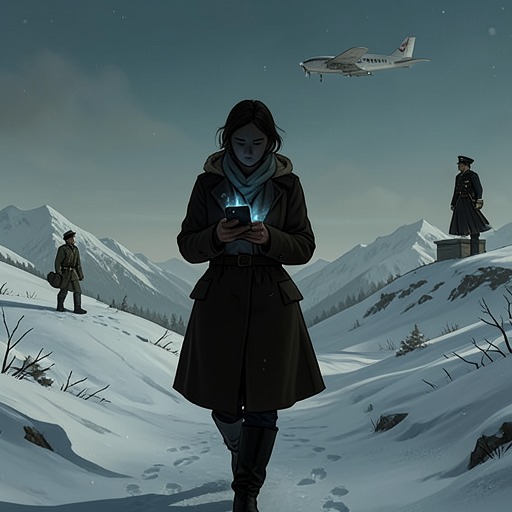
Operation NapoleonArgentina is both the planned destination of Operation Napoleon and the far-off country Kristín eventually enters while pursuing the truth about the glacier. In Robert Miller’s account, a flight across the Atlantic would carry a German aircraft, Nazi negotiators, and Jewish gold toward South America; decades later, Argentina becomes the setting for Kristín’s deliberate journey toward the island named in a surviving fragment of the operation’s documents. The country first appears as a destination chosen by others, then as a place she must reach without drawing attention.
Destination of Operation Napoleon
The plan is discussed as an operation already in motion. Asked whether the aircraft is still meant to cross the Atlantic to Argentina, Miller’s associate confirms that it is, adding that the procedure has not changed and that the operation remains on schedule. The assurance is qualified by a troubling complication: two local people have seen the plane, and, according to Ratoff, they may have seen too much. Argentina is thus not a speculative backdrop but the endpoint of a covert undertaking whose secrecy is already under pressure.
Miller later explains the purpose of the flight to Kristín. His brother piloted the aircraft from Germany to Berlin, where it was to meet Miller in Reykjavík before they travelled together across the Atlantic to Argentina. The gold packed in crates was intended to grease the wheels of negotiations and, specifically, to bribe the government in Buenos Aires. The proposed destination therefore joined a physical route to a political bargain: the cargo was not simply being moved, but used to influence a government.
The operation involved more than the gold and the two brothers. Miller describes the flight as a test of both aircraft and route, conducted while transporting the gold and some members of a Nazi negotiating committee. The two crates found at the site were only an appetiser; the parties still had to agree on a final destination in Argentina. His account identifies the Nazis as the negotiating side, while leaving the broader terms and outcome of the talks unresolved. Argentina’s importance lies partly in this gap between a clearly named destination and a plan whose full political meaning remains concealed.
The island in the document fragment
Years after the glacier events, Kristín finds a scrap bearing the words Operation Napoleon among the papers she had kept from her bloodstained overalls. It is a fragment of a document Jón found on the body of a German officer. She can decipher only scattered words and letters, so she copies what she can and asks a friend at the foreign ministry, formerly a diplomat in Germany, to translate and fill in gaps as best he can. She withholds the document’s origin and subject from him.
The translated passage proposes putting people ashore on a remote island off Argentina’s southernmost tip. It describes a small, uninhabited archipelago, abandoned after earlier periods of habitation because of its harsh climate and barren terrain, and names Borne as the final option. The fragment also refers to two other proposed locations, but the surviving text breaks off before identifying them. Kristín takes the translation home without gaining a complete explanation of the operation. She tells neither Elías nor Júlíus, and locks the paper away. Argentina is consequently both a destination in Miller’s remembered plan and a geographical clue whose most specific lead remains incomplete.
Kristín’s route into Argentina
The possibility of going to Argentina develops gradually rather than as an impulsive response. A merchant-ship captain who has become a friend tells Kristín that he once helped a young Icelandic woman escape her husband with her two children by smuggling them from Portugal to Iceland. His story gives Kristín an alternative to flying. She rejects routes through Spain or Italy because she fears surveillance cameras, passenger lists, and passport control, and takes care to avoid leaving a trail: she uses cash where possible, avoids credit and debit cards and camera-covered places, and does not use the internet at home.
The sea passage lets her arrive without following the more visible routes she considered. The ship docks at a small town on Mexico’s east coast, where she slips ashore without going through customs or immigration. She pays cash for a reliable car and drives south through Mexico, stopping at motels and visiting historical sites along the way. In Buenos Aires she rents a reasonably priced hotel room and buys a detailed road map, marking the route farther south. At this stage she believes she has reached Argentina without being followed or attracting notice.
Her journey continues by successive changes of transport. Two days after reaching Buenos Aires, she sells the car and flies to Comodoro Rivadavia, in Patagonia. She then buys a bus ticket for the further journey south, travelling by way of Caleta Olivia and the farming settlements of Fitzroy and Jaramillo. From there the route crosses the Rio Chico and continues by ferry across the Magellan Straits to San Sebastián in Puerto Harberton, a town described as lying just north of the Chilean border. These place names give the distant destination of Miller’s account a practical geography: Kristín must move across the country in stages, and each transfer brings her closer to the coast and the island mentioned in the document.
The journey’s unresolved endpoint
In San Sebastián, Kristín finds a room in a small hotel and goes to the harbour the following day. A sailor in his fifties, bearded and toothless, reminds her of an Icelandic fisherman. He indicates that the island lies a long way out; they agree on a fee and arrange to sail there early the next morning. The account establishes her intention and her passage to the harbour, but does not yet describe her arrival on Borne.
This unfinished approach echoes the document that set her in motion. The fragment names a final option without revealing the other proposed locations or explaining what the operation ultimately required; Kristín’s route brings her to the point of departure without yet disclosing what she will find offshore. Argentina thus carries two kinds of uncertainty at once: the concealed history of a wartime bargain and the immediate question of what waits at the end of Kristín’s journey. Its narrative function changes from distant destination in a secret plan to traversed territory and a threshold for her search.