Blondi grave marker
Operation NapoleonThe Blondi grave marker is a roughly half-metre stone discovered by Kristín on Borne Island, where its buried position and crude inscription turn an otherwise fruitless search into a concrete, unanswered clue. Marked with the name BLONDI and the year 1947, it gives the island’s past a material trace without explaining who or what the marker commemorates or how it came to be there.
Form and Inscription
The stone is thin, square at the bottom and rounded at the top. It lies partly buried in long grass, where its shape first makes it seem like an ordinary rock. Only when Kristín crouches and turns it over does its distinct form become apparent. The stone is heavy enough that she has to work to raise it onto its edge before letting it fall onto the other side.
Dirt obscures the carving. Kristín rubs the surface with her finger and makes out two elements: BLONDI and 1947. The inscription is crude, and the evidence offered by the object is spare: a name and a year, with no accompanying explanation of the person or history they refer to.
Discovery on Borne Island
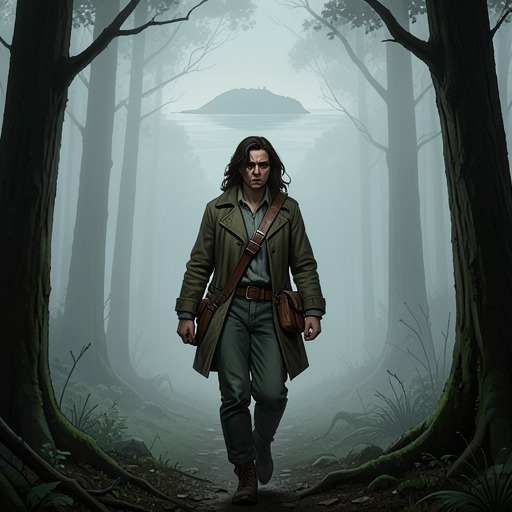
Kristín finds the marker as she retraces her steps through the island’s ruins on her way back to the waiting boat. She has already searched the remains—tumbledown wooden walls, an earth floor and a doorstep—for anything that might support her suspicions, without success. The discovery comes a short distance beyond the ruins, after she has walked to the cliff edge and felt a weight lift from her chest.
At first, she nearly walks past the stone because the fisherman is waiting to leave. She trips on it, glances down, and is about to continue before noticing its unusual shape. The marker therefore enters the search almost accidentally: not as the result of a deliberate excavation, but as something concealed in grass and exposed by a stumble, a closer look and the effort of turning it over.
Significance
The marker’s force lies in the contrast between what it makes visible and what it leaves unknown. The ruins had shown signs of earlier occupation, but yielded no clue to Kristín’s suspicions; the stone supplies a legible inscription, yet does not resolve its meaning. Its date, 1947, anchors it to a particular year, while the name BLONDI points toward a history the discovery itself does not spell out.
That incompleteness preserves the object’s mystery rather than converting it into a full explanation. Kristín reaches the marker after her search has produced no answer and after she has experienced an unexpected release of tension. The small stone does not undo that moment or settle her suspicions; it adds a new, tangible question to the island’s traces.