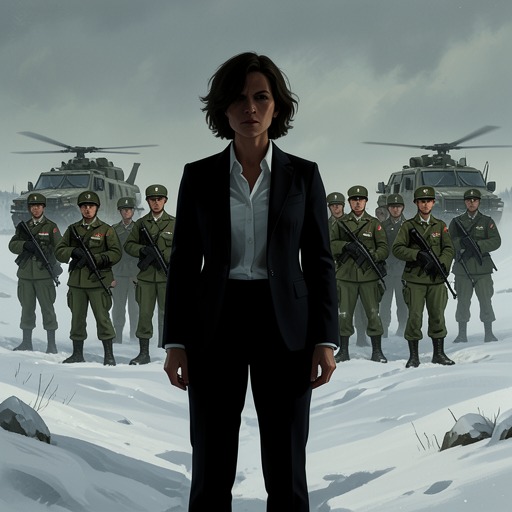
Cold War era in Iceland
Operation NapoleonThe Cold War era in Iceland is presented as both a strategic context for the American military presence and a contested justification for it. Kristín acknowledges that she can understand the base’s strategic significance during the Cold War without accepting its presence; elsewhere, Miller invokes the Cold War as part of a larger history whose consequences he wonders might have been avoided.
Strategic Context and Political Opposition
Kristín’s opposition is political as well as personal. She says she understands why the American army might have mattered strategically during the Cold War, but regards its presence on Midnesheidi as a blot on the landscape. Her objection extends beyond the visible military installation: she argues that Iceland should not have an army or become entangled with one, and condemns people—particularly businessmen—who have prostituted themselves to the Defense Force. The language turns a question of military strategy into one of national sovereignty and social compromise.
That position also shapes her unease about Steve. She admits that she should not have allowed their relationship to go so far, then struggles to find the words to explain herself. Steve reduces her stance to opposition to the army, but Kristín insists that the issue is not simply abstract or historical. As they race through the darkness at 120 kilometres an hour, she tells him that the base may close because its activities have been scaled down, yet she fears the American presence will endure for a thousand years, even for eternity. Steve answers that he is not the American army on Midnesheidi, exposing the painful gap between her political opposition and their personal connection.
A History Larger Than Iceland
The Cold War returns in Miller’s account of Operation Unthinkable. He acknowledges that the operation’s name is old news, then argues that its significance lies in the historical questions it opens: the division of Europe, the Cold War, the nuclear threat, and the Vietnam War. Rather than treating those events as an inevitable sequence, he asks whether they could have been avoided. He points to Japan’s transformation into an economic superpower after its defeat and wonders whether Russia might have undergone a comparable transformation.
Significance
These two conversations give the Cold War era in Iceland contrasting scales. For Kristín, it is the strategic rationale invoked for a military presence she experiences as an intrusion into Iceland’s landscape and political independence. For Miller, it is part of a wider chain of historical outcomes that might not have been inevitable. The contrast keeps strategic explanations from settling the question: acknowledging why a base mattered does not resolve whether its presence was acceptable, just as naming the Cold War does not answer whether the history it shaped could have unfolded differently.