Elías
Operation NapoleonElías is Kristín’s younger brother and a young member of Iceland’s rescue team. A routine winter exercise on Vatnajökull turns him into an accidental witness to a secret military operation, and his mobile phone becomes both the means by which he reaches his sister and a vital clue in the search for him after he disappears on the glacier.
Identity and Entry into the Story
Near Akureyri, Elías tells Kristín that his team is travelling to Vatnajökull for a winter exercise. She is startled by the idea of going onto the glacier in the middle of winter, but he explains that they expect to reach it the following day and plans to call again. His concern that the phone connection is clear gives their conversation an ordinary, intimate quality before the journey takes a more dangerous turn: he is checking in with his sister while setting out with the rescue team.
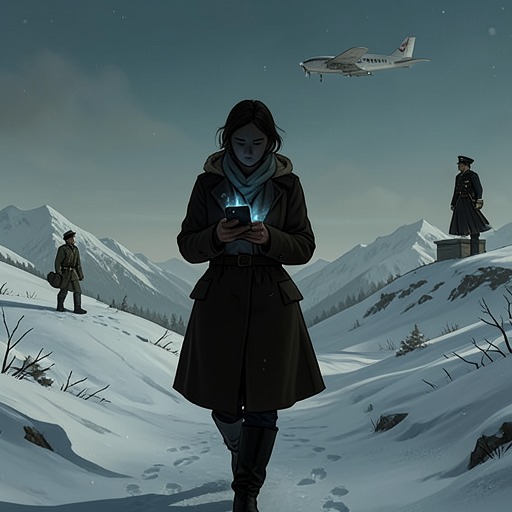
On the glacier, Elías and Jóhann separate from the larger party on snowmobiles and head towards the wreck of a German aircraft. Their route brings them into the area where Ratoff’s soldiers are working. The soldiers detect the snowmobiles on a small radar screen and intercept the two young men before the main rescue party, about forty-five miles away, can reach them. Elías has his phone with him; Jóhann has no phone or other transmitter. Both are escorted to Ratoff’s tent under armed guard, having seen the aircraft, the swastika beneath its cockpit, and the soldiers digging it out of the ice. Their presence threatens the secrecy of the operation, though the two rescuers cannot understand the full significance of what they have seen.
Interrogation and the Crevasse
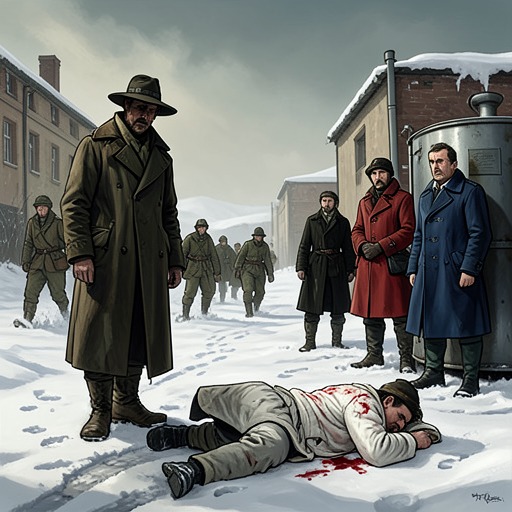
Ratoff tried to make Elías answer questions by threatening Jóhann, then drove the threat into action: with a small metal awl, he struck Jóhann in the right eye. Jóhann shrieked and collapsed on the ice, while Elías, shocked, tried to reach him. Ratoff seized Elías by the hair and forced him upright, keeping him from tending to his friend. The assault made Elías a witness not only to the aircraft and the armed operation, but also to the violence used to keep them secret.
About thirty-five miles away, eight members of the Reykjavík Rescue Team followed the two snowmobiles’ tracks west toward a broad belt of crevasses. Back at their camp, they pinpointed the signal from Elías’s phone; when they reached a jagged fissure, its faint ringing came from below. A rescuer descended roughly eight metres and found Elías and Jóhann badly injured after falling against the ice walls, with the snowmobiles landing on top of them. The team hauled up the machines, lowered stretchers for the two men, and carefully brought them to a snow-cat. The phone that had carried Elías’s calls to Kristín now helped his rescuers locate him.
Hospital, Recovery, and Testimony
Carr eventually told Kristín that Elías was alive and had been admitted to a Reykjavík hospital. When she reached his bedside, a nurse gave her a mask, paper robe, and blue plastic shoe-covers before leading her down a brightly lit corridor into a dark room. Elías lay motionless beneath the covers, connected to tubes and machines, his face obscured by an oxygen mask and a bandage covering one eye. Kristín recognized him and called his name, first quietly and then louder, but he did not respond. His survival was certain; his recovery was not yet visible.
Júlíus, released the previous day, came straight to the hospital. Kristín embraced him fiercely, and he told her that Elías was expected to make it: the doctors had managed to save the damaged eye and preserve his sight. The news gave the injury a more hopeful consequence than the initial scene in which Ratoff attacked Jóhann with an awl. Elías’s recovery remained slow but steady. He eventually regained consciousness and was able to tell Kristín about his encounter with Ratoff, turning him from a gravely injured victim into a witness who could describe what had happened on the glacier.
Kristín later told Elías that Jóhann had died. To her surprise, Jóhann’s parents had initially accepted the account that the two men had fallen into a crevasse. Kristín and Elías debated whether to tell them the truth, then decided that they should. Once Elías was stronger, they and Júlíus met Jóhann’s parents at the hospital and explained the circumstances of their son’s death and the eventual fate of his murderer. They withheld the German aircraft from their account: although Elías had witnessed the incident, Kristín believed the army would deny violence and that no one in its ranks would corroborate them.
Jóhann’s parents pursued the matter, calling on Elías, Kristín, and Júlíus as witnesses and submitting charges to the public prosecutor’s office. Their investigation produced no prosecution. Army spokesmen professed astonishment at the accusation that a killer was serving in their ranks and denied knowing either that Delta Force operators were in the country or that a C-17 transport plane was there. The proceedings dragged on and briefly returned the case to the media, but the renewed attention also faded. Elías’s testimony could restore the truth within the family and among those who had been present; it could not, against official denial and the absence of military witnesses, compel public accountability.
The Limits of Witness
Elías’s experience exposes the difference between knowing what happened and being able to establish it publicly. The initial explanation—that he and Jóhann had fallen into a crevasse—could account for their injuries while concealing the violence that preceded the fall. Elías’s later account gave Kristín and Jóhann’s parents grounds to challenge that version, but it could not supply the corroboration withheld by the soldiers who had witnessed the assault. The army’s denial of Delta Force’s presence and of a C-17 transport plane further separated the rescuers’ testimony from an official record capable of supporting prosecution.
His role therefore extends beyond survival: Elías becomes a witness whose knowledge can be shared with those closest to the dead, even as its public force is contained by military secrecy and institutional denial. The aircraft remains outside the account given to Jóhann’s parents, not because Elías had failed to see it, but because Kristín judged that naming it would not make the army acknowledge what it had done. His return to consciousness restores a truthful account within the family’s circle; it does not resolve the conflict between that knowledge and the version authorities are willing to recognize.