Emergency Talks Between U.S. and Icelandic Officials
Operation NapoleonThe Emergency Talks Between U.S. and Icelandic Officials turn a secret military recovery into a test of Icelandic sovereignty. Convened to secure cooperation for an operation already being organized on the Vatnajökull Glacier, the meetings reveal how American explanations shift from a routine recovery to a politically embarrassing wartime secret and, later, an urgent warning about a bomb. The Icelandic ministers’ repeated demand for fuller disclosure exposes the central imbalance: the United States controls the operation’s information and forces, but cannot make Icelandic consent irrelevant without provoking a crisis.
Concealed Operation and the First Meeting
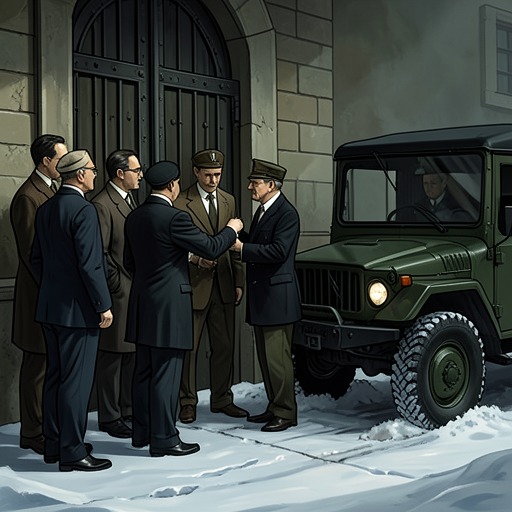
The first meeting took place in a central Reykjavík hotel suite on Friday, 29 January, at 2100 GMT. At the request of the U.S. military authorities, Iceland’s prime minister and foreign minister met the admiral from Keflavík Air Base and Immanuel Wesson, temporarily acting as U.S. ambassador during the regular incumbent’s abrupt absence. The ministers had been summoned at short notice and given no reason. As they travelled into the city, they considered several possibilities, including an unexpected presidential visit, recalling the little warning they had received before the 1986 Reykjavík summit between Reagan and Gorbachev.
Once formalities were over, the prime minister asked for an account of what was happening. The admiral apologized for the haste but insisted that nothing said in the room leave it. Wesson described the defence treaty as authorizing U.S. monitoring of military activity within and around Iceland, using submarines, reconnaissance aircraft, and satellites. He said that the United States had recently watched a section of Vatnajökull Glacier closely, first through surveillance flights and later through satellite imagery.
The explanation placed the aircraft’s loss in the closing stages of World War II. According to Wesson, an American plane had crashed on the glacier; bad weather delayed the search, and when a Defense Force party from Reykjavík finally reached the area, the aircraft had disappeared beneath the ice. New military-intelligence satellite images had now shown it again. The Americans planned to excavate the wreck, move it and substantial quantities of equipment and personnel across Icelandic territory to the base, and eventually repatriate it to the United States. The foreign minister immediately identified the issue the account sidestepped: such an operation required the Icelandic Government’s permission.
Disputed Explanations and Sovereignty
The ministers were not satisfied with being told that the aircraft was old and its recovery necessary. They asked why the matter was secret, what made the plane sensitive, and whether it had even crashed during the war. The Americans declined to identify what was special about it. Wesson described the issue as sensitive and said he hoped to give a fuller explanation later; the general then abruptly insisted that the matter was not Iceland’s concern. The exchange transformed a request for cooperation into a dispute about whether the United States had already acted without it.
The prime minister pointed out that the Americans had not requested permission but had announced what they intended to do. If an operation had already begun, he warned, it could amount to a serious breach of the defence treaty and would be damaging if exposed in the Icelandic media. He also rejected the suggestion that Iceland should simply accommodate U.S. interests: the ministers needed an account adequate to their own responsibilities. The admiral tried to restore a conciliatory tone, praising Iceland’s contribution to Western security while arguing that the matter should be handled without outside involvement and then forgotten. The foreign minister countered that the story was implausible and that Iceland could not verify the aircraft’s age or even its existence from the information provided.
When the prime minister stood to end the meeting, the Americans abandoned the aircraft explanation as sufficient cover and invoked the Manhattan Project. They said that public knowledge of the plane and its mission would revive controversy about German scientists working in America and could damage relations between the United States and Europe. The ministers remained unconvinced that they had been given all the facts. That disclosure established the political stakes more clearly, but did not answer the Icelanders’ basic questions or secure their cooperation.
The gap between what the U.S. government knew and what it told Iceland is sharpened by the wider operation. In a separate briefing, Carr had traced the Walchensee gold to Hitler’s orders to move the Reich’s remaining reserve out of Berlin, and disclosed that much of it had been taken from concentration-camp victims. That information was not part of the account given to the Icelandic ministers. The meeting therefore stages not a full exchange of intelligence but a controlled revelation: the Americans disclose enough to argue that secrecy is necessary while withholding the operation’s most consequential particulars.
The Rescue Team and the Bomb
In a later confrontation, Icelandic officials raised a new grievance: a mayday from the glacier had reportedly requested Defense Force helicopter assistance, but no response had followed. The admiral said he knew of no such incident and would have the allegation investigated. Wesson then stated the U.S. position bluntly: the Icelandic rescue team had to leave the glacier. The demand shifted the argument from keeping the recovery secret to controlling who could remain near it.
The prime minister rejected the demand and threatened a formal protest, public investigations in Iceland and the United States into an accident involving two members of the rescue team, closure of roads between the glacier and the base, and disclosure to the media. He also said he would address the nation. Wesson answered by revealing that a German bomb was on the glacier. It was old, potentially explosive, and being removed in a delicate operation by specialists; the rescue team, he said, was in danger. The warning recast the withdrawal as a matter of safety, but came only after the Icelanders had threatened to expose the affair.
The bomb claim sits uneasily beside a separate assurance given to a transport pilot. Asked whether the aircraft contained a bomb and whether the crew could inspect it before transport, the pilot was told that the German plane was safe, that no bomb had been found, and that reports of a Nazi bomb were news to the speaker. The contrast leaves the operation’s explanations unstable: Icelandic officials hear that an old German bomb makes the rescue team’s presence dangerous, while a pilot is assured there is no bomb in the plane.
Political Stakes and Significance
The talks unfold against a practical dependence that the Americans use as leverage. Wesson reminds the prime minister that a sizeable share of Iceland’s national income derives directly or indirectly from the United States. The prime minister’s response is to insist on public accountability rather than accept economic pressure as a substitute for disclosure. His threatened road closures would obstruct movement between the glacier and the base; a public investigation would challenge the American account on both sides of the Atlantic.
The sequence also exposes divisions within the U.S. operation. Before the first meeting, Carr had been instructed to send two special-forces squadrons to Iceland, describe the mission as a routine exercise, and direct uncooperative Icelanders to the defense secretary. He was to arrange an explanation to the Icelandic Government, while Immanuel Wesson served as spokesman. Carr himself grew concerned about Ratoff’s over-zealousness, even though he believed Ratoff could deliver results. Elsewhere, the plan included transporting the dismantled aircraft and bodies to Keflavík and bringing back any documents Ratoff found, despite the risk that he would read them. The meeting’s polished diplomatic explanations thus conceal an operation whose own command structure accepts that important information may escape its control.
The emergency talks do not resolve the conflict. Instead, they show Icelandic officials pressing the Americans to recognize treaty limits and answer for actions on Icelandic territory, while the U.S. side alternates between reassurance, refusal, strategic disclosure, and warnings of immediate danger. The wreck’s reappearance from beneath the glacier is the operation’s physical trigger; the meeting makes its political meaning visible. A recovered aircraft is not merely an object to be moved, but a secret whose transport implicates Iceland in a history the Americans are determined to manage.