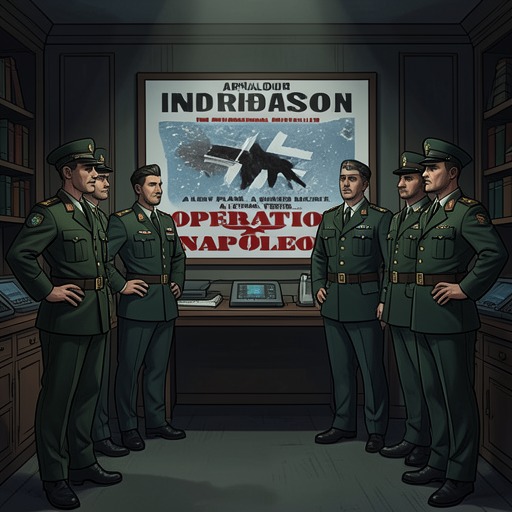
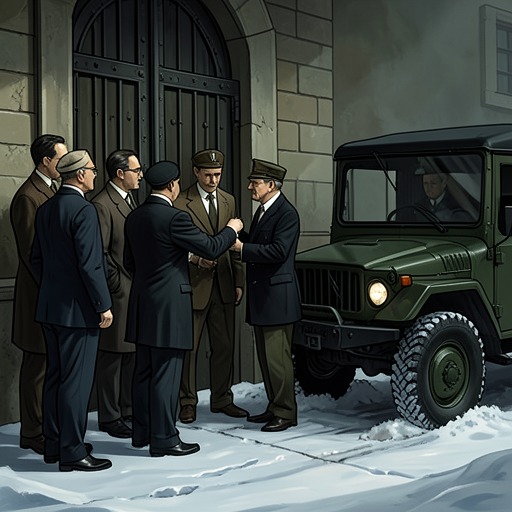
Emergency secret meeting between the Icelandic government and U.S. officials
Operation NapoleonThe emergency secret meeting between the Icelandic government and U.S. officials was an attempt to secure Icelandic cooperation for a covert military recovery operation without revealing its full significance. Convened in Reykjavík on Friday 29 January at 2100 GMT, it exposed the imbalance at the heart of the affair: the United States wanted to move personnel and equipment across Icelandic territory, while Iceland’s ministers were expected to accept an explanation they could not independently assess.
Setting and political stakes
The meeting took place in a city-centre hotel suite after the Icelandic prime minister and foreign minister were summoned with little warning. The abrupt call and lack of information led them to consider whether an unexpected presidential visit was imminent, recalling the short notice before the 1986 summit in Reykjavík. Instead, they found the admiral from Keflavík Air Base and Immanuel Wesson, temporarily acting as U.S. ambassador during the regular ambassador’s sudden absence. The ministers knew the admiral casually from official receptions; Wesson, whose appointment and purpose were unexplained, was a less familiar presence.
The formality of the meeting contrasted with its rushed arrangement. The admiral apologized for the short notice and insisted that nothing discussed leave the room. That demand for secrecy was not merely procedural. The Americans needed Iceland to permit a sizeable operation on its soil, yet their approach began by limiting what Iceland’s government could know about it.
This tension had a long political history. The U.S. military presence had been contentious since the end of the war, and the 1949 defence treaty had prompted a riot outside the Icelandic parliament. Icelandic policy also held that the country should not profit from NATO’s presence, even as contractors and nearby communities became economically connected to the base. The ministers therefore faced more than a logistical request: allowing a concealed military movement risked intensifying domestic distrust of the U.S. presence and raising questions about Iceland’s authority over activity within its borders.
The initial account of the wreck
Wesson described U.S. monitoring of Iceland’s borders under the defence treaty, including surveillance of a section of Vatnajökull Glacier. He said that a U.S. aircraft had crashed there in the closing stages of the war. Bad weather had prevented a timely search; by the time a Defense Force party from Reykjavík reached the glacier, the aircraft had vanished beneath the ice. The Americans now claimed that military satellite imagery had shown the wreck again, a discovery confirmed by subsequent images.
On that account, the proposed expedition would excavate the aircraft, move it to the base, and eventually repatriate it to the United States. It would require substantial military personnel and equipment to cross Icelandic territory. The foreign minister immediately identified the political question implicit in the briefing: the United States needed the Icelandic government’s permission. The admiral replied that the Americans did not wish to act against Iceland’s will, while Wesson promised inconspicuous travel and described the mission as a scientific expedition accompanied by senior scientists.
The explanation was designed to make a military deployment sound limited and manageable: a historical wreck, a recovery effort, and scientific personnel. But the ministers knew that military manoeuvres were unpopular in Iceland, and the claim that secrecy was necessary sat uneasily beside the request for their full cooperation. When the foreign minister asked why the recovery could not simply be announced, Wesson called the matter sensitive but offered no fuller explanation. The prime minister warned that cooperation depended on candour.
A deeper explanation, and an incomplete disclosure
When the prime minister stood to end the meeting after the admiral refused to explain what made the aircraft special, Wesson introduced a second account. He connected the wreck to the Manhattan Project and to the postwar recruitment of German scientists who had taken part in Nazi nuclear research. According to his briefing, the aircraft had left Hamburg carrying four such scientists, stopped to refuel in Scotland, and was due to land in Reykjavík on its way to New York before a storm damaged it and brought it down on the glacier. The Americans believed everyone aboard had died.
Wesson argued that public knowledge of the plane and its mission could revive controversy over German scientists employed in America after the war, including allegations that some had participated in experiments on concentration-camp prisoners. He presented the risk to U.S.–European relations as the reason for keeping the recovery clandestine and asked the ministers to cooperate. Even after this disclosure, the prime minister said that much remained to be explained. The meeting therefore produced a more elaborate justification, not a demonstrated agreement or a resolution of Iceland’s concerns.
The briefing was also incomplete in light of what the U.S. operation’s other participants knew. In a separate conversation, Carr raised the Walchensee gold with the U.S. defense secretary and explained that the gold had been acquired in large part from concentration camps. The Icelandic ministers were not given that information at the meeting. The gap between the diplomatic account and the discussion inside the U.S. command underscores how secrecy worked: different audiences received different versions of what the aircraft represented.
The dispute after the meeting
The meeting’s unresolved questions became more urgent as the operation continued. In a later exchange with Icelandic officials, the foreign minister challenged the Americans over an alleged failure to answer a mayday call from the glacier requesting Defense Force helicopters. The admiral denied knowing that this had happened and said he would investigate. Wesson then bluntly demanded that the Icelandic rescue team be removed from the glacier. When the prime minister threatened a formal protest, public investigations, road closures, and a national address, Wesson invoked a German bomb on the glacier and warned of danger to the rescue team. He described its removal as delicate and said the team should be called home.
That warning sat against another reassurance given within the operation: a pilot asking to inspect the aircraft was told that there was no bomb in the plane, that the wreck was safe, and that the speaker had heard nothing of a Nazi bomb. The differing claims do not establish what danger existed at the glacier, but they show how the bomb became part of the Americans’ effort to control access and movement. The diplomatic meeting had begun with an appeal to treaty monitoring, scientific purpose, and historical embarrassment; later, the demand for Icelandic compliance was reinforced with an immediate threat of catastrophe.
Significance
The meeting turns the recovery operation into a contest over both sovereignty and information. Iceland’s ministers were not simply asked to approve a search: they were asked to accept a secret military movement while the U.S. side successively framed the aircraft as a lost historical wreck, a source of embarrassment over German scientists, and, in later dealings, part of a dangerous bomb-removal operation. Each account sought to make extraordinary measures appear necessary, but none dispelled the ministers’ suspicion that essential facts were being withheld.
Its dramatic force lies in the difference between the room’s formal language and the practical pressure behind it. Requests for discretion and cooperation gave way to demands, allegations, and warnings, while the Icelandic prime minister answered with the possibility of protests, investigations, and public disclosure. The meeting did not settle the dispute; it established the pattern that would define it, with Iceland pressing for an explanation and the United States treating control of the explanation as part of the operation itself.