German Hydrogen Bomb
Operation NapoleonThe German Hydrogen Bomb is the most dangerous explanation offered for the mystery of the German aircraft on Vatnajökull: U.S. officials identify it as a live, primitive weapon, supposedly brought by German scientists and lost in a wartime crash. They call it their first “broken arrow,” a term for a nuclear weapon lost in an accident. Yet the bomb is never confirmed by an inspection in the evidence presented. Its power in the story comes both from the catastrophe officials say it could cause and from the way competing accounts make its existence impossible to take at face value.
Rumours and competing explanations
Before officials disclose the weapon to Iceland’s prime minister, the bomb circulates as a rumour. Kristín tells Steve that someone claimed the aircraft carried a Nazi bomb intercepted before the Russians could take it, which the Americans were now trying to recover and transport to the United States. The report supplies a possible reason for the military’s determination, but Kristín cannot identify the kind of bomb, and Steve’s questions receive no answer. At this stage the weapon is hearsay, one explanation among the possibilities surrounding the plane.
When Kristín and Steve discuss the rumour with Jón, Steve repeats that the Americans were transporting a Nazi bomb to the States. He then states that it was a hydrogen bomb the Germans had planned to drop on London or Russia at the end of the war, while admitting that its intended target is uncertain. Jón does not understand German, and the conversation does not establish that he has seen evidence of the weapon. Instead, the account adds a more specific and more alarming version to the rumour without resolving its source.
The bomb story also competes with a separate explanation of the aircraft’s cargo. In a conversation about the Walchensee gold, Vytautas Carr tells the secretary that much of the gold was acquired from concentration camps. The secretary grasps the implication: the plane may contain plundered Jewish gold. This exchange does not disprove a bomb, but it makes clear that the cargo question has more than one politically explosive answer. The plane’s secrecy may concern the gold’s origin, a weapon, or both; the claims are not reconciled in these scenes.
The official disclosure
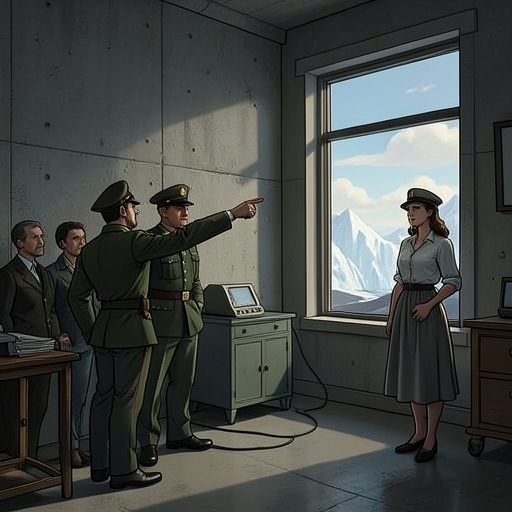
At an emergency meeting with Icelandic ministers, the American admiral insists that nothing discussed should leave the room. He explains that the defence treaty allows the United States to monitor activity within and around Iceland’s borders for military purposes, and that the Americans have been watching part of Vatnajökull. Against this background of surveillance and secrecy, the general tells the prime minister that there is a bomb on the glacier and urges him to call the Icelandic rescue team home.
The general describes it as old and German, says that American experts are trying to remove it in a delicate operation, and argues that the rescuers are in danger. When pressed about its identity, he claims that German scientists brought it and that it is a primitive hydrogen bomb. The admiral then supplies the military designation: a “broken arrow,” meaning a nuclear weapon lost through an aircraft crash or another accident. He says there are a small number of such weapons scattered around the world and that the military goes to considerable lengths to control information about them. Immanuel Wesson reinforces the urgency by declaring that this one is still live and extremely dangerous.
The disclosure changes the meeting’s stakes. The prime minister has just threatened a formal protest, public investigations in Iceland and America, road closures between the glacier and the base, and a public address. The general’s warning arrives as the ministers prepare to leave, recasting the rescue operation as a possible nuclear emergency and asking Iceland’s government to stop its team for its own protection. The bomb therefore becomes not only a reported physical threat but also a demand for immediate cooperation under conditions of strict secrecy.
Secrecy, denial, and unresolved status
The bomb’s supposed danger is paired with an effort to restrict who can learn about the aircraft. At the base, pilots ask whether there is a bomb and whether they can see inside the plane, explaining that regulations require them to verify what they will transport. Ratoff tells them there is no bomb, describes the German aircraft as a safe World War II machine, and says the bomb rumour is new to him. The pilot accepts the answer uncertainly; another asks why the crew must remain in the tent if the aircraft is harmless. Ratoff’s assurance conflicts directly with the senior officials’ disclosure to the Icelandic government, and the pilots are not allowed to resolve the contradiction by looking inside.
That denial leaves the bomb’s status unsettled rather than proving it absent. The general and admiral present it as a live nuclear weapon, while Ratoff offers a categorical reassurance to personnel whose duties would ordinarily require inspection. The secrecy surrounding the aircraft thus shapes what each audience is told: Icelandic ministers hear a warning intended to bring the rescuers home, while pilots hear that the plane is safe and that there is nothing to inspect. The text does not establish which account is true.
Narrative significance
The German Hydrogen Bomb concentrates the story’s central conflict between danger and control of information. If the officials’ account is true, the glacier contains an immediate threat that could justify extraordinary precautions; if it is false, the same claim can serve as a powerful means of directing Icelandic authorities and rescuers. The bomb is never reduced to a confirmed object examined on the page. Instead, it appears through successive reports, official language, and denial, each changing the pressure on those who hear it.
Calling the weapon a “broken arrow” gives the secret operation an institutional vocabulary, while the designation’s plain definition—nuclear weapons lost in accidents—makes the claimed loss sound both exceptional and administratively familiar. The glacier, the crash, and the closed rooms of the emergency meeting become linked by a threat that is said to be physically present but kept beyond verification. Whether the aircraft contains the bomb remains unresolved, and that uncertainty is itself consequential: it sustains the operation’s secrecy while making both the military’s intervention and Iceland’s response turn on an account no one in these scenes is permitted to test.