German Transport Aircraft Wreck (Junkers Ju 52)
Operation NapoleonThe German Transport Aircraft Wreck (Junkers Ju 52) is a World War II German transport plane that crashed on Vatnajökull Glacier and remained entombed in its moving ice for decades. Its recovery exposes a troubling mixture of German and American uniforms among the dead, making the aircraft more than a lost machine: it is a physical archive whose contents challenge what its searchers have been told to expect.
Identity and physical form
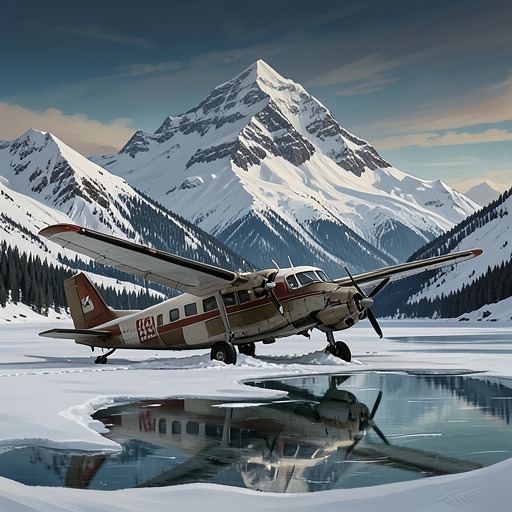
The plane is identified as a Junkers Ju 52, Germany’s principal transport aircraft, powered by three BMW engines, including one mounted on the nose. Allied troops knew the type as Iron Annie or Auntie Ju. When Ratoff first sees it emerging from the glacier, the comparatively intact nose projects from the ice, with the propeller still attached and its blades mangled by impact. A black swastika is faintly visible beneath flaking camouflage paint; two of the seven side windows have surfaced, while the tail remains buried and the wings appear to have been torn away. The aircraft’s outline is therefore incomplete but unmistakable, its military markings reappearing with it.
The wreck’s condition records the violence of the crash. The plane skimmed the glacier, one engine caught fire, and the wings sheared off in succession. Its wingless fuselage then careened across the ice before losing momentum and stopping. Two panicked passengers had left their seats and tried to force their way into the cockpit; during the impact they were thrown against the cabin walls and ceiling, and their cries stopped. The crash left other passengers able to move about, according to Ratoff’s later interpretation of how some bodies were placed. The aircraft thus preserves not a single instant of impact alone, but traces of what happened inside and around the fuselage afterward.
First search and the glacier’s concealment
Colonel Miller led an early search from the brothers’ farm. Soldiers camped at the glacier’s edge, about 1,100 metres above sea level, and spent three weeks searching the surrounding slopes and five square kilometres of the ice cap. The brothers, more experienced on glaciers than most of the troops, guided them around crevasses and gullies. Short winter daylight limited the work; severe weather eventually forced Miller to abandon the expedition, and a second storm buried tents and equipment that were never recovered.
The search produced no aircraft wreckage beyond the rim of the nose wheel, which Colonel Miller immediately took charge of. The brothers found it about two kilometres onto the ice cap. Around it, the surface appeared smooth, with no visible sign of a crash or forced landing. They reasoned that snow might already have drifted over a wreck on that part of the ice. The fragment did not locate the plane, but it gave the searchers a material clue—and the glacier’s blank surface suggested how thoroughly it could hide one.
Years later, Carr takes the wheel from storage and rereads its inscription, Kruppstahl. Its material and specifications correspond to the aircraft’s type, size, year of manufacture, and capacity. For Carr, the wheel confirms that the plane is on the glacier. The clue’s return anticipates the wreck’s own: evidence that seemed too small to resolve the mystery becomes newly legible once the ice begins giving up what it had concealed.
Rediscovery and military recovery
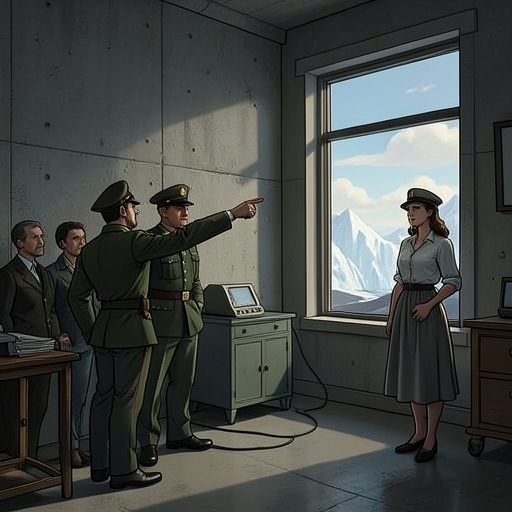
Carr presents satellite images of the south-eastern section of Vatnajökull to the secretary, identifying an aircraft believed to have crashed there near the end of World War II. He explains that an expedition set out from Reykjavík headquarters only days after the crash, in midwinter conditions when visibility was close to zero. The plane was buried, then swallowed by the glacier. Because Vatnajökull is a shifting mass of ice, objects lost within it can resurface decades later; the newly visible aircraft is evidence of that movement as well as an explanation for the failed search.
During the recovery, Delta Force operators dig from both sides of the wreck. The nose rises at an angle of about twenty degrees, but dense, hard-packed ice still holds the tail, and the entrance remains buried. The fuselage appears largely intact, with little snow inside. Floodlights, tents, oil-powered generators, snowmobiles, tracked vehicles, and transport pallets turn the remote ice into a temporary work site. Men break up the surface with pickaxes and cut the aircraft with oxyacetylene blowtorches, intending to load the sections onto pallets and haul them toward Keflavík Airport. The coming storm makes speed important, while winter darkness and the area’s lack of traffic help conceal the operation.
Ratoff’s plan is to remove the aircraft, its wreckage, bodies, and other contents, then fly them from Keflavík to a facility at Roswell aboard a C-17 transport plane. There, he says, the Nazi plane will disappear permanently. The proposed removal makes the recovery an attempt not simply to retrieve a historical object but to control where it can be seen and what can be learned from it.
The bodies inside the wreck
The recovery reveals human remains in stages. First, a leg in a black army boot protrudes from the ice beside the fuselage. The body is that of a high-ranking German officer, dressed in uniform, with an Iron Cross at his neck and his hands crossed over his chest. One leg is missing above the hip. Ratoff orders the body freed and taken into a tent; he judges that passengers who survived the impact would have been exposed to extreme cold and likely frozen to death within days.
After the front of the plane bends and the fuselage breaks in half under its own weight, Ratoff enters the cabin. He finds two more bodies together: one in a German army officer’s uniform and one in the uniform of a two-star American general. The American has an aluminium briefcase with heavy locks handcuffed to his wrist. The ice has preserved the corpses, whose skin is bluish white and shows no visible decomposition. Their close arrangement, and the apparent differences in their injuries, offer clues about death and post-crash handling, but do not resolve the larger mystery.
Ratoff searches the buried tail section and finds three further bodies huddled together. One wears a World War II American fighter pilot’s leather jacket, with an American flag on its sleeve and a name embroidered on the chest. Two bodies have crudely made splints on their legs. With the body found outside, the wreck contains six corpses, although Ratoff’s briefing had led him to expect seven. The American pilot, the general, and the German officers make the plane’s apparent nationality an inadequate guide to its occupants or mission.
A sealed historical record
The wreck’s recovered contents turn a supposed German transport crash into a question about who was travelling together and why. Ratoff cannot reconcile an American fighter pilot and an American general with German officers aboard a Nazi plane painted in American camouflage. The locked briefcase intensifies the sense that the aircraft carried consequential material, but its contents are not established by these discoveries alone.
The plane’s changing visibility gives the story its central image of history as something neither fully lost nor freely available. The nose wheel survives as a detached clue; later, the ice releases the much larger fuselage, its markings, and its preserved dead. Yet physical recovery does not mean open disclosure: Carr’s plan sends the aircraft to a place where its existence can be concealed, while Kristín and Steve later glimpse another body beneath a grey bag in the camp. The wreck therefore stands at the intersection of discovery and suppression. The glacier returns evidence, but the military operation seeks to remove the evidence from public view.