Historical truth and the manipulation of history
Operation NapoleonHistorical truth and the manipulation of history names the novel’s central conflict over the past: not simply what happened, but who possesses the evidence, who is allowed to interpret it, and which account can reach the public. The mystery of the German aircraft on Vatnajökull becomes a contest between fragmentary testimony and institutional power, with the military trying to control not only the wreck but the history that might be made from it.
Knowledge, Rumor, and the Archive
The story first makes knowledge provisional. At the base, a serviceman recalls recurring rumors about what the military was seeking and monthly flights over the south-eastern part of Vatnajökull to photograph the ice. Leo Stiller organized those flights. The speaker never personally saw anything, and the supposed sightings remained uncertain: sometimes they were taken as grounds for a closer inspection, but no one could say with confidence what the searches were meant to find. This is not direct evidence of the plane’s cargo or purpose; it is testimony about a surveillance practice surrounded by speculation.
Sarah Steinkamp’s account seems to sharpen the rumor but does not make the mystery simple. She says Leo knew about the plane and told her it belonged to the Nazis; she also says that he died afterward. Her confidence rests on what her husband told her, not on documents she has seen. The distinction matters: the story’s past reaches the present through people with different access to information, different losses, and different reasons for having remained silent.
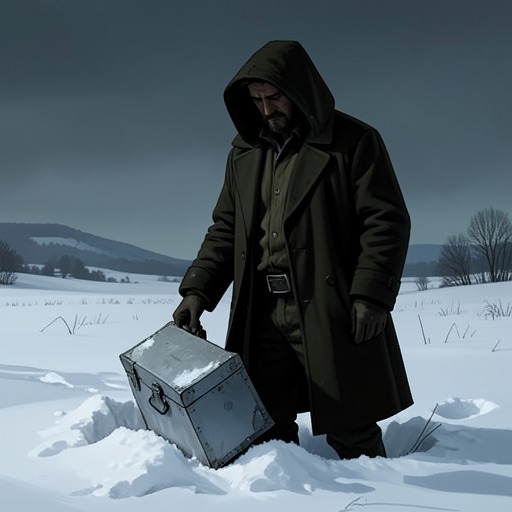
The physical archive is no more complete. Jón produces a small, scratched and dented metal case, its lock apparently tampered with and its surface rusted through in places. Inside are German typewritten papers, ruined by years of alternating heat and cold; the sheets break apart when handled, and most letters are blurred or illegible. Yet one surviving phrase can still be read: Operation Napoleon. The documents are evidence that a named operation existed in some form, but their damage prevents them from supplying an easy, self-sufficient account. Their material fragility mirrors the uncertainty of the testimonies around them.
Secrecy and Unequal Access
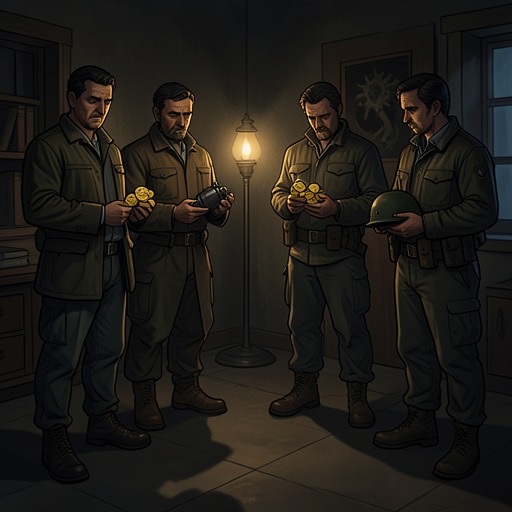
The history behind the papers is distributed unevenly. Miller explains that only a tightly controlled number of people in the army knew about Operation Napoleon. Even he, despite having been assigned to a task connected with it, says he never knew precisely what the operation involved or what the documents contained. He describes himself and his brother as pawns sent to solve a specific problem, and says that what he knew of the contents came through hearsay. His account therefore reveals both the existence of an institutional secret and the limits imposed on those who served it.
Miller’s explanation also places the project within a contested wartime setting. He believes that a handful of American generals based in Europe conceived and planned it, but does not know who initiated the idea. He recalls discussions, as Germany’s defeat became apparent, about the division of Europe between Allied- and Russian-occupied territories and about whether the Western powers should turn against the Soviet Red Army. He presents these larger discussions as context, not as proof that every proposed plan was carried out. The distinction between a plan, a negotiation, and an executed operation becomes essential: the papers can refer to an idea without demonstrating that it became reality.
Jón’s long silence adds another form of controlled knowledge. He has kept a promise made with his brother to Miller and has told no one what he knew, maintaining that silence even after his brother Karl died. Kristín’s accusation that he had helped the Americans forces that private pact into the open, and he responds by identifying Ratoff as the expedition leader. The scene shows how secrecy can persist not only through official orders but through personal promises—and how the costs of silence change when new lives are at risk.
Official Stories and Public Misinformation
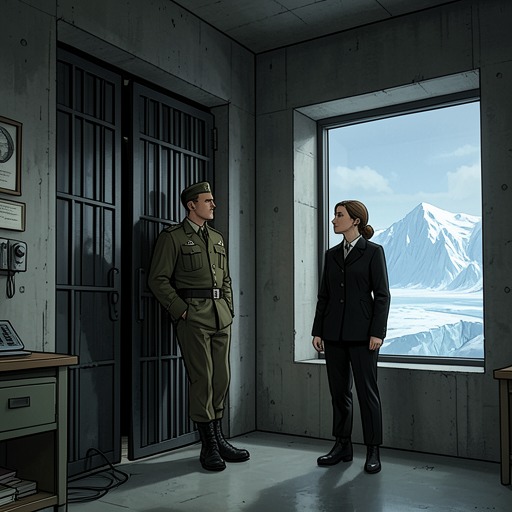
Carr makes the political use of historical uncertainty explicit. He argues that the operation was never carried out, calls it one among many ideas devised during the war’s final days, and proposes that the whole affair could be denied as a mixture of rumor and conspiracy theory. Yet he also warns that the papers name an island and imagines a live broadcast from it. His response indicates that the documents have potential public force: their importance lies not only in what they prove, but in what their disclosure might enable others to see or claim.
After the confrontation, Carr tells Kristín that misinformation about the mission has already begun to circulate. He promises that she will eventually be sent back to Iceland and may speak to authorities, the press, and her family, while predicting that few will believe her. The assurance of future freedom is thus paired with a strategy designed to make speech ineffective. The issue is not merely suppressing a witness; it is shaping the conditions under which testimony will be judged credible.
The ensuing public accounts demonstrate that strategy in practice. After American forces fire on the Icelandic rescue team, the Army apologizes for soldiers who supposedly overreacted during conventional winter exercises involving Dutch and Belgian North Atlantic Treaty Organization forces. It promises an inquiry and compensation, while denying knowledge of Elías and Jóhann’s fate and denying any connection to Kristín. Explanations of the glacier mission multiply: radio reports describe a search for lost satellite-tracking equipment, television presents a staged rescue exercise involving pieces of an old DC-8, and a newspaper suggests a hunt for lost gold reserves. The military also denies knowing of a German aircraft on the glacier. Their contradictions do not clarify the mission; they disperse attention among incompatible explanations.
Truth as an Instrument of Power
Carr’s most sweeping claim is that truth and lies are merely means to an end and that the participants are, in effect, historians correcting the past for their own purposes. He invokes public uncertainties about Neil Armstrong’s visit to Iceland, the moon landing, the Kennedy assassination, the Vietnam War, and Stalin’s death toll to suggest that no account can be secured as true. His examples turn uncertainty into a defense: because historical knowledge can be disputed, he treats deliberate fabrication as no different in kind from truth-telling.
Kristín’s response is practical rather than absolute. After Miller explains the secret’s restricted circulation, she reasons that the soldiers’ effort to remove the plane and its contents fits an attempt to prevent the story from leaking, whether or not the operation in the papers was ever carried out. She does not claim that this proves every detail of the conspiracy. Instead, she draws an inference from the military’s actions and the sensitivity attributed to the cargo. Júlíus asks whether they should take their account to the press; Kristín expects that they would become a laughing stock. The failure of public proof is itself part of the conflict: a plausible explanation can remain powerless when it depends on evidence that is damaged, hidden, or easy to dismiss.
The concept therefore develops through a sharp contrast between history as inquiry and history as administration. The documents, remembered rumors, and surviving witnesses offer partial ways of knowing; the military has the means to restrict access, remove evidence, and seed alternative accounts. Carr’s claim that the past is irrelevant is contradicted by the effort devoted to controlling it. In the novel, history is not simply a settled record waiting to be recovered: the struggle over what can be known, believed, and repeated is part of the struggle over what happened.