Icelandic opposition to U.S. military basing
Operation NapoleonIcelandic opposition to U.S. military basing is more than a dispute over the usefulness or cost of Keflavík Air Base: it is a conflict over sovereignty, national identity, and the moral price of dependence. The narrative gives that opposition both a political history and a forceful personal voice in Kristín, whose rejection of foreign troops remains firm even as the base’s economic consequences and the United States’ strategic arguments complicate resistance. A covert operation on Vatnajökull turns the issue from principle into an immediate test of who has authority on Icelandic soil.
Strategic Presence and Political Resistance
The American military presence grew from Iceland’s strategic position in the North Atlantic. After the British occupation at the beginning of the Second World War, the United States took over the island’s defence role in 1941. At the height of the Cold War, Keflavík’s location made it a valuable point from which to monitor Soviet submarines, shipping, and aircraft in the Arctic region. The U.S. occupying force reached approximately 38,000 troops. That strategic rationale helps explain the military’s importance to its own planners, but it does not settle the question of whether Iceland should host the base.
The presence of the U.S. Army became a source of political friction after the war. The 1949 defence treaty provoked a riot outside the Icelandic parliament, and left-wing parties continued to oppose the base over subsequent years, although with little practical effect. The opposition therefore precedes Kristín’s individual protest: she speaks within an established national controversy, rather than inventing one in response to the events on the glacier.
Official policy added a particular contradiction. Iceland was not to profit from the North Atlantic Treaty Organization’s military presence, and the military did not pay directly for its facilities at Keflavík Airport. Yet civilian contractors and service companies received tens of millions of dollars for work connected to the military, while neighbouring villages came to depend on the Iceland Defense Force. When operations at Midnesheidi were scaled down at the end of the Cold War, local residents protested. The resulting tension is not simply between supporters and opponents of a base: a policy rejecting military profit coexists with contracts, local livelihoods, and economic dependence.
Kristín’s Opposition as Principle
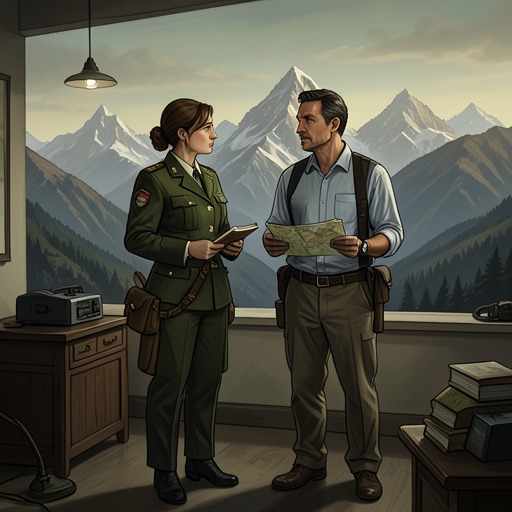
Kristín describes her opposition as personal and national rather than as membership in a political organization. She understands why the base had strategic significance during the Cold War, but that understanding has never made its presence acceptable to her. She regards the base as a blot on the landscape and rejects the idea that Iceland should have an army or become closely bound to one. Her objection extends beyond the United States: she opposes an army on Icelandic soil regardless of whether it is American, British, French, Russian, or Chinese.
Economic arguments intensify rather than soften her resistance. As public debate increasingly centres on money, unemployment, redundancies, and the economy, Kristín sees the country’s reliance on military spending as an ethical and national failure. She condemns the Icelandic nation as war profiteers, directing her criticism not only at contractors or politicians but at a society whose material interests have become entangled with the military presence. Steve tests her political identity by calling her a communist and then suggesting she is a nationalist. She settles instead on the more direct description of an opponent of the army. The distinction matters: her stated objection is to military presence itself, not simply to a party label.
The apparent reduction of the base’s activities does not reassure her. Although Steve points out that the operations have been massively scaled down and the base may close, Kristín believes the American presence will endure. Her fear that it will remain indefinitely gives her opposition a sense of permanence: a temporary military arrangement, in her view, has become a lasting condition that threatens Iceland’s independence and self-understanding.
From Political Conviction to Direct Action
The glacier crisis makes Kristín’s opposition practical. She insists on seeing the American personnel herself and on ensuring that they do not escape responsibility for what has happened. Her refusal to let the military conduct its war games wherever it chooses follows from her belief that foreign forces cannot exercise unaccountable power within Iceland. When Steve argues that American forces are treated as invaders and then expected to rescue others when something goes wrong, the disagreement exposes the unequal expectations surrounding military intervention. Kristín answers by pointing to American suspicion of communism and the country’s treatment of dissenting figures; neither accepts the other’s account of the military’s role.
Her insistence on going to the glacier is not an abstract expression of anti-base sentiment. She has seen the men at the pub and knows of the brutality committed on the glacier; she wants to confront the people involved and prevent them from evading consequences. Steve recognizes that argument will not make her turn back. Her convictions carry her into danger, placing her opposition in direct contact with the operation it condemns.
Sovereignty, Secrecy, and Economic Leverage
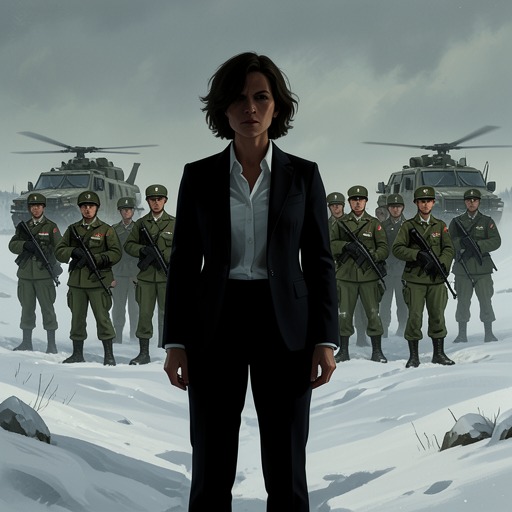
The government’s dealings with American officials show how the dispute over basing becomes a dispute over jurisdiction. At an emergency meeting, the U.S. admiral demands that nothing discussed leave the room. The American general says the military has monitored Iceland’s borders and a section of Vatnajökull, and explains that it intends to excavate an aircraft visible in satellite images and move it through Iceland to the base. Because the operation requires considerable personnel and equipment on Icelandic territory, the foreign minister identifies the need for the Icelandic Government’s permission. The American side presents secrecy and cooperation as necessities, while Icelandic officials insist that notification is not the same as consent.
The conflict sharpens when the general refuses to explain the aircraft, telling the Icelandic representatives that the matter is not their concern. The prime minister objects that the Americans have announced a plan rather than requested permission, and warns that proceeding without authorization would seriously violate the defence treaty. The admiral urges that the matter be resolved without outside involvement and then forgotten. This exchange exposes the practical limit of an alliance in which military access and strategic cooperation do not erase Iceland’s claim to authority over its territory.
When the crisis worsens, the government states that it has no authority to order the rescue team off the glacier, particularly since the team was already there before the latest meeting. The general replies that the Icelanders cannot be held responsible for the team’s welfare and urges the prime minister to call it home. The prime minister answers that one rescuer has died and another is critically injured, making it impossible to treat the operation as unrelated to the Americans. He threatens a formal protest, public investigations in Iceland and the United States, closure of the roads between the glacier and the base, and a personal address to the nation. The general responds by claiming that an old German bomb is on the glacier and that the rescue team faces danger. His disclosure recasts the operation as an urgent safety matter, but it follows the attempt to exclude Icelandic officials from its purpose and terms.
Economic dependence supplies a further instrument of pressure. When the general reminds the prime minister that a sizeable percentage of Iceland’s gross national income derives directly or indirectly from the United States, the remark converts the base’s material benefits into leverage during a sovereignty dispute. The prime minister’s threats to close roads and publicize the crisis answer that pressure with Icelandic political and territorial authority. The confrontation makes visible the contradiction Kristín condemns: the military presence is disputed, yet its economic reach narrows the government’s room to manoeuvre.
The Argument’s Wider Stakes
The narrative connects opposition to the base with the secrecy surrounding the glacier operation. In Washington, Carr introduces the Walchensee gold story to explain the political sensitivity of the aircraft’s cargo; he reveals that much of the gold came from concentration camps, and the Secretary of Defense recognizes it as plundered Jewish gold. Meanwhile, Icelandic officials are initially denied a meaningful explanation of the aircraft and its recovery. The two conversations show how secrecy protects military action while obscuring the human and political consequences that might make that action unacceptable.
A further reversal comes when Ratoff tells a flight lieutenant that there is no bomb aboard the German aircraft, although the general has just invoked a German bomb on the glacier to persuade the Icelandic Government to call back its rescue team. The changing accounts make emergency claims part of the political struggle over access, information, and control. In that context, Icelandic opposition is not merely a contest over whether foreign troops are welcome. It asks who gets to define a threat, who may act in response, and whether economic or strategic dependence can substitute for the consent of the people whose territory is being used. Kristín’s unqualified refusal and the prime minister’s threatened investigation differ in scale and method, but both resist the assumption that American military priorities automatically take precedence in Iceland.