Jóhann
Operation NapoleonJóhann is Elías’s close friend and fellow member of the Icelandic rescue team. His attempt to investigate a disturbance on Vatnajökull brings him into the hands of Ratoff, whose violence leaves Jóhann gravely injured and ultimately dead; the military operation then obscures the truth of what happened to him.
Identity and Introduction
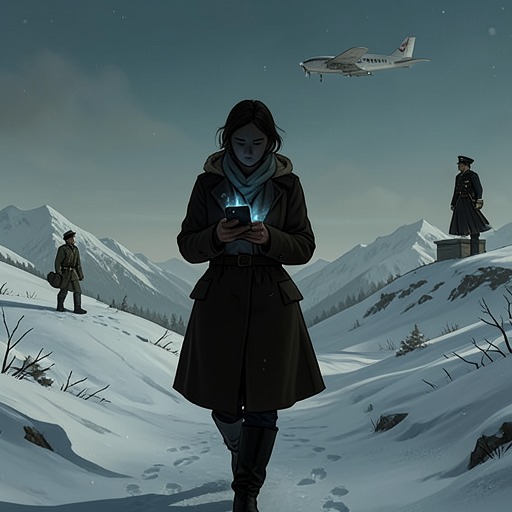
Kristín knows Jóhann as the friend who first got her brother, Elías, involved with the rescue team. Their friendship is established through Elías calling out to him when the two spot lights on the glacier and suspect that someone is digging into the ice. Elías turns from the phone to alert his sister to what they have found, while Jóhann is beside him as the discovery draws them toward the aircraft.
The two young men are barely out of their teens and wear the rescue team’s orange cold-weather overalls, their insignia visible on the breast and shoulder. Ratoff’s soldiers intercept them after detecting their snowmobiles on a small radar screen. The men had left the main party and continued toward the plane; the rest of the rescue team is about forty-five miles away. Jóhann carries no phone or other transmitter, unlike Elías, but both have seen the aircraft, its swastika, the excavation, and the soldiers around it. Their presence threatens the secrecy of the operation, and Ratoff takes them to his tent under armed guard.
Interrogation, Injury, and Death
Inside Ratoff’s tent, Jóhann becomes the means by which Ratoff tries to force Elías to answer questions. When Elías says he told Kristín nothing and ended the phone call as the soldiers approached, Ratoff turns to Jóhann. A small metal awl flashes; Jóhann shrieks, clutches his right eye, and collapses on the ice. Ratoff threatens to stab him again, then seizes Elías by the hair as he tries to reach his friend. The violence is not an uncontrolled outburst: Ratoff uses it to make Elías understand that Jóhann’s safety depends on his compliance.
Ratoff later attacks Jóhann again. Guards help the injured young man to his feet, and Ratoff stares into his remaining good eye before the awl flashes once more. Jóhann’s screams carry across the ice cap; at the aircraft, soldiers briefly pause their digging, then resume without comment. Ratoff emerges with blood spattered across his face, wipes it away deliberately, and turns to the communications tent, where he asks whether Jóhann’s death can be presented as a suicide. The proposed account is part of a larger effort to conceal the operation and the violence inflicted on the two rescuers.
Thirty-five miles away, eight members of the Reykjavík Rescue Team follow the snowmobile tracks to a jagged crevasse, guided in part by the faint ringing of a mobile phone. They find Jóhann and Elías about eight metres below the surface, their bodies terribly battered. The rescuers haul up the snowmobiles and raise the two men on stretchers, taking care not to strike them against the ice walls before loading them into a snow-cat. The apparent scene of a snowmobile crash gives the attack a cover story, while the injuries leave both men close to death.
When Elías regains consciousness in hospital, Kristín tells him that Jóhann has died. The siblings first debate whether to tell Jóhann’s parents the truth; once Elías is stronger, they explain how their son was attacked and what ultimately happened to his murderer. They withhold the German aircraft from their account, knowing that the military will deny violence and that no soldier is likely to testify against the others. Jóhann’s parents nevertheless pursue the case, calling on Kristín, Elías, and Júlíus as witnesses. The investigation produces no prosecution: military spokesmen deny that Delta Force operators or a C-17 aircraft were in Iceland, and the proceedings eventually lose momentum. Jóhann’s death is thus acknowledged privately by those who know what happened, while public institutions leave the murder without legal resolution.
Public Accounts and Narrative Absence
After the rescue team was released, Júlíus reported that it had contacted the media and that American officials had apologized for the shooting. Their spokesmen described the troops’ presence as part of winter exercises with Dutch and Belgian forces, said soldiers had fired after misreading a perceived threat, and disclaimed knowledge of what had happened to Elías and Jóhann. The aircraft acquired several incompatible explanations in the public accounts: lost tracking equipment, a staged rescue exercise involving parts of an old DC-8, and a search for gold. Jóhann himself cannot correct any of these stories. His fate becomes one of the facts around which competing versions of the glacier operation are built, while the evasions make the difference between the rescuers’ testimony and the official record newly stark.
Narrative Role and Erasure
Jóhann’s role is defined less by a separate personal history than by the bonds and responsibilities the story makes visible around him: he is Elías’s friend, a rescue-team member, and one of the two young men drawn toward the aircraft. After Ratoff attacks him, that limited public identity is narrowed further by the competing accounts of his fate. The story’s sharpest contrast is between the physical suffering that gives his death its immediate reality and the official language that tries to make the violence disappear. His parents’ attempt to establish the truth cannot secure a prosecution, leaving Jóhann’s death known to those who witnessed or were told of it but unresolved in the institutions that might have named it.