Kristín
Operation NapoleonKristín is a lawyer at Iceland’s Foreign Ministry whose insistence on clear judgment is tested by a crisis that turns her professional life into a search for her missing brother and the truth about a secret operation on Vatnajökull. She moves from managing other people’s demands in Reykjavík to confronting armed men, enduring the loss of Steve, and pursuing a clue across the world to Borne Island.
Identity and Background
At the ministry, Kristín is known for firmness and obstinacy, with little patience for foolishness. Petite and dark, with short black hair, strong features, and sharp brown eyes, she projects decisiveness and self-confidence. That composure is not effortless: after a difficult confrontation with a visitor, she waits alone at her desk until her trembling subsides. The gap between the controlled official her colleagues see and the strain she contains becomes a pattern in her story.
The visitor, Runólfur Zóphaníasson, has come to her office for the third time to demand help and compensation. He says that mobile freezing plants he sent to Murmansk and Kamchatka have disappeared without payment, leaving him more than thirty million krónur out of pocket. The ministry and the Iceland Trade Council had helped him make business contacts; he now blames the ministry for a former lawyer’s advice to ship the units before payment. In Kristín’s account of the encounter, his repeated accusations and threats are sharpened by his contempt for her as a younger woman. She hears him out, answers objectively, and tries to keep control, even as his self-important manner and dismissive remarks make the meeting increasingly difficult.
When the office confrontation finally ends, ministry employees gather outside after hearing a chair strike the wall and Runólfur shouting. Kristín appears in the doorway, calmly tells them that he has problems, and carefully closes the door. Only then does she sit and tremble. The episode establishes both her public steadiness and its limits: the professional discipline that allows her to meet aggression without yielding does not make her immune to its effects. A call from her brother Elías follows, and he immediately senses her tension, bringing their close sibling bond into the opening of the story.
The Search for Elías
When Kristín returns to her home on Tómasarhagi, she is still wearing her anorak and repeatedly trying the numbers listed for the Reykjavík Air-Ground Rescue Team. No one answers. Elías’s phone is also unreachable: the recorded message says it may be switched off, out of range, or that all lines are busy. As she waits, she fights down the growing dread, counts slowly to ten and then twenty, and tries to persuade herself that there is an ordinary explanation and that her brother will call. She is about to contact the police when a knock at the door interrupts her.
The threat becomes undeniable in Reykjavík on 29 January. Kristín runs blindly toward the coast road at Aegisída, keeping to the dark gardens and never looking back. In her mind, Runólfur’s death is inseparable from the warning signs she had been trying to understand: she has seen a bullet enter his forehead, heard another strike the door, and been told that Elías is dead. Before that, Elías had spoken of armed soldiers and a plane on the glacier; then two men forced their way into Kristín’s flat, claimed she was going to commit suicide, and invoked a conspiracy involving the Reykjavík police, the Foreign Ministry, and the Ministry of Justice. What had first sounded preposterous becomes credible when Runólfur is shot in front of her. Hurt and pursued, she slips into the basement of an apartment block and crouches in darkness among the refuse.
Kristín reaches Steve’s flat and struggles to explain what happened. She tells him that the intruders intended to kill her, that Runólfur was shot when he came to the door, and that they claimed Elías was dead. Her account comes out haltingly, while Steve listens without interrupting, unable to make sense of her distress or her sudden return to his life. She insists that Elías had seen American soldiers on the glacier just before their call was cut off, and asks what American troops could be doing there. Her fear is now joined to a specific question about the military presence and the plane.
Once Kristín has more information, she states her conclusion to Júlíus: Elías did not have an accident. She believes that he and Jóhann encountered American soldiers near a plane on the glacier, were taken captive, and thrown into a crevasse. The likely location is the glacier’s south-eastern section, based on information from an old pilot who had conducted surveillance flights there. Kristín also explains why she cannot simply appeal to official channels: she believes U.S. special forces have taken over the base on Midnesheidi and the American embassy in Reykjavík, does not know whether the Icelandic government is involved, and is wanted by police for questioning about a murder. The search for her brother has become inseparable from the danger surrounding her.
Steve tells her that Elías is still alive, and Kristín turns that hope into a plan rather than a reprieve. She resolves to meet Monica and then head for the glacier. The journey will require equipment, a guide, and a four-wheel drive; she proposes seeking help from the Thompson brothers mentioned by Steve, or from the people living in the area, and believes she knows where to obtain a vehicle. Her determination carries her out of hiding and toward the place where she thinks Elías is being held.
On the Glacier and the Cost of the Search
The route Kristín had chosen did not lead directly to Elías. At a pub, Bateman and Ripley quietly took control of Steve and then her, intending to move them without drawing notice. As Steve was led toward the white Ford Explorer outside, Kristín saw a fisherman blocking her path. She turned his earlier stare into a confrontation by telling him, in Icelandic, that Ripley had insulted him. The fisherman squared up to Ripley, interrupting the agents’ attempt to escort her out. Kristín’s quick intervention breaks the appearance of helplessness, though the scene does not yet remove the danger closing around her.
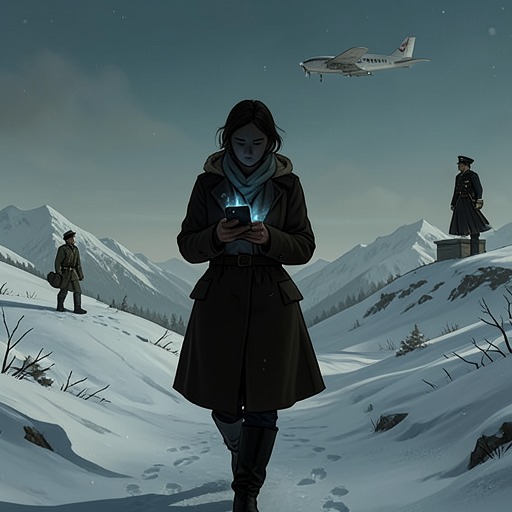
On Vatnajökull Glacier, a soldier tells Kristín and Steve that they have entered a U.S. military prohibited zone and orders them to turn back. The sight confirms what she has feared since Elías’s call: American troops are conducting an operation on the glacier, and her brother’s disappearance was no accident. To Kristín, the soldier’s order is also an assertion of American authority on Icelandic ground. She snatches at his goggles and tells him to turn back himself. He strikes her in the face with his rifle butt; when Steve tries to intervene, the soldier drives the butt into his stomach, then shoves Kristín down again as she struggles to rise. The discovery she has pursued is no longer an inference: armed soldiers stand between her and the truth, and they are willing to use force to keep her away.
Kristín later tells Ratoff that the secret is already spreading: she and Steve have informed others about him and the plane on Vatnajökull, and more observers may soon reach the glacier. Ratoff answers that they must hurry, then turns his attention to the question of Napoleon. With an awl moving along her throat, chin, cheek, and toward her eye, he forces her to stall for time. Kristín recognizes in her own terror the fear Elías must have felt when he faced the same man. When she says Ratoff is lying, he thrusts the awl through her snowsuit and clothes into her side, holds it in the wound, and twists it while demanding to know who else knows about Napoleon. Her pursuit of answers has brought her into the position of the person she set out to save: exposed to the violence she had only heard about through Elías.
After escaping into the wreck of the German aircraft, Kristín encounters Robert Miller, who is searching for his brother. Their shared search gives her a reason to trust him enough to tell her story. She recounts the events that led to her hiding in a body bag, including Ratoff killing Steve in front of her. Only as she tells it does the loss fully settle: Kristín believes Steve died because of her impulsiveness and her stubborn pursuit of the truth. She hangs her head in despair, while Miller listens and believes her. Her account becomes both testimony to what happened on the glacier and an acknowledgment that the search has exacted a cost she cannot undo.
Aftermath and the Unfinished Clue
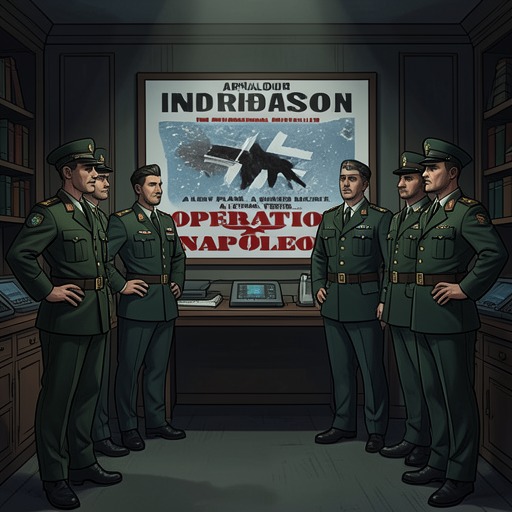
About six months after the events on the glacier, Kristín is still drawn back to them in thought. One summer evening, after a simple supper, she remembers a scrap of paper from the pocket of her overalls. She had emptied the bloodstained clothes before throwing them away and left their contents untouched in a kitchen drawer. The folded fragment bears the words OPERATION NAPOLEON; it is part of a document Jón found on the body of the German officer. Kristín studies it under a bright light, trying to make sense of the typewritten text.
She can decipher only scattered words and letters, which she copies down before asking a Foreign Ministry friend, formerly a diplomat in Germany, to translate and fill in what he can. She withholds the paper’s origin and subject. The partial translation describes putting someone ashore on a remote island off Argentina’s southernmost tip, in an abandoned archipelago, and names Borne as the final option for Operation Napoleon. The fragment does not explain what the operation means, but it turns Kristín’s unresolved questions into a possible destination. Still, she tells no one, not even Elías or Júlíus. The discovery revives memories of the glacier, Steve, and Miller’s story; unable to decide what to do with it, she locks the paper away.
Eventually Kristín travels to Borne Island. A fisherman takes her out by boat, and after about five hours points to the island rising among smaller skerries. Its inhospitable rock, sparse vegetation, and silence recall Drangey, though it is lower and much larger. Kristín climbs from the beach along a gravel path to the plateau, where she finds ruined wooden walls, an earth floor, a doorstep, and what seems to have been a kitchen hearth. The remains confirm that people once lived there, but she finds nothing to support her suspicions. The absence of evidence does not disappoint her as she expected it to. After walking to the island’s precipice and looking out at the waves, she feels, for the first time in years, some of the weight lift from her chest. The search ends not with an answer to Operation Napoleon, but with a quiet change in her relation to the burden that has kept her moving.
Aftermath and the Unfinished Clue
About six months after the events on the glacier, Kristín is still drawn back to them in thought. One summer evening, after supper, she remembers a scrap of paper from the pocket of her overalls. She had emptied the bloodstained clothes before throwing them away and left their contents untouched in a kitchen drawer. The folded fragment bears the words OPERATION NAPOLEON; it is part of a document Jón found on the body of the German officer. Under a bright light, she tries to make sense of the typewritten text.
Kristín can decipher only scattered words and letters. She copies them down and asks a Foreign Ministry friend, formerly a diplomat in Germany, to translate what he can, withholding the paper’s origin and subject. The partial translation describes putting someone ashore on a remote island off Argentina’s southernmost tip and names Borne as the final option for Operation Napoleon. It supplies a possible destination, not an explanation. Kristín tells no one, not even Elías or Júlíus; the discovery revives memories of the glacier, Steve, and Miller’s story, and she locks the paper away, unable to decide what to do with it.
Eventually Kristín travels to Borne Island. After a five-hour boat journey, a fisherman points out the island among smaller skerries. Its inhospitable rock, sparse vegetation, and silence remind her of Drangey, though Borne is lower and much larger. She climbs from the beach by a gravel path to a plateau where ruined wooden walls, an earth floor, a doorstep, and what appears to be a kitchen hearth show that people once lived there. But she finds nothing to support her suspicions. The absence of evidence brings no disappointment; at the island’s precipice, watching waves break against the cliffs, she feels some of the weight lift from her chest for the first time in years. Her search yields no answer about Operation Napoleon, but it ends with a change in how she carries its unresolved burden.
From Official Counsel to Private Witness
Kristín’s professional instinct is to distinguish what can be established from what remains uncertain. That habit first appears in the ministry, where she answers Runólfur’s accusations as clearly and objectively as she can; it later shapes her account of the glacier, where she separates what Elías reported from what she infers about his capture. Yet the institutions that should make such distinctions meaningful become suspect: she cannot safely rely on the police or the ministry, and the soldiers’ presence makes the military operation undeniable without explaining its purpose. Her work as a lawyer gives way to the less protected task of preserving testimony and following evidence herself.
The fragment bearing the words OPERATION NAPOLEON marks a final shift in that task. Kristín does not disclose its provenance to the diplomat who helps translate it, and she keeps the resulting notes from Elías and Júlíus. The restraint is significant: unlike the certainty she needs to act during the crisis, she accepts that the document offers only an incomplete lead. Her journey to Borne ends without verification, but the ruins and the empty search do not compel her to manufacture an answer. The novel leaves her with uncertainty still intact, while showing that it no longer weighs on her in quite the same way.
From Fractured Account to Testimony
Kristín’s changing ability to recount events gives her ordeal a second trajectory alongside the physical search. At Steve’s flat, shock breaks her explanation into a halting, difficult-to-follow account; later, speaking to Robert Miller inside the aircraft wreck, she assembles the events into a story that another person can hear and believe. That act does not undo what happened: telling it brings Steve’s death into focus and turns her pursuit of the truth against herself, as she attributes his loss to her own stubbornness and impulsiveness. The contrast makes testimony neither a clean recovery nor a solution, but a way for Kristín to recognize the cost of what she has lived through.
Narrative Role
Kristín anchors the novel’s movement from institutional complaint to political conspiracy: the lawyer who initially tries to answer accusations objectively becomes the person forced to test those institutions against what she sees and hears. The narrative repeatedly makes knowledge bodily and incomplete—an unreachable phone, a bullet striking a door, a soldier’s rifle butt, an awl held in a wound—before allowing documents and testimony to supply fragments of explanation. Her eventual discovery of the Operation Napoleon paper does not restore the certainty her legal training might promise; she keeps the fragment and its possible meaning to herself, and Borne yields no confirmation. The ending therefore leaves the conspiracy unresolved while changing the measure of her journey: she can return to a place associated with the secret, find no answer, and still feel some of its weight lift.