Kristín Attacked and Runólfur Killed
Operation NapoleonKristín Attacked and Runólfur Killed is the turning point in which a threat that seems impossible in Reykjavík becomes immediate and lethal: Kristín is targeted inside her own flat, and Runólfur dies while she escapes. The assault begins as she tries to reach the Reykjavík Air-Ground Rescue Team and her brother, whose silence has made her fear that he is in danger.
The Intrusion
A knock interrupts Kristín as she is about to call the police. Seeing no reason to expect violence, she looks through the peephole and assumes the visitors are Jehovah’s Witnesses. Instead, two men force their way inside. One clamps a hand over her mouth and drives her into the living room; the other shuts the door and searches the flat, checking the rooms and kitchen to make sure she is alone. Both wear white rubber gloves, and their swift, methodical movements suggest practiced intruders rather than opportunistic burglars.
The man holding Kristín draws a small revolver and presses her toward the desk. Ripley levels the gun at her head and orders her in English to sit. Its muzzle remains wedged against her temple as Bateman finds her passport, checks her face against the photograph, and turns on her computer. He creates a new file and copies text from a piece of paper, working quickly while the men speak in English. Although they seem American to Kristín, the words Bateman types are Icelandic.
The message reads, “I can’t go on living. It’s over. I’m sorry.” Kristín cannot understand why armed strangers have broken in to place what appears to be a note on her computer. She tries speaking to them first in Icelandic and then in English, but they do not answer. Her first assumption is that they are burglars; as the gun remains against her head, she begins to fear that their purpose is more violent. The speed and absurdity of the intrusion leave her unable to grasp its implications as they unfold.
When Kristín reacts angrily to the men’s talk of a conspiracy involving Elías and government ministries, Bateman concludes that she has lost control and steps back. Ripley tightens his finger on the trigger. Kristín closes her eyes, expecting a shot—but a sudden, violent pounding at the door interrupts the attack.
Runólfur Zóphaníasson’s Arrival and Kristín’s Escape
The pounding at the door gives Kristín a chance to move, but it does not bring help in time. Bateman peers through the peephole and reports that a lone man has arrived. Ripley decides they can take him too and turn the attack into a murder without Ratoff’s knowledge. As Bateman opens the door, the visitor calls Kristín’s name; Bateman seizes him by the lapels and drags him inside. Only then does Kristín recognize Runólfur Zóphaníasson.
While Ripley’s attention is drawn toward the struggle in the hall, Kristín shoves him into the table and bolts for the door, warning Runólfur that the men are armed. Runólfur has no time to answer. He sees Kristín rushing toward him and Ripley staggering, then a shot strikes him in the forehead. Kristín watches him collapse into Bateman’s arms as she dodges past. A second bullet tears by her ear and hits the door; she escapes into the snow with Ripley and Bateman close behind.
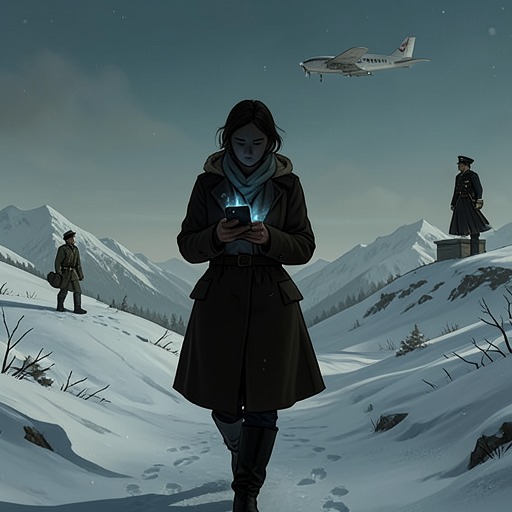
Her flight turns the ordinary details of her departure into liabilities: she had not put on her shoes and is wearing only thin socks, tracksuit bottoms, and a vest beneath her anorak. Below-freezing cold and a thin crust of ice make each step painful as she cuts across gardens, leaps fences, and crosses the road without looking back. Ripley and Bateman, in slippery leather-soled shoes, cannot keep pace; after they remove them, Kristín has already vanished among the dark gardens. Unable to distinguish her tracks from the many others in the snow, they return to the flat.
Kristín runs toward the coast road at Aegisída and then west, keeping to the dark gardens. As she flees, the shooting returns in fragments: Runólfur’s eyes as the bullet hits, the next shot striking the door, and the wound in her ear. She also recalls the men’s claims that her brother is dead, the armed soldiers and plane he had mentioned, and their talk of Ratoff and a conspiracy involving the police and government ministries. The violence has turned what sounded absurd into immediate evidence of danger. When she finds the basement door of an apartment block ajar, she slips inside and crouches in the pitch-dark, refuse-smelling space.
The Attack Within a Larger Cover-Up
The assault is set against an operation whose public explanations shift as the danger grows. In a briefing about the aircraft, Carr describes a shipment of more than three hundred bags, each containing a gold bar, sent from the Reichsbank shortly before Berlin fell. He identifies the bulk of the gold as having been taken from concentration-camp victims. The plane’s cargo is therefore not merely a military secret: it carries evidence of plundered Jewish property, making disclosure politically explosive.
The Americans also invoke the defence treaty and their monitoring of Iceland’s borders, including a closely watched sector of Vatnajökull. In talks with Icelandic officials, a general presents an old German bomb as the reason the glacier operation must continue and warns of catastrophe if the rescue team remains nearby. Yet a pilot is later told that the aircraft contains no bomb and is safe. These conflicting accounts show how the operation is protected by competing claims of danger and secrecy. The assault on Kristín, with its planted Icelandic message and the attackers’ reference to Ratoff, belongs to this landscape of concealed motives, though the evidence does not establish that the gold or the bomb story was the specific reason she was targeted.
Consequences and Narrative Significance
The attack leaves Kristín with more than the immediate task of getting away: the men have tried to place a false explanation of her death on her computer, while their talk has connected her brother’s disappearance to Ratoff and a conspiracy within Icelandic institutions. Yet the scene does not disclose who ordered the assault or establish its precise motive. Its force lies partly in that uncertainty. The planted message presents violence as a private despair, while what Kristín has actually witnessed points toward a larger operation whose participants are willing to manufacture an account of events as well as control them.
The political crisis surrounding the glacier supplies a wider frame for that danger. At an emergency meeting, American officials insist on absolute secrecy; when the prime minister later rejects their account, he promises a formal protest and public investigations, threatens to close the roads between the glacier and the base, and says he will address the nation. The general’s warning about a German bomb is an effort to persuade the Icelandic government to call the rescue team home, while the later assurance to a pilot that the aircraft is safe exposes how differently the operation is described to different audiences. These exchanges do not prove that the disputed aircraft or its cargo prompted the attack on Kristín. They do show why the violence belongs to a story in which official explanations are contested and the power to control information is itself at stake.
Runólfur’s death makes that conflict personal and irreversible. He arrives because Kristín is in danger, is shot before he can answer her warning, and becomes the cost of the moment that allows her to escape. The contrast between the familiar Reykjavík flat and the covert violence inside it gives the event its decisive turn: Kristín’s fear that something is wrong becomes knowledge that she is being hunted, while the apparent safety of home collapses. Her flight into the dark gardens and then an apartment-block basement leaves her alive, but not beyond the reach of the men or the story they are trying to impose.