Kristín’s drug-induced amnesia
Operation NapoleonKristín’s drug-induced amnesia is a disorienting interruption in which a familiar home and familiar thoughts conceal a missing stretch of time. After Vytautas Carr’s warning, an unseen assailant injects her in the neck; she collapses into tranquillity and blackness. She later wakes on her sofa in Tómasarhagi with no memory of how she got there, and only gradually recognizes that her apparently ordinary awakening is a false one. The return of the memories restores the sequence of threats and violence, but not before her own body and front door disclose that something terrible has happened.
Onset and the missing interval
Carr has stopped speaking when he tells Kristín that there is no such thing as truth and that few people care to ask questions. It is the last thing she hears. She does not notice anyone behind her and never sees the needle: she feels a pinch in her neck, goes limp, experiences a sudden sense of tranquillity, and loses consciousness. The narrative moves from this abrupt bodily shutdown to her later awakening without supplying her with a conscious account of what happened in between.
The first thoughts that return are strikingly commonplace. Lying on the sofa, she worries that the shop may have closed and remembers that she needs milk for her coffee. At the same time, one name keeps surfacing: Ratoff. It frightens her, though she cannot yet understand why. The jumble of these concerns gives the missing memories a shape by contrast: daily routine remains accessible, while the events that make the name dangerous have not yet returned.
A false awakening in Tómasarhagi
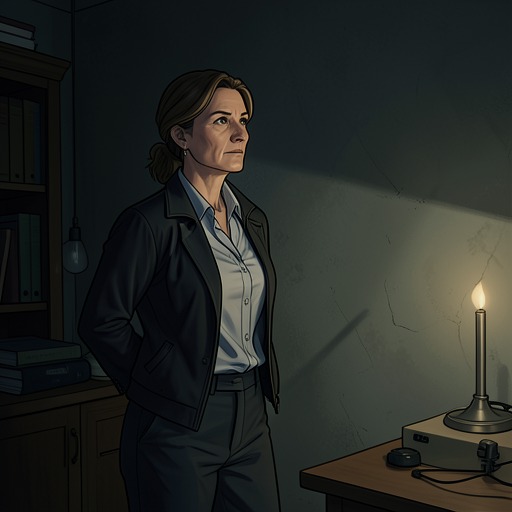
Kristín initially takes her condition for ordinary tiredness. The flat is dark, she believes she has got up too early, and she feels unusually comfortable and exhausted. Her thoughts drift among her parents, her former boyfriend, and Steve, whom she regrets having dropped and would like to see again. She also considers leaving her ministry job, where threats have made an already unappealing workplace worse, and possibly opening a legal practice with a friend. These are not recovered answers to the crisis so much as intact fragments of a life that seems, to her, to be continuing normally.
The body interrupts that impression. After lying on the sofa for half an hour, she tries to move and discovers a throbbing ache in her side. Her outdoor clothes are filthy, yet she does not stop to question why she is wearing them. When she raises her jumper, she finds a dressing below her ribs, with plasters and gauze covering an injury she cannot remember receiving. She does not know how she was hurt or recall going to hospital. The large dressing and dark-blue bruising on her side make the injury look serious, even while its cause remains inaccessible to her.
Her surroundings also fail to fit her sense of waking. She thinks the kitchen light should have been left on, but the flat appears normal. She drinks a can of Coke beside the open fridge, then gulps cold water straight from the tap; the flat feels stiflingly hot, so she opens the kitchen window to the winter air. The ordinary actions do not restore a reliable sense of time. Rather, they hold her within the mistaken belief that she has simply overslept, while her pain and unexplained dressing register what her memory cannot.
The bullet hole and recognition
A sentence from a phone call keeps returning to her: Never cross Carr. Standing alone in the dim living room, she begins to recall an incident that she has been treating as an absurd dream. Holding her side, she peers into the hall and approaches the door hesitantly. The delay matters: she has a vivid sense that something happened, but still tests that impression against the familiar entrance to her flat.
The door supplies the evidence her memory has withheld. Under the hall light she sees a small, neat black hole, unmistakably made by a bullet, and touches it with one finger. At that point she understands that the shooting was not a dream and that this is not the day she had imagined waking into. The event is already over; her sense of the present has lagged behind it. She remembers Ratoff and Steve, and the phone warning becomes intelligible. The discovery turns an apparently minor detail of the apartment into proof that her own account of her recent past cannot be trusted.
The return of memory and its consequences
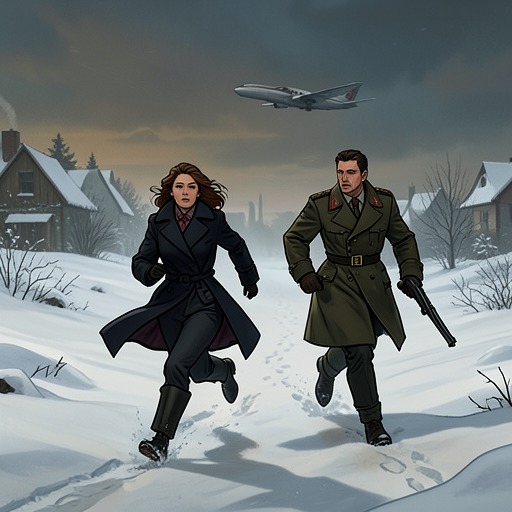
The first half hour as her senses return brings a rush of recollections rather than a tidy chronology. Kristín remembers Ratoff’s words on the plane and what Miller had told her; the body bags; Steve and Jón, the farmer at the foot of the glacier; the shooting outside the pub; and being hunted across the U.S. base. She also recalls the Jehovah’s Witnesses and Elías calling her from the glacier. The range of these memories reveals how much of her recent experience has been missing: the blackout has severed her from personal relationships, immediate danger, and her brother’s crisis at once.
The recovery remains incomplete. When she later speaks with Steve, she says that she thinks she was drugged, points out a mark on her neck, and explains that she woke in her flat with increasingly clear flashbacks but still has gaps. Steve describes being taken prisoner when the men left the glacier, transported with the equipment, threatened repeatedly, and pressed for information about where she had gone. His account establishes that the missing interval also separated Kristín from what had happened to him; her blankness is not simply a private confusion but a break in her access to events unfolding around others.
Elías’s whereabouts give the recovered memories an urgent practical consequence. Once she remembers his call from the glacier, Kristín rings the National Hospital and learns that he is not there, then calls the City Hospital. After a wait, she receives confirmation that he is a patient there. The search does not erase the uncertainty of her own condition, but it converts memory into action: remembering Elías leads her to check whether he survived and where he has been taken.
Narrative significance
The episode makes memory return through discrepancies rather than explanation. A name that feels frightening, clothes she cannot account for, a wound without a remembered cause, and a bullet hole in a familiar door each challenge Kristín’s assumption that she has merely slept too long. The ordinary details are not evidence that nothing happened; they are the temporary cover under which the missing events remain inaccessible. The repeated warning about Carr likewise changes function as recollection advances, moving from an unexplained phrase to a clue she can connect with the violence.
The sequence also separates bodily knowledge from conscious knowledge. Kristín’s side hurts before she knows why it hurts, and the mark on her neck becomes something she can identify only after she has begun to recover the surrounding events. The narrative lets readers encounter these traces alongside her, withholding a stable account until the bullet hole forces recognition. Her memories return forcefully but unevenly, and the episode ends not with a complete reconstruction, but with enough recovered knowledge for her to seek Elías and enough remaining uncertainty for her to acknowledge that much is still missing.