Michael Thompson
Operation NapoleonMichael Thompson is a retired pilot resident on the military base in Iceland, where he has lived since the 1960s. Kristín and Steve find him in the middle of the night while searching for answers about soldiers and an aircraft on Vatnajökull Glacier. Thompson cannot identify the plane or its cargo, but his account of decades of surveillance and a secret 1967 expedition reveals how long the military had watched the glacier—and how little even those involved in that surveillance knew.
Identity and Introduction
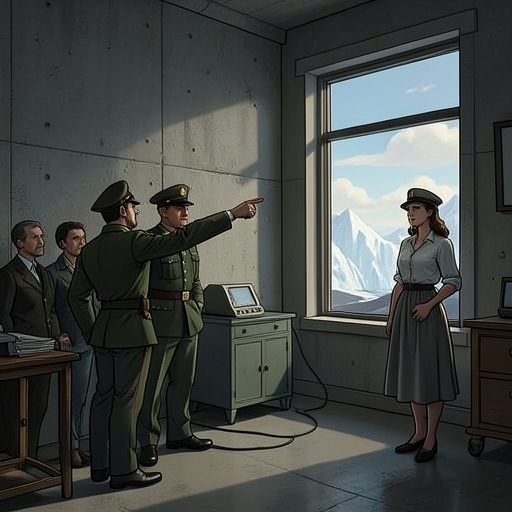
Thompson appears in the United States Army’s employment records as retired, a pilot, born in 1921, and still living on the base. Steve finds his name while he and Kristín search the records in an office lit only by a computer screen. The pair decide to wake him because Kristín’s brother, Elías, has disappeared during a training exercise on Vatnajökull Glacier, and two Americans have tried to kill her after she saw evidence of soldiers there.
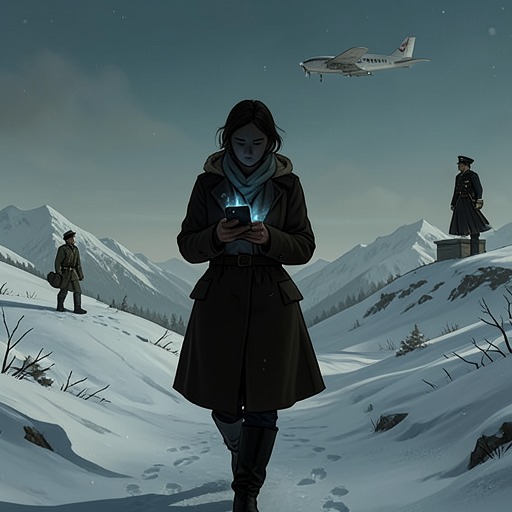
They reach Thompson’s home through the dark, snow-covered base and wake him at his door. He is thin and stooped, wearing slippers and a robe; his legs are strikingly pale and bony, and his white Clark Gable moustache is barely distinct from his skin. The scene gives his testimony the quality of an unexpected encounter with a living remnant of the base’s older history. He welcomes the visitors into his living room but regards them skeptically, aware that their late-night arrival must have a serious cause.
The Search for Answers
Kristín tells Thompson that Elías spotted a plane and soldiers on the glacier, after which his mobile phone went dead. She also explains that the attempted attack on her led her to Steve and then to the base. Thompson takes the danger seriously. Remembering the rumors that circulated among personnel, he says that they never knew for certain what the military was seeking, though they suspected it might be a plane carrying dangerous cargo.
His answer is important partly for what it does not establish. Thompson has not seen the aircraft himself and cannot tell Kristín and Steve what it is or what it contains. He can describe recurring military activity, but his knowledge of its purpose is incomplete. He warns that, judging by the way the military had behaved before, Elías may be in danger on the glacier. His caution turns the search from a mystery about an old plane into an immediate rescue concern without pretending that rumor is proof.
Surveillance and the 1967 Expedition
Thompson recalls regular monitoring flights over Iceland and the sea to its north. Once a month, pilots photographed the southeastern part of Vatnajökull Glacier. Leo Stiller, the commanding officer, organized these flights. Thompson never spotted anything himself; on some occasions, however, others believed they had seen enough to justify a closer examination. The routine created a long record of looking without certainty: photographs were taken, but the object of the search remained elusive to the pilots who made them.
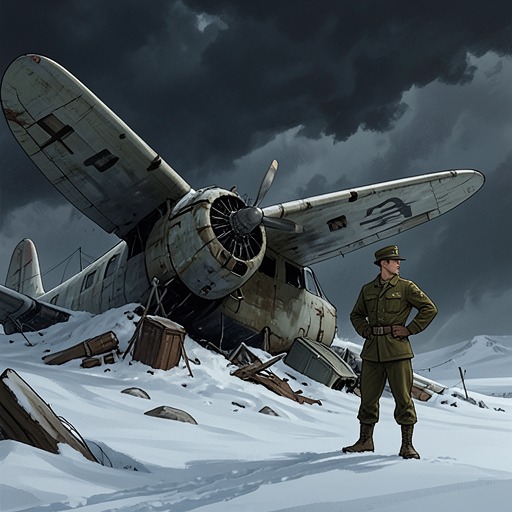
The most consequential episode came in 1967. Thompson says that surveillance was then a routine assignment for the pilots, but on one flight Stiller thought he saw something beneath the ice and repeatedly flew back and forth to photograph it. Thompson was not part of that flight; Stiller told him about it afterward. A helicopter could not land in the winter conditions, so a small expeditionary force went to the glacier with a metal detector. Preparations then began for a much larger operation, conducted in secrecy.
Thompson distinguishes what he witnessed from what he heard. He was not involved in the expedition, and the account of Stiller’s discovery came from Stiller himself. Yet the secrecy did not remain secret within the close-knit base community: people heard about the operation despite the effort to conceal it. Thompson’s testimony therefore preserves both the military’s formal silence and the informal circulation of knowledge among those who served there.
Stiller, the Astronaut Cover, and the Limits of Knowledge
Thompson identifies Stiller as the officer responsible for the surveillance flights and describes him as a good man. Stiller later died in a helicopter accident on the base; his wife, Sarah Steinkamp, moved to Reykjavík after his death. The report of his death gives Thompson’s recollection a personal dimension, but it also fixes the limits of the history he can offer: the officer who made the discovery and could have supplied more detail is gone, and Thompson’s account depends on what Stiller once told him.
According to Thompson, military intelligence was mainly responsible for the secret operation. Because Icelanders were sensitive about troop movements, the Americans arranged for Armstrong and other astronauts to train in the lava fields north of the glacier. The explanation given to the public was that the interior landscape resembled the Moon. Thompson calls that rationale preposterous and says the astronauts’ presence helped deflect attention from a major movement of troops and equipment. The contrast between a celebrated training exercise and a concealed military deployment shows how public events could serve as cover for activity on the glacier.
Thompson’s role is that of a witness with partial, inherited knowledge rather than an insider who can resolve the central question. His recollections connect the present search to surveillance flights, Stiller’s discovery, and a concealed expedition, but they do not reveal what the plane carried. That gap matters: the base’s rumors and security measures have accumulated for years without giving Thompson, or the people now questioning him, a verified answer. His testimony widens the history of the mystery while leaving its most urgent secret open.