Nazi Germany
Operation NapoleonNazi Germany appears as a defeated power seeking to escape the consequences of defeat by offering its military strength to the Allies against the Soviet Union. The disclosures surrounding these proposed dealings complicate the familiar account of the war’s end: German leaders hoped to turn fear of Soviet expansion into a bargain, while Allied planners considered a scheme that would make former enemies partners in a new conflict.
Defeat and the search for escape
In Michael Miller’s recollection, Nazi Germany’s leaders wanted to escape as the war closed around them. Germany was defeated, he says, and could not dictate the terms of a ceasefire; yet many Germans feared that Soviet forces would reach Berlin first. Some, in the final months of the war, were prepared to join the Allies if they could be trusted to turn against the Soviet Union. The prospect of collaboration arose not from a position of strength, but from the regime’s approaching collapse and its fear of what would follow.
The same account connects the proposed bargain to efforts by senior Nazi figures to secure a political future. Miller says that Himmler wanted to make a deal with the Allies to fight the Communists and expected to become the head of a new government. A Swedish count acted as intermediary between the Allies and Nazi Germany; Miller leaves open whether the count first suggested the idea or whether Nazi representatives raised it. His account makes the negotiations appear exploratory and contingent, rather than a settlement Nazi Germany could impose.
German forces in Operation Unthinkable
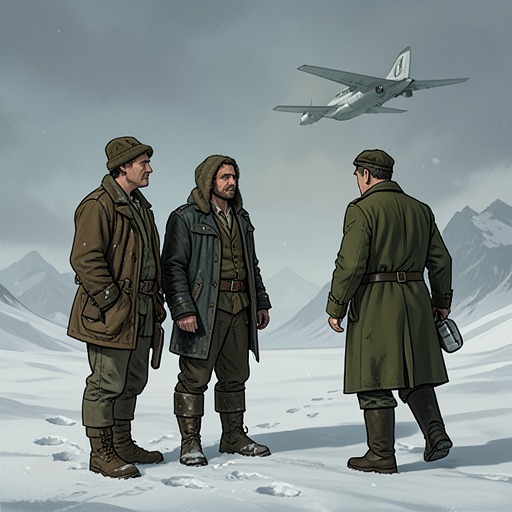
A briefing document recovered from the plane describes a British War Cabinet plan, codenamed Operation Unthinkable, for an Allied attack on Stalin’s government in Moscow after the Yalta meeting. Under its proposed terms, the war in Europe would end through a treaty with the Germans, and approximately one hundred thousand German soldiers would join the Allies, deployed in the first wave of an invasion advancing east from northern Germany near Dresden. A further attack from the Baltic was also considered.
The document presents the proposal as fiercely contested. Its opponents regarded negotiation with Nazi Germany as tantamount to alliance with the regime that had devastated Europe; recent discoveries in Eastern Europe had also confirmed suspicions about the organized extermination of Jews. Supporters, by contrast, argued that an attack might shorten the war and limit further deaths, and feared that Soviet control over much of Europe and the Baltic States would imperil the postwar peace. The projected use of German soldiers thus sits at the center of a stark contradiction: a plan to confront Soviet power by relying on forces from a regime whose crimes made cooperation morally abhorrent.
The disputed trail to Eichmann
Miller also describes a deliberate effort to misdirect Mossad. He says that when Israeli agents had uncovered too much, the Allies arranged matters to make the trail appear to lead to Adolf Eichmann in Argentina. Miller claims the deception satisfied them, and that they would not have found Eichmann without Allied intelligence. In his telling, the Eichmann trail was not simply the result of Nazi flight after the war, but part of a managed diversion connected to what the Allies knew and concealed.
Taken together, Miller’s recollections and the recovered briefing document reveal different levels of the same hidden history: Nazi Germany’s attempts to bargain for survival, Allied consideration of German military assistance, and the contested handling of intelligence about Nazi figures after the war. The evidence does not establish that Operation Unthinkable was carried out; it shows that the proposal and the possibility of cooperation were entertained, even as Nazi Germany’s defeat and crimes made that possibility profoundly compromised.