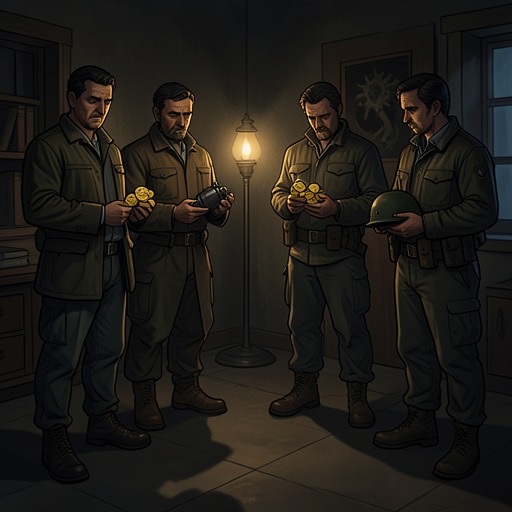
Nazi gold crates
Operation NapoleonThe Nazi gold crates are the tangible cargo at the center of a covert negotiating mission: two boxes of Jewish gold were carried alongside Nazi representatives as a proposed bribe for the government in Buenos Aires. When Kristín encounters the crates aboard a United States Army C-17 transport plane, their gold and the swastika visible on one box give physical form to the history Miller is trying to explain.
Appearance and discovery
Miller sits on one of the two crates aboard the C-17. Kristín catches sight of a swastika outline on the box, a marking that makes the cargo’s connection to Nazi Germany visible before Miller has fully explained it. The crates are not incidental freight: their presence gives Kristín a concrete clue to the importance of the aircraft and to the violence surrounding its recovery.
Cargo for the negotiations
Miller explains that the gold had been carried on the earlier flight, which his brother flew from Germany to Reykjavík. The plan was for the brothers to meet there and continue across the Atlantic to Argentina. The gold was Jewish gold, intended to bribe the government in Buenos Aires; additional gold was to follow if the negotiations proceeded. The two crates were only an initial offering, not the whole proposed payment.
The flight also served as a test of the route and the aircraft during a second round of talks with Nazi representatives. It carried some members of the negotiating committee as well as the gold, while the final destination in Argentina remained unsettled. The crates therefore connect a practical trial flight to a larger plan whose destination and terms had not yet been agreed.
Significance
The boxes turn Miller’s account of clandestine diplomacy into an object Kristín can see and question. Their markings and contents join the aircraft’s operational role to the intended bribery and the negotiations with Nazi Germany. By distinguishing the two crates as an appetiser, while noting that more gold was expected, Miller also reveals that the cargo was one installment in a broader scheme rather than a complete settlement.