North Atlantic Treaty Organization
Operation NapoleonThe North Atlantic Treaty Organization is the alliance framework through which the novel places a secret American military operation on Icelandic territory inside a larger dispute over defence, consent, and sovereignty. NATO is invoked both as a reason for cooperation and as cover for concealed military activity: the United States presents troop movements as an exercise involving allied forces even as Icelandic officials challenge the operation’s legality and demand an account of its consequences.
The alliance and Iceland
The alliance’s presence in Iceland is tied to the country’s strategic position in the North Atlantic. The American base at Keflavík, on the Midnesheidi lava fields southwest of Reykjavík, had served as a key point in Western defences during the Cold War, when its location helped monitor Soviet submarines, shipping, and air traffic. By 2000, the base’s activities had been substantially reduced, but the alliance’s military footprint still affected Icelandic politics and local economies.
The novel distinguishes the alliance framework from the American military authority exercising power on the ground. Under the defence treaty between the two countries, the Americans tell Icelandic ministers that they monitor activity within and around Iceland’s borders for military purposes, using submarines, reconnaissance aircraft, and satellites. Their close surveillance of part of the Vatnajökull Glacier is described as historical in origin, but the operation to excavate a newly visible aircraft wreck requires personnel and equipment to move across Icelandic territory. The treaty supplies the setting for that cooperation; it does not erase the Icelandic government’s expectation that it be consulted.
Domestic opposition and dependence
Iceland’s relationship with the alliance is presented as politically contentious rather than settled by the treaty. The signing of the defence agreement in 1949 provoked a riot outside the Icelandic parliament, and left-wing parties continued to oppose the base. The government’s stated policy was that Iceland should not profit from NATO’s presence. Yet military facilities and contracts channelled substantial sums to civilian contractors and service companies, while nearby communities came to depend on the Iceland Defense Force. When operations at Midnesheidi were scaled back after the Cold War, local residents protested the resulting changes.
That tension also appears in Kristín’s opposition to the base. She accepts that it had strategic significance during the Cold War but regards an army on Icelandic soil as unacceptable, regardless of its nationality. She objects in particular to a debate that has come to revolve around money, jobs, and redundancies: in her view, economic reliance has made the country complicit in a military presence it should reject. Her position gives the alliance’s local effects a personal and moral dimension, setting national economic dependence against the principle of keeping Iceland free of foreign forces.
NATO as cover for the glacier operation
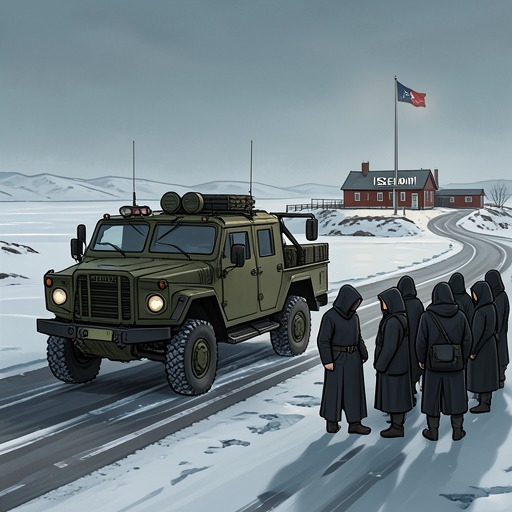
The secret operation begins when American military intelligence identifies the aircraft on satellite imagery and sends a force to recover it. At Keflavík, a C-17 transport plane arrives at night carrying snowmobiles, tracked vehicles, skis, and other equipment. The cargo is moved in civilian-looking trucks that leave at intervals and blend into ordinary traffic. The preparation is American, but the alliance becomes part of the proposed public explanation for the deployment.
At an emergency meeting with Icelandic ministers, American officials describe the wreck as a World War II aircraft lost in the glacier and say that an expedition will excavate it before transferring it to the base. They acknowledge the need for Icelandic cooperation, promise discretion, and characterize the expedition as scientific, with senior scientists accompanying the military personnel. If the operation becomes public, they suggest describing it as small winter exercises involving Belgian and Dutch NATO forces alongside the American force. The allied framing offers a plausible explanation for troop movements while withholding the aircraft’s significance and the true purpose of the mission.
The mismatch between that account and events becomes harder to contain. Later, the American explanation calls the deployment a simulation exercise involving visiting forces from the Netherlands and Belgium, a staged plane crash, and approximately 150 personnel carrying blank rounds. Icelandic ministers point out that they had not been informed about the weapons and had been told the effort concerned removing an aircraft, not staging a war game. The alliance’s name lends the exercise an appearance of routine cooperation, but it does not answer the government’s complaint that the operation was conducted without adequate notice or permission.
Consent, pressure, and consequences
The Icelandic government challenges the Americans’ interpretation of their obligations. When an official says the operation is not Iceland’s concern, the prime minister objects that the Americans have announced their plan rather than requested permission and warns that acting without consent would seriously violate the defence treaty. The disagreement exposes the difference between alliance membership and unrestricted authority: the American side treats secrecy and urgency as reasons to proceed, while the Icelandic side insists that cooperation depends on being properly informed.
After a rescue-team member has died and another is critically injured, the government demands a public investigation, threatens to close the roads between the glacier and the base, and says it will inform the media. The Americans answer that the rescue team cannot be controlled by the government and invoke the share of Iceland’s national income derived directly or indirectly from American activity. The prime minister rejects that economic pressure and maintains the demand for disclosure. Only then does the American general reveal that the aircraft contains an old German bomb and that the team is in danger.
NATO therefore functions less as an independent actor than as the political language surrounding the conflict. The operation is carried out by American forces; allied participation appears in the proposed cover story and in the later account of a simulation. Against that language, the Icelandic officials’ objections make consent, public accountability, and territorial authority the real tests of the alliance relationship. The gap between the benign image of a joint exercise and the concealed recovery operation is central to the novel’s portrayal of how security cooperation can become a means of exerting pressure on a smaller ally.