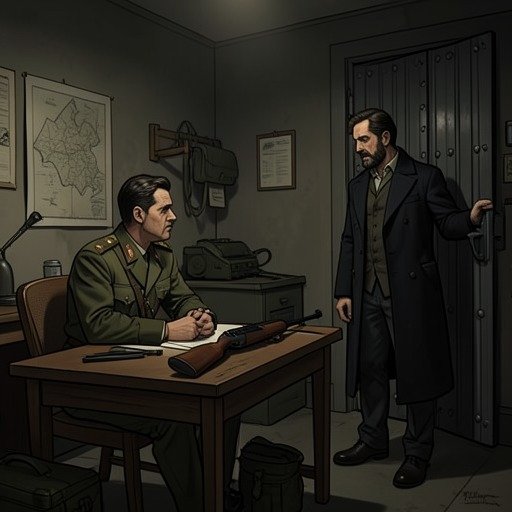
Ratoff and Carr’s hierarchical relationship and falling-out
Operation NapoleonRatoff and Vytautas Carr’s hierarchical relationship and falling-out are shaped by the same secrecy that makes their partnership useful: Carr recruits and commands Ratoff, but keeps him outside the operation’s central secret. When Ratoff discovers what the recovered aircraft and its papers might expose, he turns his access into leverage. Carr answers not with negotiation but with force, making their final encounter an extreme version of the authority and distrust that had long defined their working relationship.
Recruitment and Command
Carr originally recruited Ratoff into the organisation. Over time, however, Carr became increasingly remote, until Ratoff felt that the general was no longer willing to acknowledge his existence. Ratoff had some freedom to decide his movements within the service, but that latitude did not make him his own master: he remained an operative doing the organisation’s information-gathering work, often by methods others preferred not to know about.
Carr’s decision to put Ratoff in charge of the Iceland operation initially looks like an exercise of confidence. The assignment required a director in Keflavík, two special-forces squadrons, and a cover story of a routine exercise; local resistance was to be referred to the defence secretary while Carr handled an explanation to the Icelandic government. Yet Carr explicitly tells Ratoff that the mission is covert, and the instructions leave the operative responsible for carrying out a consequential operation without giving him its full rationale.
That distance persists as Carr’s own doubts grow. After Ratoff chooses Ripley and Bateman, Carr rebukes him for losing control and reminds him that the Icelanders are allies. He knows Ratoff’s alarming army record: Ratoff delivers results, but tends to be over-zealous. Carr nevertheless proceeds with the mission, then calls Miller to say the plane has turned up and that they need to meet, honoring an old promise before flying to Iceland. The contrast is telling: Carr has doubts about his director, but the operation and its older obligations continue to depend on him.
The Secret and the Operative
The recovered aircraft sharpens the imbalance between them. Carr knows what the plane contains, while Ratoff has not been briefed. Carr expects him to bring back the documents and accepts that he will probably read them, treating that curiosity as an unavoidable risk. Trucks are ready to take the dismantled aircraft to Keflavík, and the bodies are to travel with the wreckage. Carr’s expectation is that the papers will close a chapter of the war within days; the secrecy is not incidental to his command but the means by which he hopes to contain the consequences.
Ratoff reads the documents and concludes that Carr chose him because he was expendable. He assumes that Carr and a handful of senior military intelligence officers know what the aircraft contains, but cannot tell how many others understand the operation or whether anyone outside the army knows what is happening. This is Ratoff’s inference, not confirmed knowledge of Carr’s private intention. Still, the possibility that he has been selected as a disposable instrument changes how he reads the assignment: he is no longer simply carrying out orders but trying to survive the people who issued them.
The secret he encounters is the name Operation Napoleon and its connection to a British War Cabinet plan, Operation Unthinkable. Ratoff recognizes that the papers make his knowledge dangerous, even though he does not know whether the proposed operation was ever carried out. He also understands that the spectacular rumours surrounding the recovery—including gold, a virus, a bomb, and German scientists—have misdirected attention from old papers. His awareness of the deception gives him a bargaining position, but only if he can make Carr believe he has secured evidence beyond the briefcase in his possession.
From Subordinate to Threat
By the time Carr meets him aboard the C-17 transport plane, the operation’s Icelandic phase is nearly over. The two sections of the Junkers Ju 52 are being loaded into the aircraft’s vast hold, and Carr is waiting there for Ratoff. Carr looks markedly older than at their previous meeting: his face is ashen and withered, his uniform hangs loosely, and his shoulders sag. Ratoff reports that events went according to plan only “for the most part,” signaling that the chain of command has not delivered the uncomplicated conclusion Carr expected.
Ratoff’s account of Kristín and Steve’s escape gives the immediate reason for that qualification. He says he did not have time to interrogate Kristín properly, and believes her mention of Napoleon was a desperate attempt to delay him rather than evidence that she understood the documents. Carr responds that she was lucky to escape alive. Ratoff then reminds him that Carr knew what he was doing when he put him in charge. The exchange is more than a defence of his conduct: Ratoff places responsibility for the violence and its consequences back on the commander who chose him.
Asked what he thinks of Operation Napoleon, Ratoff declines to offer an opinion and instead holds up a briefcase, proposing an agreement. Carr refuses. Three men surround Ratoff, and Carr takes the case; its pages are blank. Ratoff is searched, but the men find nothing. His claim that he has made an insurance arrangement therefore remains unverified at this point. He says that the papers will be released automatically if he fails to confirm his safety by a designated time, and asks to leave alive and richer. The subordinate has made himself a threat by claiming control over information Carr cannot safely dismiss.
Coercion and the Final Warning
Carr does not accept the proposed bargain. He has his men take Ratoff and find out what he has done with the documents. On the flight, Carr can no longer hear Ratoff’s screams above the engines and concludes that he has given in. The narration describes drugs and physical horrors, and makes clear that Ratoff is shown no mercy. Carr does not want to know the sordid details; what matters to him is extracting the information and finishing the mission.
Even then, Carr’s language remains that of command rather than personal confrontation. When asked what should be done with Ratoff, he says that the service has no further need of him and instructs his men to do whatever is necessary, adding that he does not want to be told about it. He also orders that a convoy carrying the documents be intercepted and the papers destroyed. Carr’s authority thus extends beyond extracting Ratoff’s secret: it reaches the removal of both the operative and the evidence, while keeping the final act of disposal out of the commander’s stated knowledge.
Kristín later finds Ratoff bound on a moving pallet, gravely injured: his fingernails have been removed, both thumbs are missing, his nose is broken, several teeth have been knocked out, and part of his chest has been flayed. He warns her, “Never cross Carr.” The line recasts their history as a lesson learned too late. Ratoff’s attempt to bargain has not displaced Carr’s power; it has exposed its limitlessness. Their falling-out is therefore not a clean break between equals, but the violent end of a command relationship in which Carr can use Ratoff, withhold the truth from him, and finally order him erased when he becomes dangerous.