Robert Miller
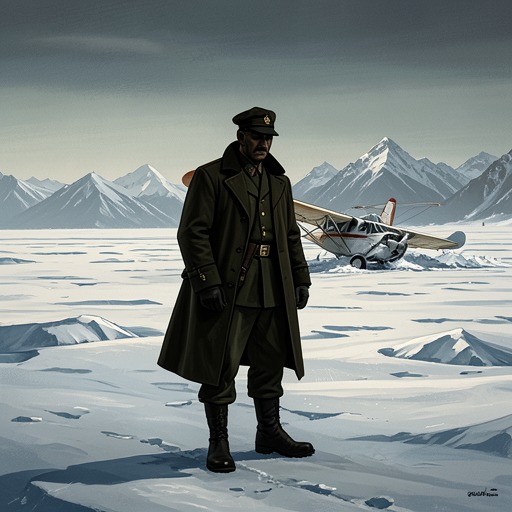
Operation NapoleonRobert Miller, an American army colonel and former chief of the organization directing the glacier operation, is bound to the wreck on Vatnajökull by two histories: the failed 1945 expedition he led and the death of his brother William, one of the aircraft’s pilots. His decades of searching make the discovery more than a military recovery. The plane’s return brings back the brother he sent into danger and the guilt he has never been able to settle.
Identity and the First Expedition
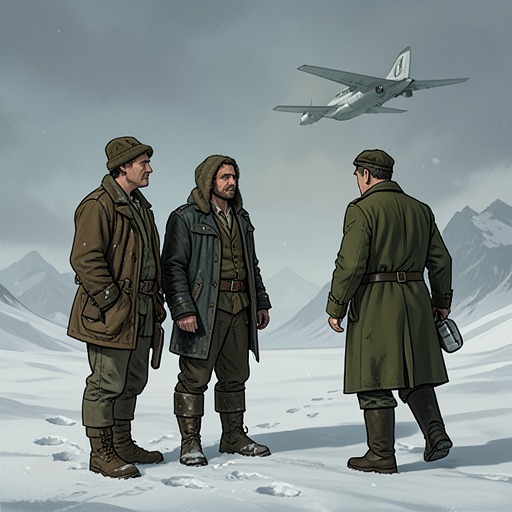
In 1945, Miller was in charge of the first expedition to find the aircraft after it crashed in Iceland. He told the local brothers Jón and Karl that the plane carried dangerous biological weapons, a virus developed by the Germans, and that it had to be found urgently. They accepted his explanation and helped guide him on the glacier. At the time, they knew the war and its aircraft as a shared interest; Karl recognized the wreck’s type as a Junkers. Miller’s warning supplied a reason for the search, but the later recovery exposes how little the searchers then understood about the plane and what it contained.
Miller’s command responsibility was also personal. He had sent his brother William on the mission. Their plan was that Miller would meet him when the plane stopped in Reykjavík to refuel and then fly back with the Germans. Instead, Miller remained behind, and William’s aircraft vanished on the glacier. Years later Miller tells Carr that he blames himself for putting his brother in that position: he had taken William off the battlefield, only for him to die in the Arctic. Miller never learned whether William died in the crash or froze afterward. The distinction remains unresolved even when the wreck and its dead are recovered.
The Long Search
Jón’s memories trace the search across decades. Miller returned to the brothers’ home every three to five years, saying he was on summer vacation before going up to the glacier. He would stay with them for as long as a week or two, and they acted as his guides. He was tireless in looking for the plane, yet Jón recalls that he never found anything. By the time of the present-day events, more than thirty years had passed since Miller’s last visit, and the brothers had been told that he had died.
The remnants of this relationship give the search a domestic scale. Jón keeps a photograph Karl took of Miller and produces yellowed thank-you letters Miller sent after his stays. The letters are addressed in an elegant hand; their writer carefully spells both Jón’s patronymic and the name of the farm. They bear Washington postmarks and stamps showing Abraham Lincoln. These details record an attentiveness distinct from the urgency of the military mission: Miller was not simply a colonel passing through, but a guest who remembered the people who had sheltered and guided him. Jón describes him as exceptionally nice and recalls that Miller asked to be called Bob. When Kristín asks whether he ever found anything, Jón answers that he did not.
Return to the Recovery Operation
The discovery of the aircraft turns Miller’s old search into an active concern again. Carr, who is beginning to doubt his choice of Ratoff as mission director, decides to set the operation’s next phase in motion and calls Miller before flying to Iceland. The call also fulfills an old promise between the two men. Miller’s involvement reaches back beyond this crisis: he had once led the organization, and Carr treats the news of the plane’s return as something that must be brought to him directly.
During the recovery, Miller asks whether Ratoff has been told what the plane contains. Carr replies that Ratoff will soon find out, and that he is trusted to bring back the documents, although he may read them. Trucks are ready to transport the dismantled plane to Keflavík, and the bodies are to travel with the wreckage. Carr expects the chapter to be closed within days, but Miller’s question makes clear that the documents and the dead matter as much as the aircraft itself. The operation is meant to remove evidence as well as wreckage, while the contents remain consequential enough that even its director has not yet been briefed.
Guilt, Loyalty, and What Remains Unknown
Miller’s meeting with Carr gives his pursuit its clearest emotional account. In the hangar, away from the others, he explains that his planned reunion with William was supposed to end in a return flight together. Instead, William disappeared, and Miller was left with the knowledge that his own decision had placed his brother on the mission. He calls the operation preposterous and says it should never have been set in motion. His confession does not resolve the mystery of William’s final hours; it sharpens it. Miller still wants to know whether there are bodies, what condition they are in, and what happened to the men.
The aircraft’s pilot is eventually identified through papers found with the wreck as William Miller. Ratoff recognizes the family connection when he realizes that the pilot must have been the former colonel’s brother. William’s pencil diary, recovered under the co-pilot’s seat, is sporadic and difficult to sequence; some entries seem addressed to the brother who might one day find them. The bodies have been preserved in the ice, a fact that gives the recovery an unnerving immediacy after decades of absence. Miller’s search has therefore succeeded in finding the plane, but not in recovering the certainty he wanted: his brother’s precise cause of death remains unknown, and the documents open a further chapter of the wartime secret rather than closing it.