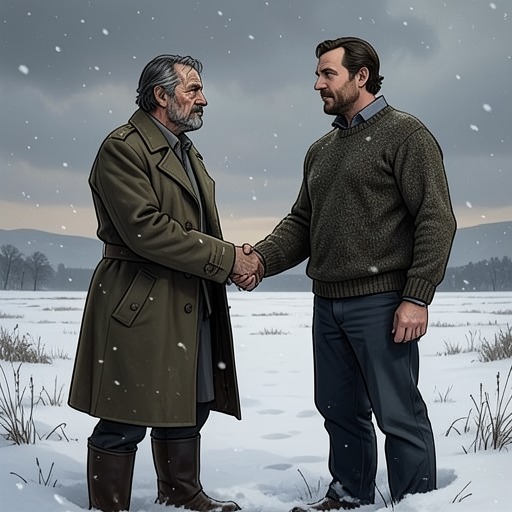
Robert Miller’s longstanding trust and secrecy pact with Jón and Karl
Operation NapoleonRobert Miller’s relationship with Jón is a friendship forged through years of searching for Miller’s missing brother and sustained by a promise that outlasts the search itself. Jón and his brother Karl become Miller’s local allies on Vatnajökull, then custodians of knowledge they keep to themselves for decades. The relationship is conveyed less through declarations than through acts of help, a private moment of grief, careful correspondence, and Jón’s eventual decision to break his silence only in part.
The Search and an Unusual Friendship
When Miller arrives to search for the aircraft, Jón and Karl draw on their interest in wartime aircraft and their knowledge of the area to help him. Karl recognizes the wreckage type as a Junkers. The brothers find the rim of the nose wheel, which Miller takes charge of, and discover it about two kilometres farther onto the ice cap. Beyond that fragment, the glacier appears smooth, with no visible trace of a crash; the brothers suggest that snow may already have covered the wreck. The search finds no plane.
Miller’s determination makes a strong impression. He seems tireless, consults the brothers frequently about local conditions, and earns their affection and respect. They are eager to help him. But severe weather interrupts the expedition twice, and after a second storm buries the tents and other equipment, Miller has to abandon the search. The shared effort establishes the practical basis of their friendship: the brothers offer local knowledge and assistance, while Miller treats them as trusted partners rather than incidental guides.
The brothers also glimpse a more vulnerable side of the young colonel. They find him alone in a stable, stroking a horse’s head and weeping. When he notices them, he quickly dries his face and acts as though nothing has happened. He calls the horse handsome, though the brothers do not understand his language. They speculate that he may be homesick, but the scene stays with them. Their image of Miller therefore includes both the commanding officer whose courage impressed them and a private grief he does not explain.
A Brother’s Disappearance and Years of Return
Miller eventually tells the brothers that his search is for his brother. That disclosure gives them a reason for the intensity they have witnessed, though it does not make the plane easier to find. Jón later remembers Miller returning at intervals, saying he was on summer vacation and going up to the glacier. The brothers let him stay with them, sometimes for a week or two. He came every three to five years, searching again, and still found nothing.
The visits continued over a long span. By the time Jón recounts them to Kristín, more than thirty years have passed since Miller’s last visit. Jón and Karl have been told that Miller died, and Jón does not know whether the missing brother was ever found. The search thus becomes a recurring bond without a resolution: Miller returns to the same household and glacier, while the brothers repeatedly help him pursue an absence that remains unexplained.
The Promise, and What the Letters Preserve
Jón connects the brothers’ loyalty to an earlier wartime memory. He and Karl remembered an American military aircraft that had crashed on Eyjafjallajökull; little information had circulated at the time because of a news blackout, but all aboard survived and returned to safety. When Miller first came to them, they were eager to assist. Jón later admits that their loyalty may have been exaggerated, but says they gave Miller their word and kept it. He does not define the promise more narrowly in his account; what matters is the lasting obligation it creates between them.
That obligation survives Karl’s death and Miller’s absence. Jón tells Kristín that he and Karl never told anyone what Jón knew, and that he maintained their promise even after his brother was gone. The silence is not simply a lack of information: it is a choice Jón understands as loyalty to Miller and to the word the brothers gave him. Its cost becomes apparent when Kristín arrives accusing him of having helped the American soldiers involved in her brother’s near-fatal ordeal. Jón is taken aback by her charge, but he does not respond by disowning the old bond. Instead, he gives her the name of the expedition leader, Ratoff, a disclosure that helps her identify the man she is seeking.
The surviving letters make the friendship tangible. Jón produces an old photograph of Miller and yellowed thank-you letters addressed to him. The letters are written in an elegant hand and carefully spell both Jón’s patronymic and the name of the farm. Their Washington postmarks and Abraham Lincoln stamps mark the distance between the correspondents, while the precise address suggests the care Miller took with the people who had hosted and helped him. Jón remembers him as exceptionally kind and says Miller asked to be called Bob. The documents preserve a personal connection that the long silence might otherwise make difficult to see.
Trust Within a Larger Secret
The relationship also has limits: Miller’s confidence in Jón does not mean that he understood the full history of the plane or the operation later associated with it. Miller says that only a tightly controlled number of people in the army knew about Operation Napoleon, and that he himself never knew exactly what it entailed or what the documents contained. He describes himself and his brother as pawns assigned to solve a specific problem, while believing that a small group of American generals in Europe conceived the plan and entered into discussions with the Germans. His account places the brothers’ private search inside a larger secret without making Jón or Karl insiders to its full design.
That distinction sharpens the meaning of Jón’s fidelity. He can preserve a promise and remember the man who made it without possessing a complete explanation of what the promise surrounded. Years later, when Kristín’s search brings the old history into the present, the photograph, letters, and remembered visits offer evidence of a real friendship, while Jón’s silence reveals its enduring burden. The bond is at once intimate and incomplete: built on practical help, sustained by trust, and marked by a secret neither man could fully explain.