Runólfur Zóphaníasson
Operation NapoleonRunólfur Zóphaníasson is a businessman who blames Icelandic officials for losses from a failed Russian deal and turns his grievance into threats against Kristín and others. His story moves from a prolonged dispute over who bears the risk of commerce to sudden, lethal violence: when he arrives at the flat where Kristín is under attack, he is shot and killed, although the scene does not identify the shooter.
Identity and Business Dispute
Kristín estimates Runólfur to be about forty, roughly ten years older than she is. He presents himself with conspicuous polish: slicked-back black hair, a carefully cultivated three-day beard, a dark suit and waistcoat, and a watch on a small silver chain. During their meetings he repeatedly draws out the watch and flicks it open, a self-important gesture that makes his impatience with what he calls “this crap” part of his performance. He also calls Kristín “a girl like you,” using their age difference to assert authority in her office. She cannot tell whether his contempt is directed at her for being a woman or a lawyer, but it is clear that he does not treat her as an equal interlocutor.
The grievance behind his anger is specific. The Icelandic Ministry of Foreign Affairs and the Iceland Trade Council helped him make business contacts in Russia, where he sent four mobile freezing plants to Murmansk and Kamchatka. He received no payment and says that a ministry lawyer advised him to send the units first and charge later, as a way to facilitate further contracts. The value of the missing goods exceeds thirty million krónur. The lawyer, whom Kristín contacts, cannot remember giving that advice and warns her that Runólfur once threatened him.
Kristín explains that the ministry can help Icelandic companies establish commercial contacts but cannot assume the companies’ business risks. She offers to help Runólfur approach Russian buyers through the embassy in Moscow, while making clear that the ministry cannot recover his money for him. He returns to her office three times with the same demand for compensation. His account of being misled and the ministry’s refusal to accept responsibility remain in tension; the narrative establishes his allegation, not that the alleged advice was given.
From Complaint to Threat
At their third meeting, Runólfur repeats his accusations and threatens that Kristín and the ministry will not escape the matter so easily. He alleges that officials trick people into dealing with the Russian mafia and insinuates that they take backhanders. He says he wants his money returned and leaves the threat unfinished. Kristín, tired of the repeated confrontation, ends the meeting bluntly: she tells him that the loss is not the ministry’s responsibility, calls him foolish for exporting goods worth tens of millions without securities, and orders him to leave and not return with further claims about the ministry’s obligations.
His anger becomes physical. After she tells him to get out, he stands slowly without taking his eyes off her, then loses control, picks up his chair, and hurls it against the wall. He yells that the matter is not finished, promises they will meet again, and says she will suffer. Kristín recognizes that her dismissive reply is goading him, but cannot resist doing so. The exchange sharpens the imbalance between them: she has formal authority to end the meeting, while he tries to make the unresolved commercial claim into a personal threat.
The threat extends beyond Kristín. The next morning, the chairman of the Iceland Trade Council and the foreign minister’s aide tell her that Runólfur called the chairman late the previous night. He was apparently sober, furious about the advice he says he received, and had threatened physical violence seriously enough for the police to be notified. He named Kristín specifically. The grievance that began as a demand for compensation has therefore become a danger recognized by officials outside her office.
Death at the Flat
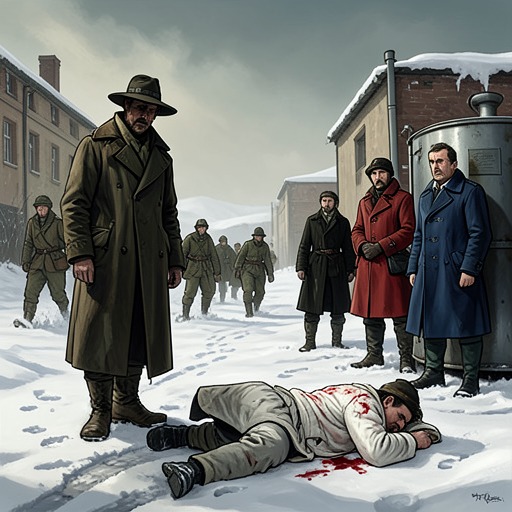
Runólfur reappears when Kristín is inside a flat with Ripley and Bateman, who are armed and threatening her. As the banging at the door grows louder, a man calls Kristín’s name. Bateman opens the door, seizes the visitor by the lapels, and drags him inside. Kristín recognizes Runólfur and uses the distraction to shove Ripley away and run toward the exit, warning Runólfur that the men are armed.
He has no time to answer. He sees Kristín rushing past and Ripley staggering against a table; a shot sounds, and a small red hole appears in Runólfur’s forehead. He collapses into Bateman’s arms as Kristín escapes into the hall and out into the snow, pursued by Ripley and Bateman. The scene does not establish who fired. Runólfur’s arrival momentarily diverts the attackers and gives Kristín an opening, but the person whose earlier threats had made her fear another encounter is killed within that same burst of violence.
Narrative Role
Runólfur’s appearances connect two kinds of danger without making them identical. At first, the conflict concerns the limits of government responsibility for a risky private transaction: he seeks compensation, while Kristín insists that the ministry cannot guarantee payment for goods sent without security. His accusations of conspiracy and corruption convert that dispute into personal hostility, and the report of his threat against the Trade Council chairman confirms that his anger has reached beyond the office.
His sudden death at the flat overturns the expectation created by his promise that he and Kristín will meet again. The anticipated confrontation does occur, but not as a contest between the two of them: he arrives amid an attack on Kristín, and the gunfire kills him before they can speak. His final entrance thus serves both as a fatal consequence of the scene’s armed violence and as the interruption that enables Kristín to flee. The novel leaves the shooter unidentified, preserving the distinction between the danger Runólfur posed earlier and the circumstances of his death.