Steve
Operation NapoleonSteve is an American press-office employee stationed at Keflavík whose former romance with Kristín becomes a partnership in her search for answers about the glacier. His practical knowledge of the base and its records helps her pursue the mystery, but his decision to stand by her carries him into the camp where Ratoff kills him. The loss becomes more than a tragic consequence of their investigation: it remains the central private reason Kristín cannot let the secret go.
Identity and Background
Steve has been stationed at the base for three years, working in its press office and liaising with Icelandic government ministries that deal with the U.S. military, chiefly the foreign ministry. He lives alone after divorcing his wife in America. At thirty-five, he is a few years older than Kristín, lean and strongly built, with dark coloring and unruly black hair. His Irish extraction is one part of a life shaped by movement between countries and kinds of work.
His family had long been involved in retail, but Steve had no interest in the business. He studied politics at university, then worked for the U.S. Department of Defense. Travel, rather than a career in commerce or government, was his real enthusiasm; when the opportunity to work in Iceland arose, he took it. His post at the base thus brings together his professional familiarity with military institutions and the curiosity about the world that later makes him an active participant in Kristín’s investigation.
The Relationship with Kristín
Steve and Kristín met through official work. He eventually gathered the nerve to invite her to dinner, and during their first two dates in Reykjavík he spoke about his family and background. For their third date, he invited her to the officers’ mess at the base and then to his apartment. He was considerate, but Kristín panicked at the prospect of sleeping with an American serviceman on the base. Her reaction was bound up with the public stigma attached to Icelandic women who became involved with American soldiers, a prejudice she felt had changed little over time.
When Kristín tried to explain, Steve was hurt that she saw him through that stigma. She left, and the relationship dwindled through a quiet, unresolved withdrawal. By the time she appears unexpectedly at his flat, they have not spoken for six months. He is caught off guard, holding newspapers and magazines he has picked up from the floor and sofa, and says he had not expected to see her. His unfinished recollection that it must have been a year conveys both the distance between them and the fact that their separation never received a clean ending.
From Former Partner to Ally
Kristín comes to Steve because she needs to know what is happening on the glacier and whether her brother is in danger. He first proposes calling the rescue service; when the first numbers go unanswered, he keeps trying until someone responds. His help is not limited to making the call. Once he recognizes that Kristín is in danger, he is determined to stand by her, and his own journalistic instincts begin to draw him into the case.
After escaping from the men pursuing them, Steve takes Kristín to his workplace, not as a place to hide but because the building contains Defense Force archives he can access. He knows the archive from a summer job and looks for records of surveillance flights over Iceland, reasoning that a plane on Vatnajökull might have belonged to the U.S. Air Force or Navy. The archive itself is a maze of wire-netted compartments, filing cabinets, shelves, boxes, and files. Steve knows the general territory but not where to start; after searching several boxes, he and Kristín leave empty-handed. His attempt fails as research, but it demonstrates both his access to institutional memory and the limits of what that memory readily yields.
The investigation continues alongside his efforts to find out what is happening inside the American establishment. While Kristín searches old newspaper microfilms at the National Library, Steve rents a hostel room nearby for part of the day, using cash and avoiding the guest book. He intends to telephone people and gather more information about the glacier operation before they travel east. He has had little time to absorb the events since Kristín rang his doorbell, yet he accepts the uncertainty because she needs his help.
At the U.S. Embassy, Steve and Kristín tell Monica what happened. Monica reports that the embassy is effectively under siege: staff are armed, most employees have been forced to take leave, and she has been told the situation will return to normal in a few days. Steve himself admits that he does not know what is going on. Later, during the drive east, he asks Kristín whether she has thought about him since their separation. She says she has, and that she had tried to explain. Their exchange brings the earlier rupture back into the open, including the stigma that had made her retreat from their relationship.
The Glacier Camp and His Death
At Jón’s farm, Steve tries to persuade Kristín not to go up to the glacier. He believes the rescue team can handle the situation and that the authorities in Reykjavík will be informed; going themselves could expose them to unnecessary danger. Kristín insists on seeing the soldiers and making sure they do not escape responsibility. Steve is about to object, but accompanies her into the danger she has chosen to face.
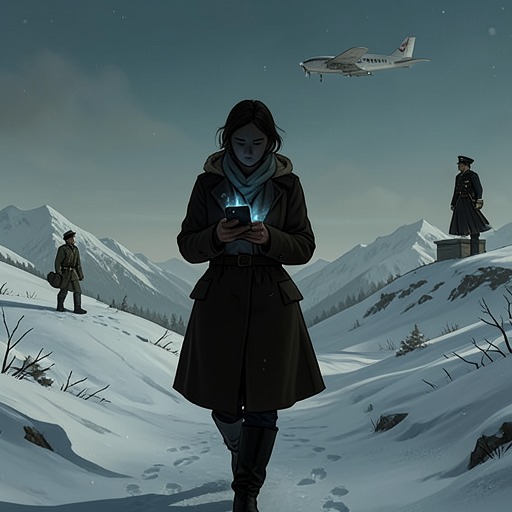
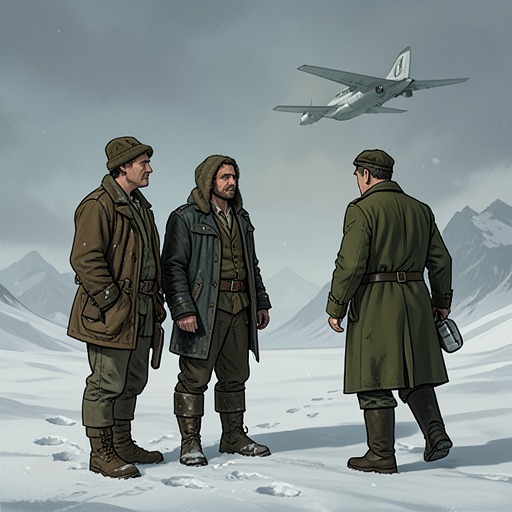
At the camp, Steve checks whether Kristín is all right. She looks at him and briefly imagines a future with him, a possibility set against the immediate threat surrounding them. The plane lies cut in half in a shallow depression in the ice, while soldiers attach heavy slings and cables to its two sections in preparation for removal by helicopter. The sight gives the danger a concrete object: the aircraft is not simply a rumor or a historical record but something the soldiers are about to carry away.
When Ratoff presses them about how they learned of Napoleon, Steve claims that a retired pilot from the base told them and insists that he, not Kristín, knows what the name means. Kristín calls the claim a lie. The exchange shows Steve trying to redirect Ratoff’s attention and place himself between Kristín and the threat. Ratoff then draws a revolver and blames Kristín for what is about to happen. Without warning, he shoots Steve in the face. Steve dies in front of her; she sees his body fall onto the ice and blacks out after retching. His death is abrupt, not a sacrifice that averts the violence, but his attempt to protect Kristín remains part of the scene’s final, fatal imbalance.
Aftermath and Narrative Significance
Kristín later recounts Steve’s murder to Robert Miller, whom she meets while hidden in the wreck of the German aircraft. She believes that Steve died because of her impulsiveness and her pursuit of answers, and she sinks into despair as she tells the story. Miller believes her. The account gives Steve’s death a continuing presence in the narrative: it is not left behind with the camp, but becomes the loss through which Kristín understands the cost of what happened.
For years, Kristín relives Steve’s death in waking thought and in dreams. She describes the void he left as one that would never heal, and she cannot bear the thought that he died for nothing. That conviction helps drive her eventual decision to seek the truth connected with Borne Island. Steve’s role therefore extends beyond his brief return to Kristín’s life: his practical assistance enables her investigation, his loyalty accompanies her into its most dangerous setting, and his death becomes the personal consequence that keeps the buried secret alive for her.