U.S. Operatives Attack Kristín's Apartment
Operation NapoleonU.S. Operatives Attack Kristín's Apartment is the point at which the covert struggle over the glacier reaches directly into Kristín’s home. The intruders come not to rob her but to silence and control her; the attack leaves her facing a threat whose connection to the plane and the military operation is initially beyond her understanding.
The Intrusion
Kristín is still wearing her anorak when she tries to contact the Reykjavík Air-Ground Rescue Team and repeatedly calls her brother, Elías. No one answers either. Convinced that he may be in danger, she tries to steady herself and is about to call the police when someone knocks. Expecting Jehovah’s Witnesses, she opens the door—and two men force their way inside. One covers her mouth and drives her into the living room while the other shuts the door and methodically checks the rooms and kitchen to make sure she is alone. They wear white rubber gloves; one draws a small revolver and warns her into silence. Their practiced efficiency makes the assault feel planned rather than impulsive.
After finding her passport, Bateman checks her face against its photograph. Ripley points a revolver at her head and orders her to sit at the desk. Bateman switches on her computer and creates a file, copying a message from a sheet of paper: “I can’t go on living. It’s over. I’m sorry.” The men speak English, yet the message is in Icelandic. Kristín cannot make sense of the apparent suicide note or why armed strangers are composing it on her computer. As the gun remains pressed against her temple, the familiar idea of a burglary gives way to the possibility of a different kind of violence.
The Attack Turns Lethal
When Kristín demands to know what the men want, she hears enough to understand that the threat reaches beyond an ordinary burglary: they refer to a conspiracy involving the foreign ministry and her brother, and Bateman says she has lost control. Ripley tightens his finger on the trigger. Kristín closes her eyes, expecting the shot, but a sudden pounding at the door interrupts him. The men quickly decide that the visitor can be taken too, and that the operation can be turned into a murder without Ratoff’s knowledge. Hearing Ratoff’s name, Kristín recognizes that the attack belongs to a larger operation, though she still does not know its purpose.
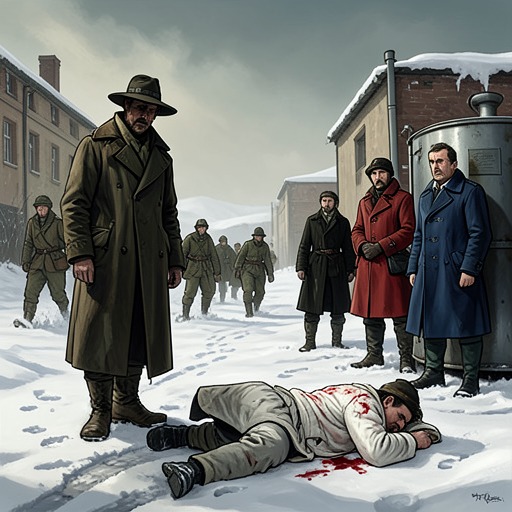
The visitor is Runólfur Zóphaníasson, calling Kristín’s name. Bateman drags him inside by the lapels. As Ripley’s attention shifts to the struggle, Kristín shoves him into a table and bolts for the door, warning Runólfur that the men are armed. A shot hits Runólfur in the forehead; he collapses into Bateman’s arms as Kristín passes him. Another bullet tears past her ear and strikes the door. His sudden death marks the attack’s irreversible turn from intimidation to lethal violence, while Kristín’s escape leaves her the only witness able to carry the danger beyond the flat.
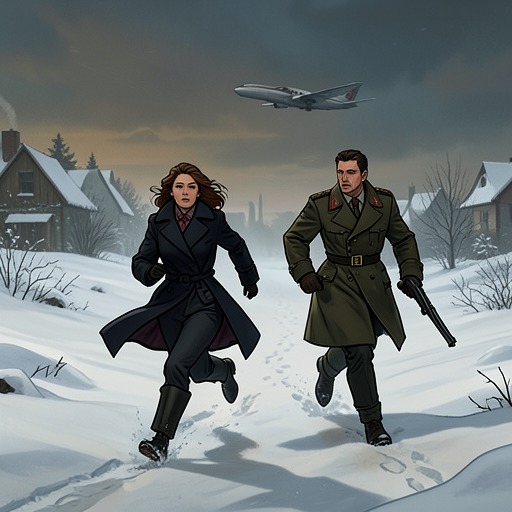
She runs into the snow without shoes, wearing only thin socks beneath her anorak. The icy crust breaks underfoot, and the cold cuts through her as she crosses gardens and fences, pursued by Ripley and Bateman. Later, she attributes her escape to their leather-soled shoes, ill-suited to running on snow: by the time they take them off, she has vanished. The men lose her among the tracks and return to the flat; despite the gunfire and chase, no one from the upstairs apartment appears. They leave five minutes later, climbing wordlessly into their Explorer. The assault thus ends without capture, but with Runólfur dead, Kristín forced into flight, and the attackers free to withdraw.
The Larger Secret
The attack on Kristín’s flat unfolds against a secret whose stakes reach far beyond a missing person. When the secretary demands to know what the plane carried and why the operation involves the U.S. Army Delta Force and Ratoff, Carr turns to the story of the Walchensee gold: shortly before the Red Army took Berlin, more than three hundred small bags of gold bars were sent from the Reichsbank toward the Alps on Hitler’s orders. Carr then identifies the more politically explosive truth: most of the gold had been taken from concentration camps. The secretary understands that the aircraft under U.S. command may contain plundered Jewish gold. In this context, the men’s attempt to put a fabricated Icelandic message on Kristín’s computer, and their readiness to make a second killing without Ratoff’s knowledge, belong to a struggle over what the operation can be shown to mean.
The official explanations surrounding the glacier shift with the audience. At an emergency meeting, the American admiral insists that nothing said leave the room; a general invokes the defence treaty and explains that U.S. forces have monitored part of Vatnajökull using submarines, reconnaissance planes and satellites. When the Icelandic prime minister threatens a formal protest, a public investigation and closure of the roads between the glacier and the base, the general warns that a German bomb is on the ice and that the rescue team is in danger. Yet Ratoff later tells transport pilots that the German aircraft is safe, that no bomb has been found, and that he has not heard of either Armstrong’s search or a Nazi bomb. The contradiction makes secrecy itself part of the danger: the flat invasion is one episode in an operation where competing accounts of the aircraft are used to control who may know, investigate or approach.
Staging and Aftermath
The Icelandic message Bateman types on Kristín’s computer is more than an unexplained intrusion into her private life: it places a false account of despair in a form that appears to belong to her. The contrast is pointed—two armed men speaking English compose an Icelandic message in the home of the person they have subdued. The scene makes the computer a tool for manufacturing a version of events, as well as a means of threatening Kristín; the narrative does not establish exactly how the men intended to use the file, but its wording suggests an attempt to make later violence appear self-inflicted.
Escape does not immediately give Kristín a coherent explanation for what happened. In the days that follow, she repeatedly replays the assault yet struggles to recall the thoughts that passed through her mind during it. The attack’s speed and incomprehensibility remain part of its aftermath: a danger that began while she was trying to reach her brother and the rescue team has abruptly made her both a target and a witness, without giving her the knowledge needed to understand the operation behind it.