US Embassy, Reykjavík
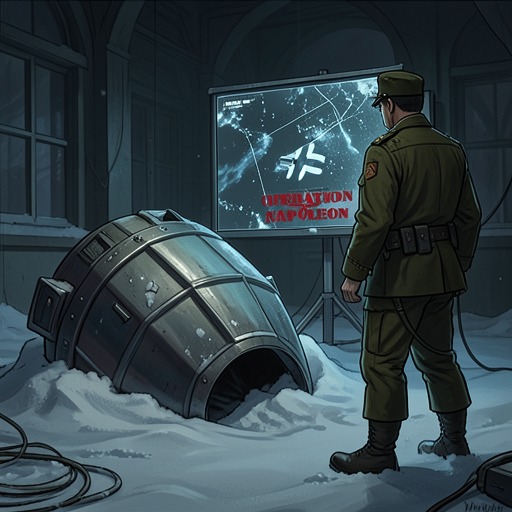
Operation NapoleonThe US Embassy, Reykjavík is transformed from a diplomatic workplace into the Reykjavík command post of a covert military operation. After American special-operations personnel take control, the ambassador and immediate staff are sent on leave, embassy employees are ordered to keep out of the way, and communications are monitored. The building becomes a place where the Icelandic authorities encounter an official American account of events even as the operation concealed behind that account threatens Icelandic sovereignty and the lives of a local rescue team.
Setting and diplomatic role
The embassy is in central Reykjavík, on Laufásvegur. It houses the Fulbright Commission, whose director, Monica Garcia, also has an apartment there. This combination of official offices and a staff member’s home gives the building a double role: it is both a diplomatic institution and a place where people live and receive private calls. Monica’s apartment is part of her ordinary life at the embassy, but the military takeover soon makes the building’s altered routines impossible for her to ignore.
The ambassador’s absence changes who speaks for the American presence in Reykjavík. When Icelandic detectives arrive to ask about a shooting involving a vehicle registered to the Defense Force, they are told that neither the ambassador nor the attaché is in the country. The chief press officer is also unavailable. General Immanuel Wesson, identified as the highest-ranking officer at the embassy in the ambassador’s absence, receives them instead. His provisional authority reflects a larger change: diplomatic channels remain visible, but military officers now control the premises and the official response.
The military takeover
The embassy’s transformation is prepared as part of a wider deployment. After a mark appears on satellite images of Vatnajökull, General Vytautas Carr arranges for a C-17 transport plane to remain on standby at Keflavík Airport, guarded around the clock by eight armed men. Its passengers have included General Immanuel Wesson and ten Delta Force operators, sent to Reykjavík with orders to assume control of the embassy. The ambassador and his immediate staff are placed on leave without explanation or delay.
Monica later describes the effects from inside the institution. Military intelligence has taken control by direct order of the defense secretary; special-operations personnel have arrived, embassy staff are being kept uninformed, and the ambassador has been sent away. She reports that three special-forces companies landed at Keflavík more than a day earlier and may have gone to the glacier, while computer equipment has been installed and a command-and-control centre established. Her comparison of the situation to a military coup expresses how completely normal embassy procedures have been displaced, though she admits she does not know what the equipment is for or what is happening beyond the restrictions imposed on the staff.
The takeover is presented as temporary. Staff are told that the Americans will be there only a few days and that matters will then return to normal. That assurance does not lessen the immediate coercion: most employees are forced to take leave, and those still present are ordered to stay out of the way and keep quiet. Monica finds the armed presence unprecedented and the officer who tells her to be patient outwardly polite but intimidating. The institution continues to operate, but access to information and authority over its own work have passed to the military.
Surveillance and control of information
The embassy’s communications are part of the operation’s machinery. On Vatnajökull, Ratoff takes Elías’s phone and checks the last number called. The call has lasted long enough, he believes, for Elías to have described the area and the activity around the aircraft. The phone displays only that number and otherwise appears new and little used. Ratoff orders the communications officer to have the embassy trace it. The number leads to Kristín, registered at a Reykjavík address and bearing the same patronymic as the phone’s owner, which prompts the inference that she may be Elías’s sister.
That trace turns the embassy into an instrument for identifying and locating people connected to the glacier. The information gathered there does not remain an abstract intelligence lead: Ratoff receives Kristín’s name and address and asks to be connected to Ripley. The episode shows how quickly the military’s reach extends from the aircraft site to a private home in Reykjavík, using a mobile call to bridge the distance between them.
The surveillance is not limited to tracing a particular number. When Steve asks Monica whether embassy phones are being monitored, she confirms that calls are tapped, including calls both to and from the embassy. Her confirmation changes the practical meaning of the building’s apparent access to information: contact with embassy staff may be observable to the same authorities who have taken over their workplace. The embassy can supply intelligence to the operation, while the people inside it cannot safely assume that their own conversations are private.
Public account and Icelandic challenge
The embassy also serves as the American military’s point of contact with Icelandic investigators. In the interview about the Reykjavík shooting, Wesson calls the attack on the injured American shocking and says the United States will demand a thorough investigation. He presents the incident as a brawl between fishermen in which the American was caught in the middle. The detective counters that the fishermen say the American started the brawl and that his companion entered the pub with a gun and later fired in the street. Wesson rejects that account as preposterous and challenges the suggestion that responsibility lies with the American. The exchange places the embassy between local evidence and an official American version that minimizes the conduct of its personnel.
The Icelandic government’s dealings with the American authorities expose the same conflict at a higher level. In a secret meeting away from Reykjavík, the admiral representing the American Defense Force at Keflavík and Wesson, now the provisional head of the embassy, face Icelandic ministers. The meeting follows reports that armed American soldiers have been seen on Vatnajökull and that two members of a rescue team have been found, one dead and one gravely injured. The Icelandic prime minister has also learned that American helicopters are airborne without a submitted flight path or the required request to cross Icelandic airspace. The American side’s embassy leadership is therefore implicated in a crisis that is no longer confined to hidden military activity on the glacier.
Narrative significance
The embassy’s changing role makes the operation’s information policy concrete. Its diplomatic leadership is removed, its staff are silenced, its computers and command centre are installed under military control, and its communications are used to trace people beyond the building. Yet it remains the address to which Icelandic detectives bring questions and through which American officials present a public account. That contrast exposes the gap between the embassy’s familiar diplomatic function and its new use as an operational base.
Monica’s position makes that gap especially clear. She works for an educational exchange programme rather than the military, lives in the embassy, and has no access to the reasons for the extraordinary measures around her. She can report the armed guards, enforced leave, telephone tapping, and commands to stay silent, but not the operation’s purpose. The embassy thus contains both the machinery of secrecy and people excluded from its decisions. Its occupation is not merely a change of personnel: it turns a diplomatic building into a mechanism for surveillance, message control, and the projection of American authority in Iceland.