Vatnajökull Rescue Team Confrontation with U.S. Troops
Operation NapoleonThe Vatnajökull Rescue Team Confrontation with U.S. Troops is the moment a secret American glacier operation becomes an open clash with Icelandic civilians. On the night of Saturday, 30 January, Júlíus led a large, unarmed rescue party toward an area where Icelanders were believed to be in danger. U.S. soldiers blocked the team, claimed authority over a prohibited zone, and fired into one of its vehicles after Júlíus rejected their orders. The confrontation makes the operation’s secrecy tangible: it is enforced not only through official explanations, but through armed control of Icelandic territory.
Causes and Background
The stand-off followed the rescue team’s discovery of two members at the bottom of a crevasse. One was dead and the other was unlikely to survive; Júlíus suspected that the soldiers in white camouflage were responsible for what had been presented as an accident. The team was therefore heading toward a distress signal with immediate reasons to distrust the military presence, not merely to satisfy curiosity about the glacier.
The American operation had been concealed behind competing accounts of danger. At an emergency meeting with Icelandic ministers, an admiral insisted that nothing discussed leave the room and a general described U.S. monitoring of Iceland’s borders under the defence treaty, including surveillance of a section of Vatnajökull. When the prime minister threatened a formal protest, public investigations, a road closure between the glacier and the base, and an address to the nation, the general disclosed that an old German bomb was on the glacier and that the operation to remove it was delicate. He urged the prime minister to call the rescue team back for its own safety. The explanation established a real hazard, but it also served as a reason to keep Icelandic rescuers away.
The secret had a further political dimension. In a separate briefing, Carr introduced the story of the Walchensee gold: more than three hundred small bags, each containing a gold bar, had been sent out of the Reich shortly before the fall of Berlin on Hitler’s orders. He explained that much of the gold had been taken from concentration camps. The secretary recognized the implication that a U.S.-commanded aircraft had crashed carrying plundered Jewish gold. This history helps explain why the aircraft and the military activity around it were treated as matters requiring concealment, even as officials offered different accounts of what the glacier contained.
The Encounter on the Glacier
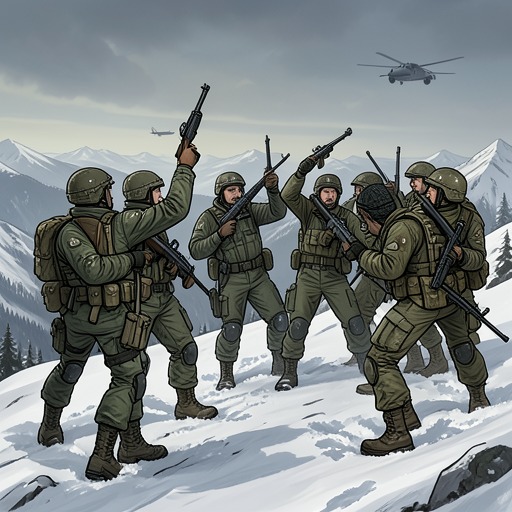
At 2315 GMT, around twenty helmeted and goggled soldiers arrived on snowmobiles, rifles slung across their backs. Júlíus’s party numbered about seventy men and women and had travelled on skis, snowmobiles, and two tracked vehicles. The two groups stopped roughly ten metres apart. Arctic camouflage and rifles marked the soldiers as a force prepared to control the approach; the rescue volunteers’ bright orange jackets, by contrast, made their work and presence conspicuous against the dark glacier.
Júlíus left his tracked vehicle to speak with the young officer who came forward. The officer said that the team had entered a U.S. military prohibited zone and that he had orders to stop it. He offered no further details, saying only that the restriction would not last long and asking for cooperation. Júlíus replied that the team had heard nothing about such a zone. He challenged the soldiers over the injured rescuers, the aircraft on the glacier, and the secrecy surrounding the operation.
Instead of answering, the officer ordered the team to hand over its mobile phones, radios, and emergency flares. Júlíus refused. The rescue party was responding to a distress signal, he pointed out, and Icelanders were in danger; the officer countered that there were no Icelanders in the area apart from the rescuers themselves. Júlíus rejected the claim and the authority behind it, insisting that there was no declared prohibited zone and that the glacier was Icelandic sovereign territory. He also doubted the volcanic-eruption alert that had circulated as an explanation for the restrictions.
Gunfire and Immediate Consequences
Júlíus turned back toward his team, intending to continue. He did not see the officer signal one of the soldiers. That soldier took his rifle from his back, knelt, and fired a volley into the nearest tracked vehicle. Bullets punched through its grille and bonnet; the engine caught fire, and an explosion hurled the bonnet onto the vehicle’s roof. The rescuers inside kicked open the doors and crawled clear. The vehicle then burned in the winter darkness.
The shooting stopped almost as abruptly as it had begun. The soldiers unslung their weapons and covered the rescue team while the officer repeated his demand for phones, radios, and flares. Júlíus, who had never before encountered military force or seen weapons used in combat, stared at the burning wreckage and felt his anger give way to trepidation about what might happen next. At fifteen degrees below zero, the fire’s warmth reached him as he looked from the wreck to his scattered, unarmed colleagues. The physical destruction of the vehicle had transformed a verbal refusal into a warning backed by force.
Political and Narrative Significance
The confrontation followed the prime minister’s refusal to accept the American general’s appeal without conditions. His proposed road closure and public investigation put Icelandic sovereignty and the U.S. military presence into direct political conflict; on the glacier, the soldiers attempted to impose their own boundary regardless of whether the Icelandic team had been notified. Júlíus’s refusal to surrender rescue equipment arose from the team’s practical need to respond to danger as well as from his rejection of foreign control. The demand itself would have left the rescuers less able to communicate or signal for help.
The episode also exposes the instability of the official explanations. The general told the prime minister that a German bomb required careful removal, while a pilot later asked whether a bomb was present and was assured that the aircraft was safe and that no such bomb had been found. That denial sits uneasily beside the general’s urgent warning. Against the earlier revelation of gold looted from concentration camps, the shifting accounts make secrecy part of the crisis rather than a neutral precaution. The glacier’s restricted zone, the rescue team’s demand for access, and the burning vehicle turn a hidden military operation into a visible contest over who may act, know, and move on Icelandic ground.