Vatnajökull plane crash
Operation NapoleonThe Vatnajökull plane crash was both a deadly wartime accident and the point at which a covert mission disappeared into the glacier. The aircraft, a German Junkers Ju 52 painted in American camouflage, carried German officers, an American general, and an American pilot; its frozen wreck would eventually reveal that the flight had been tied to secret negotiations near the end of the Second World War.
Causes and Background
Shortly before peace was declared, the aircraft crossed Iceland in darkness and crashed on Vatnajökull. Jón later told Kristín that he and his brother had seen it fly low over their farmhouse and vanish into the night. They knew it had gone down, but Colonel Miller had given them a different explanation for the urgency of the search: the plane was supposedly carrying dangerous biological weapons, a virus developed by the Germans. The brothers helped without questioning the account. Jón recalled that the plane was thought to be German, not American, and that it had disappeared shortly before the war ended.
The flight’s actual purpose emerged much later through a diary found among the wreckage. Its American pilot described a journey that began after he parted from his contact in Copenhagen. Two unnamed intelligence officers met him in a park, drove him south in a military jeep to Flensborg, and introduced him to a German lieutenant, a German major, and a Swedish count said to belong to the royal family. The group travelled through Schleswig-Holstein, where the pilot was given a German uniform, then through Hamburg and along the River Elbe to Berlin. Refugees and bomb craters filled the roads; the Swedish count’s papers helped the party pass through checkpoints.
Berlin’s airport had been destroyed by bombing, so the aircraft took off from outside the city. At the aerodrome, the pilot saw Nazi leaders and German generals meeting with a general from the American side. He was not allowed into the meeting and understood his role to be that of a driver. Soldiers loaded two crates of gold bars and provisions onto the plane. The aircraft’s American camouflage concealed its German identity, while the pilot’s account made clear that the passengers and cargo belonged to a much larger and deliberately obscured arrangement.
The meeting ran on for hours. At one point, the American representative walked out, but the Swedish count persuaded him to return. Afterward, the two men spoke beside the aircraft about the Russians, the Ardennes, and Argentina. The pilot could not hear or understand the negotiations and could only speculate about whether the parties were discussing an end to the war, trying to shorten it, or planning against the Soviet advance. His uncertainty is central to the surviving account: he witnessed the preparations and their consequences without being admitted to the decisions that gave them meaning.
That delay helped bring the flight into the storm. The diary describes night flying in gale-force winds, snowfall, and complete darkness, with severe turbulence and ice coating the wings. The pilot wrote that the aircraft struck the glacier unexpectedly, probably first with its left wing; the propellers caught in the ice, the wings sheared away in a shower of sparks, and the fuselage ploughed onward without breaking apart. The wreck’s later discovery would turn that brief, confused account of impact into the beginning of a much longer investigation.
The Trapped Passengers and the Frozen Wreck
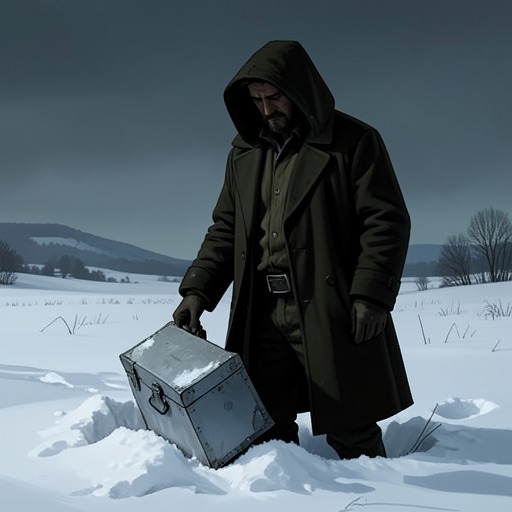
The pilot’s diary records the hours after impact as a narrowing struggle against cold, darkness, and confinement. On the evening of 30 January, he wrote that the survivors were trapped inside the fuselage, with two kerosene lamps of uncertain duration and no clear sense of how long they had been there. The metal box had gone with Count von Mantauffel, handcuffed to his wrist; the pilot did not know whether the count had a key or what the box contained. Two German passengers were still alive, but they blamed the pilot, while the bodies of those killed in the landing remained inside with them. The diary’s uncertainty about their location and prospects stands in stark contrast to the later precision of the physical evidence.
The same account describes an attempted flight through gale-force winds, snowfall, darkness, and turbulence, with ice weighing down the wings. The impact came without warning. The left wing probably struck first; the propellers caught in the ice, the wings tore away, and the fuselage continued forward. The pilot’s earlier entry about the wreckage also describes a plane almost filled with snow and the death of Dietrich, whose body had been placed outside on the ice. He believed the remaining passengers were dying and that rescue was unlikely. Together, the entries preserve both the violent moment of the crash and the slow, exposed aftermath, when even the survivors’ choices were shaped by dwindling warmth and shelter.
When Ratoff later inspected the aircraft, the glacier had preserved its dead with a stillness that made the cabin resemble a sealed room. Beside the fuselage lay a German officer in uniform, an Iron Cross at his neck and his hands crossed over his chest. One leg was missing from the hip; his cap had frozen to his face. Ratoff thought the body had been deliberately laid there and inferred that some passengers had survived long enough to move those who died on impact. The corpse’s position and clothing offered evidence of care, but its terrible wound also marked the violence of the landing.
Inside the forward section, Ratoff found two more middle-aged men: one in a German officer’s uniform and one wearing the uniform of a two-star American general. A locked aluminium briefcase was handcuffed to the general’s left wrist. Both bodies lay close together, apparently arranged side by side, their exposed skin bluish-white but without visible decay. Ratoff judged that one had suffered a fatal head wound during the landing; the other appeared uninjured externally, though his death was likely caused by internal injuries. Two overcoats and a fur hat had not saved him from the cold.
The tail contained three further bodies, huddled together as if their occupants had tried to share their remaining warmth. Their skin, like that of the other corpses, was preserved by the ice, and crude splints had been fashioned for the legs of two. One wore an American uniform, including a World War II leather flight jacket and a small American flag sewn to its sleeve. His name was embroidered on black linen, but Ratoff could not reconcile an American fighter pilot with the German aircraft and its passengers. Counting the body outside, he found six corpses, although his briefing had specified seven. The discrepancy, the American uniforms, and the general’s locked briefcase turned the wreck from an apparent wartime loss into a scene whose details resisted the story Ratoff had been given.
The frozen remains surfaced again when Kristín and Steve searched a tent on the glacier. Beneath a tarpaulin they saw the corner of a grey body bag, open at the top; a peaked cap bearing an eagle and swastika showed first, then the pale face beneath it. The discovery brought the dead out of the aircraft’s sealed interior and into the present operation. Across the crash’s successive recoveries, bodies, clothing, wounds, and belongings function as a record that the ice has preserved but that official explanations have not made coherent.
Recovery and the Limits of the Record
The crash site became the focus of a winter recovery operation conducted under conditions that were harsh but, in one respect, useful: at about –15°C, the glacier’s darkness and the near-absence of local traffic helped conceal the work. Soldiers broke up the hard surface with pickaxes while others cut the aircraft with oxyacetylene torches, intending to load the sections onto pallets and tow them west to trucks bound for Keflavík Airport. Ratoff believed the operation was on schedule, although a storm was forecast. The wreck was not simply being examined; it was being dismantled and prepared for removal, a process that threatened to erase the scene even as it exposed it.
That effort itself altered the evidence. When the fuselage gave way under its own weight, the front section crashed onto the ice while the tail remained partly buried. Ratoff ordered the severed section prepared for removal and barred anyone from entering without his permission, then went inside himself. The brief collapse converted a concealed wreck into an accessible one, but the bodies and objects found within it could not settle every question raised by the flight. The pilot’s diary preserves his suspicions about the secret meeting, while his exclusion from it leaves its purpose uncertain; the crash yields physical traces, not a complete account of the decisions that sent the aircraft across the Atlantic.
The Crash as an Unfinished Record
The wreck never supplies a single, authoritative explanation for the flight. The pilot’s diary, written by someone who carried the passengers and witnessed the preparations but was excluded from the negotiations, records conjecture rather than a full account: he wondered whether the talks concerned ending or shortening the war, or anticipating a confrontation with Russia. His observations of the meeting’s long delay and the subsequent discussion of the Russians, the Ardennes, and Argentina establish the reach of the secret diplomacy without revealing its terms. The two crates of gold make the mission materially legible, but they do not resolve what the participants intended to accomplish.
That gap between evidence and explanation defines the crash’s later significance. Colonel Miller’s account of biological weapons had mobilized Jón and his brother to help search in 1945, while the surviving diary and the bodies recovered decades later point toward a more complicated mission involving American and German personnel. Yet the evidence remains incomplete: Ratoff counts six corpses against a briefing that specified seven, and the locked briefcase attached to the American general’s wrist remains an object whose importance is suggested but not explained in the recovered scene. The glacier preserves the aircraft, its passengers, and fragments of their journey; it does not preserve the negotiations themselves. The crash therefore turns history into a physical investigation in which every recovered detail sharpens the questions without closing them.