William Miller
Operation NapoleonWilliam Miller is the young American pilot at the center of the wartime crash on Vatnajökull Glacier. His body, uniform, and surviving diary turn the buried Junkers Ju 52 into more than a wreck: they reveal the human cost of a secret flight and expose a connection to Colonel Miller that had endured through decades of silence.
Identity and discovery
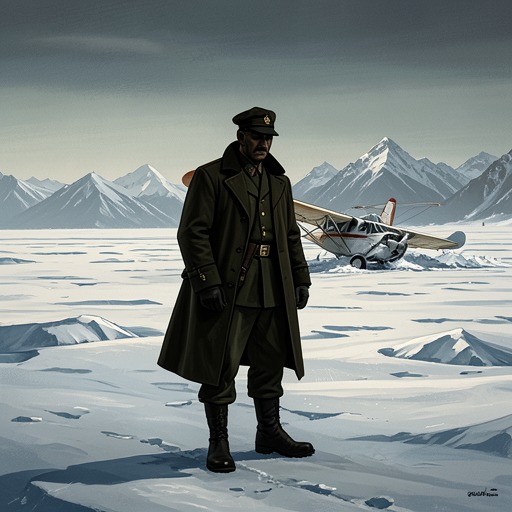
When Ratoff explored the aircraft decades after the crash, he found William among the bodies preserved in the ice. An American flag was sewn to the sleeve of his World War II bomber jacket, and his name was embroidered on a strip of black linen over his breast. The uniform identified him unmistakably as an American fighter pilot, while the frozen condition of his body made him appear scarcely changed by the passage of roughly half a century. Ratoff judged him to have been no more than about twenty-five.
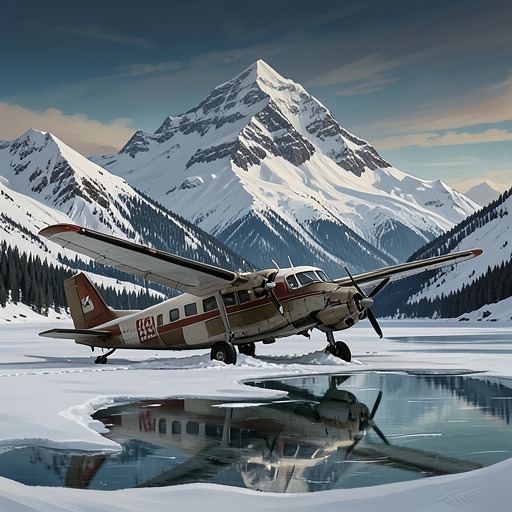
That identity made the scene harder to explain. William had died aboard a German Junkers Ju 52 carrying German officers and an American general across the Atlantic; the aircraft was painted in American camouflage. The plane’s passengers, its markings, and the pilot’s uniform did not fit any simple account of an ordinary wartime flight. William’s remains therefore register the central contradiction of the crash before its purpose is understood: an American pilot was flying a mission bound up with German officials, in a German aircraft disguised as American.
The flight and its purpose
William’s diary supplies the surviving account of how he came to be on that flight. Its pencil entries are irregular, sometimes little more than fragments, and do not provide a neat chronology. He writes as though the record might eventually reach his brother, and Ratoff recognizes that the pilot seems to have intended Colonel Miller to find it. The diary’s broken form reflects the conditions in which it was written: William was trying to leave a record while the crew was isolated, cold, and increasingly certain that rescue would not come.
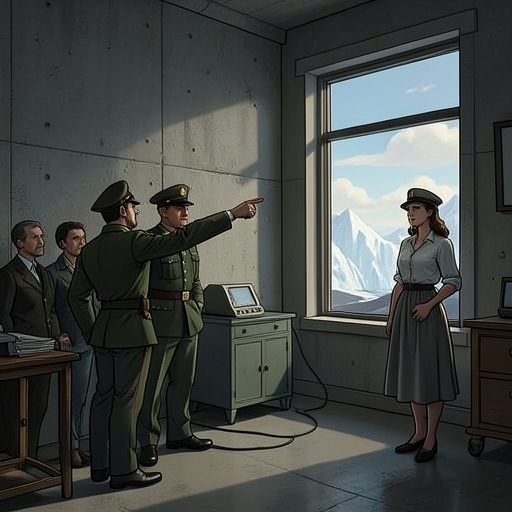
Before reaching Berlin, William travelled with a delegation through a Europe shattered by war. His account describes a route from Copenhagen to Flensborg, then through Schleswig-Holstein and Hamburg before following the River Elbe to the German capital. He was given a German uniform for part of the journey. At the aerodrome in Berlin, he waited outside a long meeting attended by Nazi officials, German generals, a Swedish count, and an American general. He was not permitted to join them; he understood his place to be that of a driver, not a participant in the negotiations.
The meeting ended with soldiers loading two crates of gold bars and provisions onto the plane. William noted that the Junkers was a powerful aircraft with substantial carrying capacity and range. He also recorded that it was painted in American camouflage. He could not establish what the delegates were negotiating, but the presence of German and American representatives, their guarded conversations, and the cargo left him trying to infer the purpose of a mission whose details had been withheld from him.
Crash and diary
The journey ended in darkness and severe weather over the glacier. In William’s account, the wings were heavily iced, the aircraft encountered violent turbulence, and the crew had little visibility in the gale and snowfall. The plane struck the ice; the left wing may have hit first, the propellers caught, and the wings sheared away as the fuselage ploughed on. His description gives the crash a suddenness that the frozen wreckage could not: the aircraft that had carried him through a secret diplomatic journey was stopped by the ice in a moment of disorienting impact.
The diary records what followed in the wreck. William wrote of unending darkness, extreme cold, and men dying. One dead passenger was put outside on the ice; the plane filled with snow, and William believed no one would come to rescue them. He also described the German Count von Mantauffel as a disturbing presence, still behaving like a victor despite Germany’s defeat. These entries preserve both the physical ordeal and the strained relations among the survivors, without resolving every question about their mission.
William’s account of the Berlin talks remains explicitly uncertain. He wondered whether the negotiations were an attempt to shorten the war, make a deal with the Nazis, or prepare for an attack on Russia. Those possibilities are suspicions, not knowledge he claims to possess. He had heard rumours, recognized that the Germans were part of a negotiating team, and knew that the talks involved powerful figures, but he was excluded from the meeting itself. The gap between what he witnessed and what he could know is essential to the diary: his testimony exposes the secret operation’s outline while preserving its limits.
Colonel Miller and the secret’s aftermath
The diary identifies William as Colonel Miller’s brother. When Ratoff finds papers naming the pilot, he recognizes the family resemblance and realizes that Colonel Miller must have been the young man’s brother. The discovery gives new meaning to the colonel’s long search for the aircraft and to his earlier connection with the local brothers who had guided him on the glacier. In a later recollection, Colonel Miller remembers those guides as discreet people who had offered him hospitality and never pressed him with questions. His own bond with William was also shaped by trust: William understood that his brother had chosen him because he could keep a secret, and his diary insists that Colonel Miller should not regret that choice.
The aircraft’s return to view reactivated the secret William had died carrying. Carr ordered a covert operation at Keflavík, instructing its director to use special forces and present the mission as a routine exercise. Colonel Miller was told that the plane had turned up; the plan was to recover the documents and transport the dismantled aircraft and bodies to Keflavík. The military response thus treated William’s remains as part of the evidence to be controlled, even as his diary made it harder to reduce him to a piece of operational history.
Colonel Miller later explains that knowledge of Operation Napoleon was restricted even within the army. He says he never knew precisely what it entailed and understood himself and William to have been pawns assigned to solve particular problems. William’s diary cannot settle the full history of the negotiations, but it supplies a rare witness to their setting, their cargo, and the flight’s catastrophic end. The ice preserved his body and his words together: one an unsettling physical return, the other a fragmentary record that both reveals the secret and shows how little its young pilot was allowed to know.