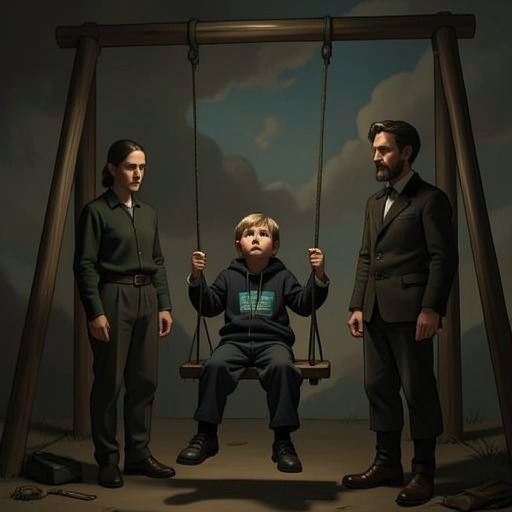
“Watch this! Look at me!”
Other PeopleThe expression “Watch this!” and “Look at me!” turns a children’s call for attention into a compact motif of recognition. Mary Lamb / Amy Hide hears it in a sleepy game at the squat, then imagines it as something people may keep saying throughout their lives. Her guess that Amy Hide used the same call makes the refrain a small but telling link between Mary’s present observations and the identity she is recovering.
The Children’s Refrain
On a Sunday morning, Mary watches children playing without competition and listens closely to what they say most often. Their repeated calls—“Watch this!” and “Look at me!”—lead her to wonder whether the desire to be seen persists beyond childhood. The scene gives an ordinary playground phrase a broader reach: attention is not merely a feature of the game, but a possible lifelong appeal.
Mary then connects the children’s words to Amy Hide, guessing that Amy said them often. This is an inference, not a recovered memory, but it makes the refrain part of Mary’s effort to understand who Amy was and what that past means to her. The expression therefore carries both a general meaning and a personal one: a child’s demand to be noticed becomes a clue through which Mary approaches a self she cannot yet fully claim.
Attention and Recognition
The phrase’s force lies in its directness. It asks for another person’s attention, but the scene does not make the children’s play competitive or elaborate; Mary notices the words precisely because they recur in uncomplicated play. Her thought extends that recurrence across a whole life, suggesting that the need for recognition may outlast the particular performance that first calls for it.
That extension also reflects Mary’s heightened attention to other people. In London, routine encounters with shopkeepers and passers-by can lift or unsettle her, and she invests unusual feeling in whether people acknowledge her. Against that background, the children’s appeal to be watched resonates with a wider pattern in her experience: small signs of attention matter because they make contact with a world from which she can feel excluded.
Money, Time, and Unequal Possibility
The expression appears within a story attentive to the unequal terms on which people spend their lives. The narrator describes tramps as people who refuse to sell their time, and Mary encounters money first as something unfamiliar, then as a means of saving while shopping with Mrs Botham. Her changing understanding makes the wish to be noticed more than a private emotional matter: attention, like money and time, is shaped by the conditions in which people live.
Mary later recognizes that life need not be poor in the way she had assumed. She does not want the well-kept people’s money so much as their time, and she thinks of the poolside as a place where she, too, might swim and play if she dared. The children’s refrain thus sits beside a sharper awareness of exclusion: wanting to take part and wanting to be seen are related forms of reaching toward a life that seems available to others.
Recurrence and Meaning
The expression’s significance comes from its movement between scenes and scales. It is first heard as children’s repeated speech, then becomes Mary’s speculation about what people say throughout their lives, and finally attaches itself to her uncertain picture of Amy. That progression does not establish that Amy’s words were remembered; it shows Mary using an observed refrain to imagine continuity between the child at play and the woman whose identity she is trying to recover.
The novel leaves the phrase open rather than resolving it into a single explanation. It can name a simple wish for attention, but its recurrence also gathers the book’s concerns with recognition, belonging, time, and the possibility of participation. In Mary’s reflection, the children’s call is not merely about performing a trick or winning a game: it becomes an image of the enduring wish for someone to look.