Alan
Other PeopleAlan is a pale, socially hesitant man whose fear of going bald becomes the first visible sign of a vulnerability that shapes his relationship with Mary Lamb. His hair-loss anxiety begins as a private, repetitive distress; as Mary watches him, it becomes a measure of how exposed he is to the ordinary losses and humiliations he cannot control.
Identity and Introduction
Alan sits in a little office beyond the kitchen, looking out of the window and worrying about his thinning hair. Every ten or twelve seconds, his right hand slips from the desk and rises to take another bite out of it. He examines the hairs in his palm with tight-lipped annoyance, shakes them away, and returns his hand to the desk until the same movement begins again. The measured repetition makes his anxiety almost physical: a small, involuntary drama enacted at intervals while the room carries on around him.
Mary Lamb tries the gesture on her own hair, finding a light wisp that she flicks to the kitchen floor. The comparison clarifies the difference between them. She assumes there will always be more hair, while Alan sees his as scarce and failing; what barely registers for her has become a source of distress he repeatedly renews by pulling at it. Yet Mary watches his suffering with pangs of her own. Her curiosity does not cancel her sympathy: she wants him to stop hurting himself over the hair he is so afraid to lose.
The fear also exposes Alan to mockery. Russ, who combs and fusses over his own hair in front of a mirror, jokes about haircuts and calls Alan “Baldie.” Alan threatens that he will murder Russ one day, then adds a nervous insult. The exchange gives his resentment a brief, brittle voice, but it does not make him an equal antagonist to Russ. His anger surfaces amid embarrassment, and the threatened violence remains a nervous retort rather than an action.
Falling in Love and Seeking Closeness
After only fifty hours in Mary Lamb’s company, Alan has fallen in love with her. The change is registered less through declaration than through the narrative’s account of his attention: he thinks about her constantly, and everything she does seems to hurt his heart. He loves her face, her black hair and expectant eyes, the way she stands with folded arms and nods, and the way she agrees with old Mr Garcia and works at the washing-up without complaint. Her refusal to give Russ much attention also matters to him. Alan’s infatuation turns even his hair-loss distress into a subplot, while the thought that Mary may be out of his class leaves him deeply worried.
The narrative gives this new attachment an image of physical pressure. After Russ leaves, Alan returns to the room with a presence Mary senses as yearning, apology, and tentativeness; she feels the air move behind her and imagines his eyes swarming across her back. The metaphor makes his desire palpable while emphasizing how little confidence he has in approaching her. He does not come forward with Russ’s theatrical heat or ease. His longing seems to reach Mary first as a cautious, almost wordless appeal.
Alan’s first practical offer is shelter. When a room becomes available at his place, he tells Mary that she can move in whenever she likes, pay only her share of the rates, and use the furnished attic. Russ immediately recasts the modest-sounding attic as a studio or penthouse, but Alan’s offer is straightforward: a place to stay, without a demand attached to it. It gives Mary a possible home and gives Alan a way to bring her nearer, though the offer itself does not establish that she shares his feelings.
He later asks whether she will go out with him the following night, nervously qualifying the invitation and giving her an easy way to refuse. Mary says she is seeing a man then. Alan bites his lower lip, raises his eyebrows, and nods twelve times. The small, repeated gesture captures how he absorbs disappointment: he does not argue or press her, but his body registers the hurt that his words cannot manage. His attempt at courtship remains tentative, and Mary’s answer leaves the distance between his private devotion and their actual relationship plain.
Intimacy, Separation, and Death
Alan’s devotion becomes explicit when he tells Mary Lamb that he loves her and would die for her. The declaration gives his attachment the force of an absolute promise, but it does not resolve what the relationship means to Mary: she asks him what he means by loving her. Their closeness is real, yet unequal, and Alan’s willingness to make himself entirely available cannot by itself create a mutual understanding.
One night Mary finds Alan waiting in her dark room, crying with his hands over his face. She invites him into bed. The encounter is brief, and the distinction she makes between him and Trev is crucial: Alan wants to get inside her to hide, not to hurt her. Mary helps him, but her hope that he will not break anything carries a foreboding that she thinks he probably has. Intimacy offers Alan refuge for a moment without repairing the fragility beneath it.
Mary eventually decides that he can no longer come to her room or share her bed at night. When she tells him, Alan stands naked with his head bowed. He begins to cry silently, his chest rocking, and cups his hands protectively over his body. His response makes the separation more than a rejected advance: Mary is setting a necessary limit, while Alan receives it as a devastating exposure of his helplessness. The scene’s careful attention to his gestures leaves the pain visible without making Mary responsible for continuing an intimacy she no longer wants.
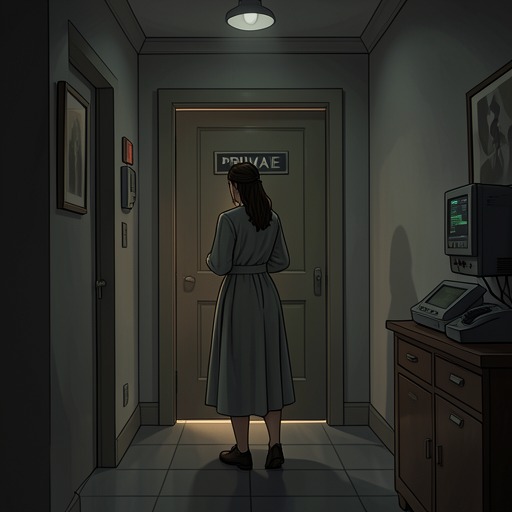
After they part, Mary imagines love as a circle formed by people joining arms to protect one another, imperfect but continually trying to become whole. She believes she will remain among those who protect Alan and hopes he will stand in the line protecting her. The image is generous but not a reconciliation: Mary resolves to tell him, yet when she enters his room, it is silent and empty. In the dusk she first mistakes a tall figure in the corner for Alan, then discovers him hanging by the cord of his dressing-gown. His note is about his hair. The anxiety that had seemed a repeated, almost comic private ritual is left beside his death, though the narrative does not establish that it caused it.
The aftermath turns Mary’s shock into bewilderment and guilt. Asked to write an account for the police, she wonders whether Alan’s hair could have been responsible, as he had claimed, and writes that she is sorry and did not mean to do it. The words register her inability to make sense of his death, not proof that she caused it. Russ, grieving and unable to write his own account, accuses her of doing it and insists that Alan was only twenty-one. Alan’s end thus leaves Mary caught between an imagined circle of mutual protection and the blunt, unanswered fact of his absence.
Narrative Role and Significance
Alan’s portrayal pivots on a contrast between comic repetition and irreparable loss. His hand’s recurring journey to his hair first makes distress visible as an almost mechanical habit; later, his note about that same hair gives the detail a darker afterlife without explaining his death. The book preserves the connection while refusing to turn it into a certain cause. What had seemed like a small, even absurd worry becomes one of the few clues left beside an absence that Mary cannot understand.
The chapter’s language of a “force field” makes Alan’s inner life perceptible through its effects on Mary: where Russ projects heat and opposition, Alan’s presence is rendered as yearning, apology, and tentativeness. That emotional exposure also shapes the narrator’s reflections on love, which warn that falling can mean breaking while insisting, “Love is nothing without you there to feel it.” Alan’s story tests both sides of that claim. His feelings are powerful and real, but they cannot ensure that intimacy is mutual or protect him from loss; after his death, the image of people joining arms remains an aspiration, not a completed circle.