Alan's suicide
Other PeopleAlan's suicide turns an intimate rupture into a death that Mary Lamb cannot understand and is soon made to answer for. After she tells Alan that he can no longer come to her bed at night, Mary begins to imagine love as an imperfect circle of people trying to protect one another. She goes to his room intending to explain that hope, but finds that he has died by suicide. A note about his hair becomes the only stated clue to his thinking, while the police investigation and Russ's accusation replace uncertainty with suspicion directed at Mary.
Background and the break between them
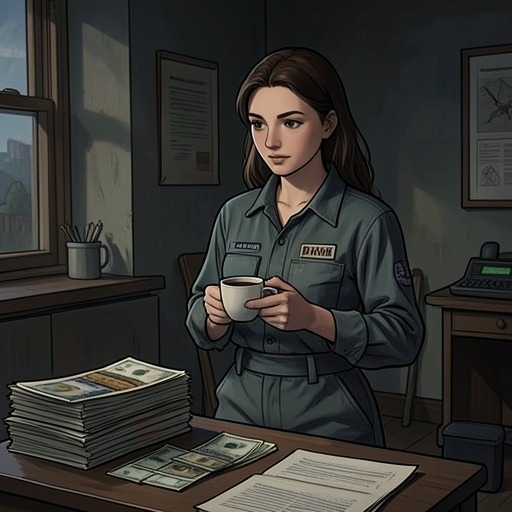
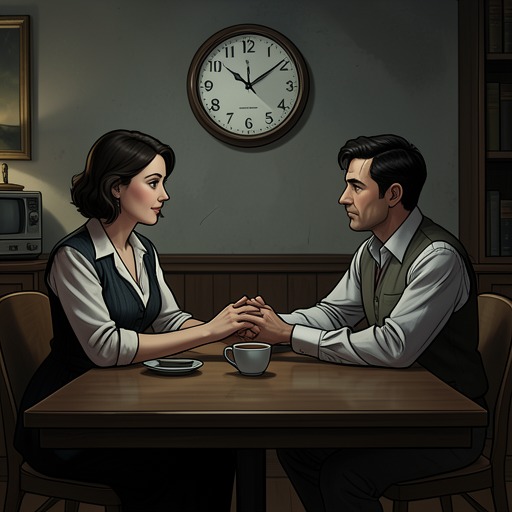
Mary has little time to herself, and the account presents her decision as something she has reached after waiting alone in bed for Alan. When he enters, she tells him plainly that he cannot come to her room at night or share her bed anymore. The boundary is necessary to her, but the scene also shows Alan receiving it as a devastating rejection: he begins to cry silently and covers himself in a protective gesture. The narration records his distress without explaining what he intends to do or suggesting that Mary knows what will follow.
The separation does not leave Mary settled in her decision. She soon imagines love as a circle that people continually try to complete, despite broken links and people left without anyone to hold. In this conception, she still hopes to be one of those who protect Alan, just as she hopes he will protect her. She resolves to go to him and tell him this. Her intended return is therefore not a reversal of the boundary she set so much as an effort to describe a wider, less possessive form of connection. The attempt arrives too late: in the dusk, his room appears empty until she notices a figure standing in the corner.
Discovery and the note
Mary first mistakes the figure for Alan standing with his face to the wall. As she approaches, the height seems wrong; she wonders whether he is standing on furniture, then sees that the chair has fallen over. When she touches his shoulder, he turns in a way that reveals the cord of his dressing gown around his neck. The discovery is narrated through Mary's hesitant attempts to make the scene fit ordinary explanations, each possibility giving way to what she has found.
A note lies on the table by the window. The account says only that it is about Alan's hair; it does not reproduce the note or explain its contents. That detail links the note to a concern named at the moment of his death, but it does not establish a full motive or show that his hair alone explains his decision. Mary wonders whether his hair could somehow be responsible, then turns the possibility against herself, imagining that she must have caused his death. Her written apology expresses confusion and remorse, not knowledge of what happened inside Alan's mind. The distinction matters: the narrative gives the reader a concrete clue and Mary's desperate self-blame, but not a definitive account of Alan's reasons.
Inquiry and accusation
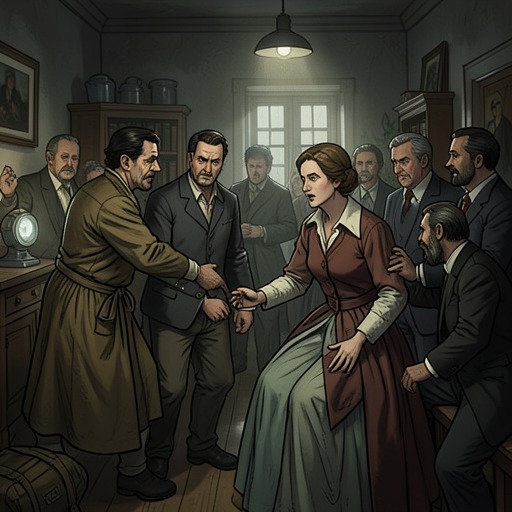
The first consequence of the death is an official request for Mary's statement. A shabby policeman describes it as a formality, while also indicating that the matter lies outside his proper area of responsibility. His uncertain manner does little to orient Mary; she sits across from Russ without knowing what to say. The scene makes the inquiry feel less like a clear process of establishing facts than a pressure placed on someone already unable to explain the death to herself.
Russ then accuses Mary of causing Alan's death and of not caring, emphasizing that Alan was only twenty-one. His charge is an accusation, not a finding established by the account. Mary has already imagined that she broke Alan's neck and written an apology, so Russ's certainty lands in a situation where her own understanding is profoundly unstable. The story leaves the reader with the contrast between Mary's failed attempt to reach Alan and the blunt certainty with which Russ assigns her responsibility; neither supplies the missing explanation of Alan's decision.
Detention and narrative framing
After the death and accusation, Mary is taken through several days of displacement and confinement. She rides the Circle Line repeatedly without reaching anywhere, sleeps among other people, and is eventually transported to a place where her belongings are searched. She spends the night in custody, is examined after being made to undress, and is moved again to a dormitory where other women call out through the night. Her possessions are returned in a brown envelope, along with pills that make the present recede. The account does not present these details as proof of guilt; they show the institutional aftermath Mary undergoes while the circumstances of Alan's death remain unresolved for her. Prince eventually comes to get her out, and the authorities allow him to take her.
The narration widens the episode with reflections on suicide, youth, and the passage of time. It observes that young people may imagine suicide when the future seems to end early, while many live beyond that imagined boundary; the narrator also acknowledges having considered suicide, but says that a score with Mary remains unsettled. These intrusions make death part of the book's larger meditation on uncertain futures and the stories people tell about their own endings. They do not disclose Alan's motive. His note, Mary's interrupted effort at reconciliation, and the accusation that follows remain separate elements rather than a complete explanation. The event's force lies partly in that gap: Mary finds the irreversible fact of Alan's death just as she is preparing to tell him that their imperfect connection might still matter.