Amnesia and personal identity
Other PeopleAmnesia and personal identity are bound together through Mary Lamb’s effort to understand a present she can perceive but cannot securely connect to her past. Her memory loss leaves her with more than an informational gap: she knows that something is missing, yet cannot establish what that absence means for who she is. The novel sets this uncertainty against other characters’ attempts to make identity legible through fixed categories, especially the claim that alcoholism remains part of a person even after drinking stops.
The experience of lost memory
When Mary wakes in a London park, she cannot identify where she is or how she arrived there. Her sense of time ends around the previous day. She can remember that she has lost her memory, but this knowledge does not restore the events or personal history she needs. The distinction is central: she is aware of the blank without being able to fill it. Her thoughts circle around whether memory has gone permanently or might be recovered, while even the word “memory” offers no explanation of what its loss entails.
The novel presents this condition against the narrator’s generalization that people with amnesia are usually at least partly conscious of what they cannot remember. Mary’s case is introduced as an exception, complicating that confident account. Her own early awareness does not amount to a complete understanding: she recognizes the fact of loss, but the limits, duration, and consequences of that loss remain unclear to her. The narrator’s framing and Mary’s incomplete perspective therefore do not neatly coincide.
At the same time, her memory loss has not erased every kind of knowledge. Mary can name birds, distinguish some kinds from others, and loosely associate animals with things encountered the day before. This retained ability gives her a foothold in the world, but not a reliable place within it. She can identify what she sees without knowing how it relates to her former life or where she herself belongs. The contrast between intact naming and missing personal history makes identity feel both available and out of reach.
The uncertain link between Mary and Amy
A letter from John Prince provides a concrete clue to Mary’s possible past. Its reverse describes Amy Hide, a 26-year-old woman listed as missing and thought by the police to have been murdered, though the letter does not present that conclusion as certain. The photograph attached to the letter shows Mary. This evidence connects her appearance to Amy’s reported identity, but does not supply the memories that would explain the connection or establish its full meaning.
Mary consequently begins to ask whether she is Amy Hide, whether she was Amy at some earlier point, and how much of Amy’s past belongs to her. The questions are not resolved by the photograph: resemblance or identification cannot tell her what Amy did, how those actions relate to Mary, or whether the two names describe one continuous self. Mary takes the uncertainty seriously. She wants to be good and resists the possibility that Amy’s character could be judged as wholly bad simply because Mary may have emerged from her. Her reasoning allows for continuity without making the past transparent or reducing a person to a single moral verdict.
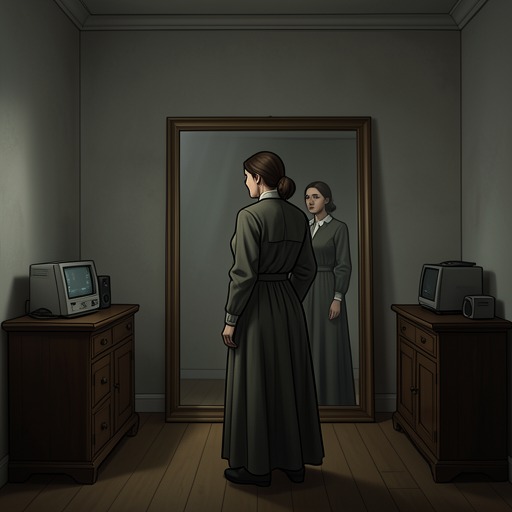
The mirror becomes the setting for this unsettled inquiry. Mary studies her reflection while trying to know Amy through the face they apparently share. The image seems, for a moment, to promise a knowing self behind the glass; yet Mary senses that whatever she cannot see will gather itself again after she turns away. The mirror offers an image but no history, making recognition provisional rather than conclusive. Her dreams also cease to vary, so the passage from uncertainty to knowledge is not accompanied by a sequence of clarifying revelations. The unresolved identity persists into ordinary nights and days.
Memory as a story told by others
The novel places Mary’s experience beside an anecdote Mrs Botham tells about a woman from a clinic who could remember almost nothing after a blow to the head. In Mrs Botham’s account, the woman could not recognize even her husband or children. Gavin Botham dismisses the explanation as drunkenness or a hangover, while Mrs Botham insists that the woman had amnesia. The exchange offers no independent confirmation of the story; its importance lies in the competing explanations and in the different authority each speaker claims over the meaning of memory loss.
Reading provides another contrast between information and self-understanding. The pamphlets Mrs Botham receives from Al-Anon describe a progression in which drinking, deception, physical symptoms, visions, forgetting, and death appear within a broad account of alcoholism. Books, meanwhile, are where Mary discovers language is kept. These materials make knowledge available in an external form, but they cannot by themselves furnish Mary with a personal past. A category or printed account may name a pattern without proving that it explains the individual before it.
Amnesia and the fixed identity of alcoholism
The narrator’s discussion of alcoholism makes the contrast between lost memory and imposed identity especially pointed. It describes alcoholics as unable to remain sober and as using drunkenness to escape being themselves. It also insists that people with drinking problems are not as individually exceptional as they may believe: they share a condition, though their reasons differ. This is the narrator’s sweeping account, not a clinical finding established by the novel. Its certainty nevertheless echoes the problem Mary faces from the opposite direction. The alcoholic is assigned a persistent identity; Mary cannot determine which identity, if any, belongs to her past.
Within the Botham household, the label is also disputed. Gavin calls Mrs Botham an alcoholic, while Mr Botham calls her an ex-alcoholic. Mrs Botham rejects the idea that alcoholism can be left behind, describing sobriety as an encompassing commitment rather than merely the absence of drunkenness. Her statement turns recovery into an identity claim: the past remains relevant even when a person seeks to live differently. The disagreement does not settle what Mrs Botham is; it shows how names for a person’s condition can carry different accounts of continuity and change.
Significance
Together, these episodes distinguish remembering facts from possessing a stable account of oneself. Mary retains language, perception, and some fragments of recent association, but lacks the autobiographical links that would make those capacities into a secure personal narrative. The letter gives her a possible name and a photograph, while the mirror returns a face; neither can verify the history behind them. Other characters’ accounts of amnesia and alcoholism likewise demonstrate that explanations of identity are spoken, contested, and sometimes repeated without resolving the person they describe. The concept therefore remains open at the novel’s center: Mary’s search is not only for forgotten information, but for a trustworthy relation between the life attributed to Amy Hide and the self Mary can presently recognize.