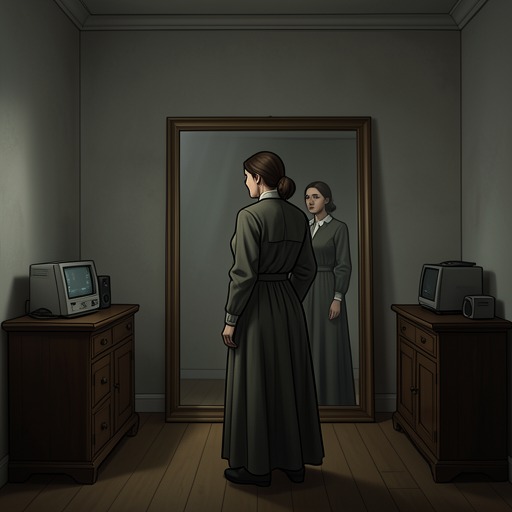
Augusta
Other PeopleAugusta combines an imposing social presence with a life that seems to her perpetually vulnerable to defeat and betrayal. Her routines, anger, relationships, and recollections make her more than a colorful member of Jamie’s household: she recognizes Mary Lamb / Amy Hide from before Mary’s current life, offering fragments of a past Mary cannot retrieve. At the same time, Augusta’s own account of that past is partial, arriving amid telephone calls, drinking, and talk of other ambitions.
Identity and Daily Life
Augusta has spiky black hair and a dramatically pale face. Mary Lamb / Amy Hide sees her naked often because the two spend time together in Augusta’s lavish bedroom; Augusta is the same height and weight as Mary, but appears both slimmer and more physically full. The narrative describes her as having a notably athletic, curving figure, and says that she has many male companions. Her social and sexual life is active, while her emotional life is portrayed as a succession of campaigns, reversals, affronts, and betrayals.
Her day has a distinctive ritual. She rises late, even later than Jamie, and keeps an enormous mug beside her bed, its enamel bearing a picture of the Queen of England. Before doing anything else, she drains the mug of water, then makes coffee in a quiet, forbidding manner. The repeated routine gives her mornings a composed, almost regal air, though her hands tremble. Her demeanor is particularly severe after a man has stayed with her, or when a recent arrival has left again. She sometimes sees men slip out in the morning; on other occasions, she appears naked to hurry them away. The contrast between these unsettled encounters and her formal bearing suggests a person trying to gather herself after each disappointment.
Augusta’s presentation changes over the course of the day. After drinks and lunch, she seems to grow more beautiful as the hours pass, reaching an especially striking appearance by evening. Unless something has gone wrong, she goes out, departing by car or taxi, or with a man, to meet the night. If she stays home instead, she becomes more dignified and forbidding. On those nights she may drink, talk at length, and laugh fiercely at her own jokes. Jamie sometimes mocks her disappointments, but only when he thinks it is safe to do so.
Relationship with Jamie
Augusta and Jamie were a couple long before the events of their shared household. She tells Mary Lamb / Amy Hide that the relationship ended after what she considers a trivial quarrel. Augusta says she visited Jamie every day for three weeks while he was at a clinic, but that after leaving he told her he was finished with the relationship. She attributes the failure to his inability to do the work their partnership required and says she understood from their first meeting that he had lost his nerve.
Her account blends conviction with provocation. Augusta generalizes bitterly about men and their capacity for feeling, while continuing to engage with them through a battered telephone. During her conversation with Mary, she alternates between taunting and conciliating callers, and repeatedly breaks off to answer. The interruptions make the disclosure of her history with Jamie feel less like a settled confession than one strand in a crowded, ongoing social life. Her interpretation of their breakup is clear; the evidence does not establish that Jamie would describe it in the same way.
Augusta’s emotional intensity is not merely a reaction to particular slights. Mary observes that Augusta’s anger seems to come from an inexhaustible source, and that touchiness and tantrums are familiar parts of her manner. Yet this volatility coexists with control over her public presentation: she can be quiet and forbidding in the morning, fiercely amused at home, and conspicuously self-possessed as she sets out for the evening. The shifts make her difficult to reduce to a single role, whether wounded former partner, social force, or performer of dignity.
Recognition of Mary’s Past
During a long conversation on her glossy bed, Augusta tells Mary Lamb / Amy Hide that they have met before. Mary does not recognize the encounter and asks what her name was. Augusta’s recollection is initially hesitant, but she later remembers Mary doing unusual things with men she describes as heavy and ethnically different, then telephoning her parents. She also recalls Mary speaking of loving a man so deeply that she would not mind if he killed her. Augusta cannot reproduce the statement with complete precision, but says she has never forgotten it.
The recollection establishes a connection without resolving its circumstances. Augusta does not identify the man, explain the earlier events, or provide a full account of her own relationship to Mary at that time. Mary, for her part, has no corresponding memory in the conversation. Augusta’s testimony therefore works as a fragment of recognition rather than a complete recovery: it gives Mary evidence of a prior self and of an attachment that once seemed to define her, while leaving the people and events around that attachment uncertain.
An earlier episode invokes the name Janice in a conversation between Sharon and Trev about Trev’s previous promise concerning a woman. Janice is an alias associated with Augusta, linking her name to the novel’s earlier depiction of criminal men and women treated as vulnerable targets. That connection does not supply a detailed account of Augusta’s own experience, but it places her within the same threatening social landscape encountered by Mary before the two women speak about their shared past.
Ambition, Performance, and Narrative Role
Augusta’s conversation with Mary moves from painful history to expansive imagined futures. They talk about a large farm where Augusta expects one day to live and the eight or nine children she imagines raising there. She also writes poems occasionally, usually late at night when she is especially drunk. These ambitions and creative acts sit alongside her volatile social life; the novel offers them as parts of Augusta’s character, not as evidence that her plans will come to pass.
The conversation takes place while Augusta’s black eye is fading through a range of colors. She has not gone out much since the morning it appeared, but the narrative does not identify its cause. She drinks vodka from a bottle kept in a plastic bucket of ice, continues to answer calls, and eventually falls asleep in an awkward position. Jamie is asleep too, in front of a buzzing television with a book on his lap. The scene closes on these ordinary, disordered surroundings rather than on a resolution between the former couple or a fuller explanation of Augusta’s injury.
Augusta’s chief narrative importance lies in the asymmetry between her memory and Mary’s. She can recognize the earlier Mary and preserve a sentence that Mary cannot remember, yet her recollection remains incomplete and emotionally charged. Her mixture of social bravado, disappointment, plans, and fragments of testimony makes her both a sharply drawn presence in the household and an imperfect witness to the identity Mary is trying to recover.